
No. Most B2B software companies do not meet Wikipedia’s notability requirements and do not need to the entity signals that matter are achievable through other means.
Worth stating plainly because this question comes up constantly and the honest answer saves people from wasting effort on something that will be deleted.
Wikipedia’s notability standard requires significant coverage in multiple independent, reliable sources meaning substantial articles about your company, not press releases, funding announcements, product mentions or listings. Most B2B software companies below a certain scale genuinely do not clear this bar.
What happens if you create one anyway?: It gets flagged and deleted, often within days. Paid editing without disclosure violates Wikipedia’s terms and, when discovered, produces a permanent public record on the deletion page that is worse than having no page at all.
What a Wikipedia page does contribute when you legitimately qualify: A structured, widely-mirrored, heavily trusted description of your entity. It is genuinely valuable. It is simply not available to most companies, and pursuing it is usually a poor use of effort.
What is Wiki data and is it different?
Wikidata is a structured database of entities and their attributes, with a lower inclusion threshold than Wikipedia which makes it achievable for many B2B companies that would not qualify for an article.
What it holds: An entity with structured properties. Founded date, headquarters, industry, parent company, official website, identifiers linking to other databases.
Why it matters for AI visibility?: It is a machine-readable, widely used source of structured facts about entities. It feeds knowledge graphs and is present in many training and reference datasets.
The inclusion criteria are lower than Wikipedia’s but not absent. An entity generally needs to be described in at least one credible external source and be a “clearly identifiable conceptual or material entity.” A funded company with press coverage, a Crunchbase entry and an active website usually clears this.
The honest caveat: A Wikidata entry is a modest signal, not a lever. It contributes to entity clarity. It will not make you appear in vendor recommendation answers on its own, and anyone selling Wikidata creation as a significant GEO deliverable is overstating it.
How do you create a Wikidata entry?
Create it accurately, cite external sources for each claim, and disclose any affiliation.
The process:
1. Check whether an entry already exists. Search wikidata.org for your company name and variants. Duplicate entries are a common problem and merging them is harder than creating one.
2. Create the item with your official name as the label.
3. Add core properties: Instance of (business), industry, inception, headquarters location, official website, country.
4. Add identifiers linking to Crunchbase, LinkedIn, and any other database where you appear. These identifiers are much of the value they connect your presences into one entity.
5. Cite a source for each claim where possible. Unsourced claims are more likely to be removed.
6. Disclose affiliation on your user page if you are editing about your own company.
What not to do?: Add promotional language, unsourced superlatives, or marketing descriptions. Wikidata holds facts, and editorialised entries get reverted.
What matters more than either?
Consistency across the sources you already control matters considerably more than adding new ones.
This is where the effort actually belongs, and it is the section most companies skip in favour of chasing a Wikipedia page.
The audit: Compare how your category and function are described across every property you control.
- Source What to check?
- Your website Meta description, About page, homepage.
- Organization schema The `description` field.
- G2 / Capterra Category assignment and description.
- Crunchbase Industry tags and short description.
- LinkedIn company page Tagline, Overview, Specialties.
- Your documentation How the product introduces itself.
- App marketplace listings Category and description.
Most companies find between five and fifteen variations. That inconsistency is what produces wrong categorisation when sources disagree, external consensus wins, and you end up in a category you did not choose.
The fix: One canonical description, one to two sentences containing category, function and target customer, deployed verbatim everywhere.
“[Product] is field service scheduling software for HVAC and plumbing contractors with 10–200 field technicians.”
Then connect them. Organization schema with a complete `same As` array listing every profile you control. That declares explicitly that these are all the same entity rather than leaving it to inference.
What order should you do this in?
Consistency first, `same As` second, Wikidata third, Wikipedia only if you genuinely qualify.
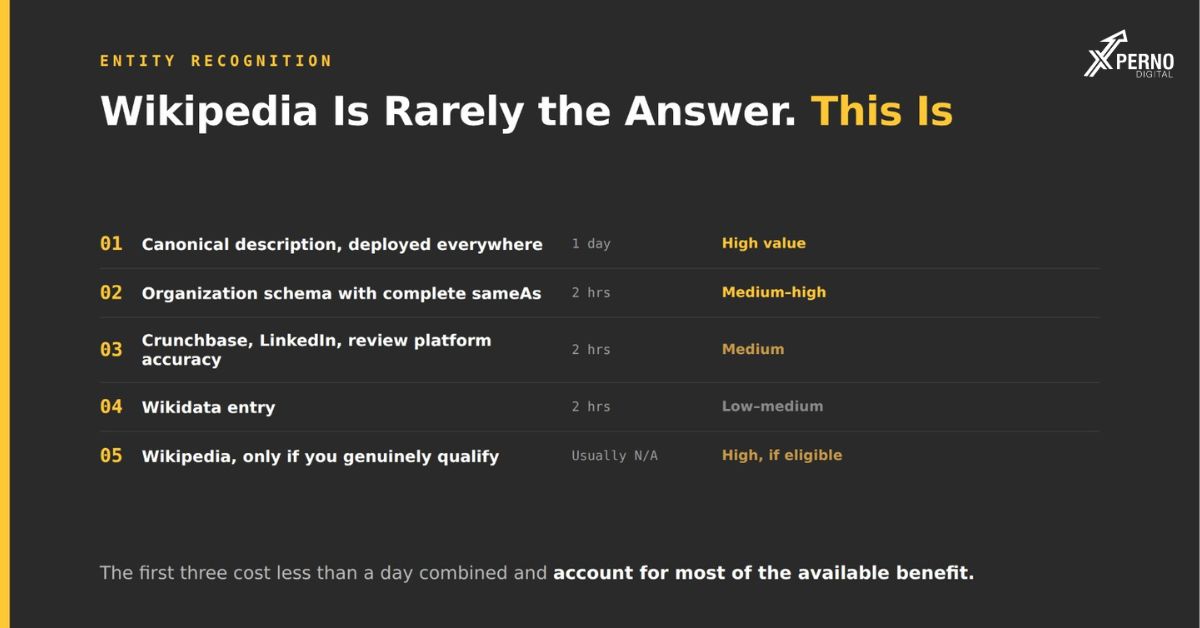
Order / Task / Effort / Value.
1 Canonical description, deployed everywhere 1 day High
2 Organization schema with complete `same as 2 hrs Medium-high
3 Crunchbase, LinkedIn, review platform accuracy 2 hrs Medium
4 Wikidata entry 2 hrs Low-medium
5 Wikipedia Usually not achievable High if you qualify
The first three account for most of the available benefit and are entirely within your control. They also cost less than a day combined.
Wikidata is worth doing because it is cheap and permanent, not because it will move your numbers noticeably.
What if another company shares your name?
Name collisions require consistent pairing of your name with a category descriptor across every source, and they resolve slowly.
This is a genuine problem for companies with short or generic product names, and it produces answers that mix your attributes with another company’s.
What to do:
Always pair the name with a descriptor in your own content. “[Name], the field service scheduling platform” rather than “[Name]” alone. Every mention, everywhere.
Ensure your structured data is unambiguous. Organization schema with a full `sameAs` array is the clearest available statement that these specific properties belong to this specific entity.
Create the Wikidata entry if one does not exist this is one case where it genuinely helps, because it establishes you as a distinct entity with distinct identifiers.
Be patient. Entity disambiguation happens through accumulated consistent signals. There is no fast fix, and claims otherwise should be treated sceptically.
Frequently Asked Questions:
Will a Wikipedia page improve my AI visibility?
It contributes to entity clarity where you legitimately qualify. Most B2B software companies do not meet the notability threshold, and creating a page anyway usually results in deletion.
Can I pay someone to create a Wikipedia page?
Undisclosed paid editing violates Wikipedia’s terms. When discovered, it produces a permanent public deletion record that is worse than having no page.
Is Wikidata worth the effort?
It is cheap, permanent and contributes modestly to entity clarity. Worth two hours. Not worth treating as a significant deliverable.
What is `sameAs` in schema markup?
A property listing URLs of other profiles representing the same entity LinkedIn, Crunchbase, G2, X. It explicitly connects your presences rather than leaving the connection to inference.
How long does entity correction take?
Live retrieval reflects changes in four to eight weeks. Trained knowledge updates on model releases, which is outside anyone’s control.
What if my category description varies across sources?
Standardise it. Write one canonical description and deploy it verbatim everywhere. When sources disagree, external consensus generally overrides your preferred framing.