
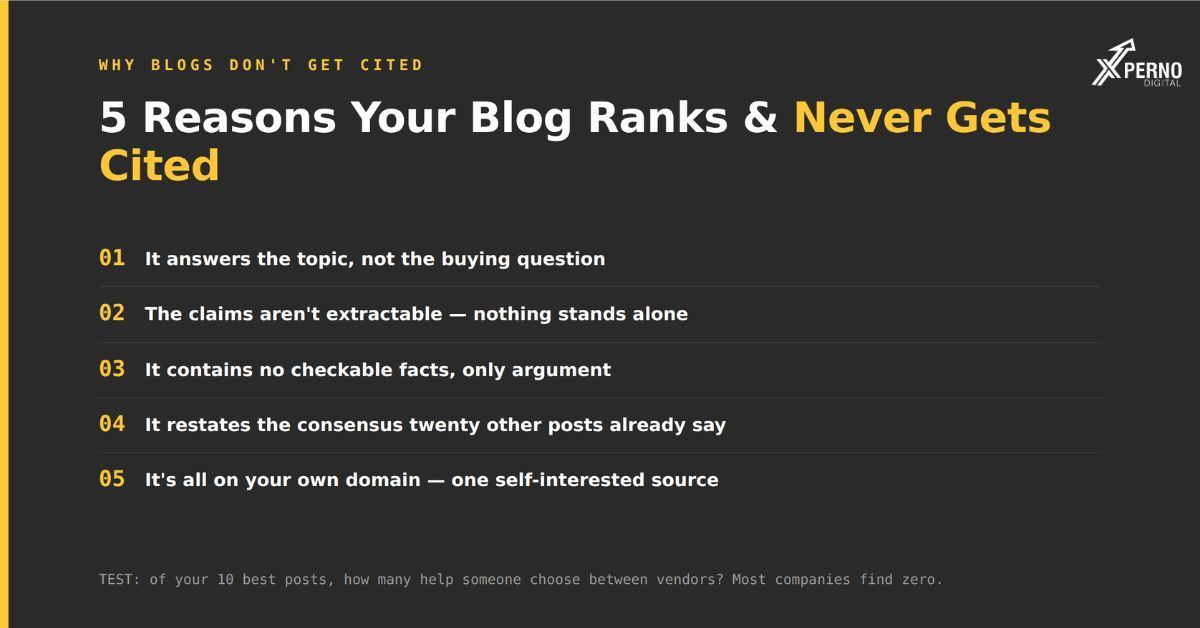
A blog can rank well and never be cited because ranking rewards topical relevance while citation requires extractable, specific, comparative claims and most SaaS blog content has none.
The gap is not about quality in the usual sense. Plenty of well-written, well-researched, genuinely useful blog content is uncitable, because it was built to answer “what is this topic” rather than “which vendor should I use.”
This produces a frustrating situation for content teams. Traffic looks reasonable. Rankings are holding. The team is publishing consistently. And the company is absent from every AI answer in its category.
The instinct is to publish more. That is the wrong response, and understanding why requires looking at what blog content actually contains.
Reason 1: It answers the topic, not the buying question:
Most SaaS blog content targets informational queries. AI vendor recommendations come from commercial ones.
Consider a typical B2B SaaS content calendar. “What is customer data management.” “Five trends in field service.” “How to improve first-call resolution.” “The complete guide to inventory forecasting.”
Every one of those answers a question about a topic. None answers “which tool should I buy.”
When a buyer asks an AI which vendor to use, the model needs sources containing vendor-level judgements — this tool suits this situation, that one suits another. A guide explaining what the category is contributes nothing to that answer, however comprehensive it is.
The test: Take your ten best-performing blog posts. For each, ask whether it contains a sentence that would help someone choose between vendors. Most companies find the answer is zero out of ten.
Reason 2: The claims aren’t extractable:
Blog content is written to be read linearly, which means individual claims cannot be lifted.
The standard blog structure hook, context, background, argument, conclusion assumes a reader who has committed. Each paragraph builds on the last.
A model looking for an attributable claim needs a self-contained statement. If understanding your third paragraph requires the second, it cannot be extracted cleanly.
What this looks like in practice:
“As we discussed above, this creates a challenge for growing teams. The implications become clearer when you consider the downstream effects on reporting”
Nothing in that passage stands alone. It is entirely dependent on surrounding context.
Compare:
“Teams above 50 users typically need role-based permissions, which most entry-tier tools do not offer below their business plan.”
Self-contained, specific, checkable, liftable.
Reason 3: It contains no checkable facts:
Thought leadership and trend content contain arguments rather than facts, and arguments are not citable in the same way.
A post arguing that customer experience is becoming a competitive differentiator may be entirely correct and well-argued. It contains no number, no boundary, no condition, no comparison nothing a model can attribute as a fact.
Claim density is the measure here. Count sentences on a page that state something specific and checkable, divide by total sentences. Under one in ten and the page is mostly connective tissue and argument.
Most SaaS blog content scores very low on this. Product documentation scores high, which is a large part of why documentation gets cited more than blog content.
Reason 4: It restates the consensus:
Content that says what twenty other articles already say gives a model no reason to cite you specifically.
This is the structural problem with volume content strategies, and it has become more acute since AI-assisted writing became common.
A model generating or retrieving content about your category produces the consensus view, because the consensus is what exists. If your post says the same thing as fifteen other posts, there is no basis for preferring yours.
What creates a reason to cite you:
- Original data nobody else has
- A specific comparison nobody else has made
- A position you would defend that others would not
- Detail at a level of specificity others have not gone to
What does not?
Being more comprehensive, better written, or more recent than the consensus version of the same thing.
Reason 5: It’s all on your own domain:
Blog content is a self-published claim, and these systems weight corroboration across independent sources heavily.
Even a genuinely excellent post is one source, self-interested, on your domain. Fifteen practitioners recommending the same thing in a forum, or six third-party roundups naming you, carries different weight.
This is why companies with large content operations remain invisible while smaller competitors get recommended. The smaller competitor is present on the sources these systems trust; the larger one has published four hundred posts on its own site.
No amount of on-site publishing substitutes for off-site presence. They are different mechanisms.
Why won’t publishing more fix it?
Publishing more of the same content type produces more of the same result, because the constraint is type rather than volume.
If twelve months of explainer content produced no AI visibility, twenty-four months will produce no AI visibility more expensively.
The reasoning is mechanical. Each of the five problems above is a property of the content type, not the quantity:
- Problem Does more volume help?
- Answers topics, not buying questions No more topic content
- Claims not extractable No same structure
- No checkable facts No same content type
- Restates consensus No more consensus restatement
- All self-published No all on the same domain
What actually changes the outcome: Different content types, different structure, and presence on sources you do not own.
What should you do with the blog you already have?
Audit it, fix the pages that have substance but poor structure, consolidate the thin ones, and redirect the effort toward comparison content.
Step 1: Score your top 20–30 pages: For each: does it answer a buying question? Is the answer in the first sentence under each heading? How many checkable facts does it contain? Is there comparative framing?
Step 2: Sort into actions:
Fix: good substance, poor structure. Rewrite headings as buyer questions, rewrite the first sentence under each. Twenty minutes per page. This is where the return concentrates.
Rewrite: right topic, no facts. Add specifics. Two to three hours
Consolidate: Several thin pages on overlapping ground. Merge and redirect.
Leave: Already good, or not commercially relevant.
Step 3: Redirect new content effort: Instead of the next four blog posts, build one comparison page and one alternatives page. Roughly the same hours, substantially different return.
Step 4: Start off-site work: Review presence, roundup inclusion. Longest lead time, so start it while the on-site work is happening.
Does blog content have any value now?
Blog content still supports rankings, brand and nurture it is simply not what produces AI citation.
Worth being fair here rather than overcorrecting.
Blog content still does: Rank for informational queries and bring people into your orbit, give sales something to send, support email and social programmes, demonstrate expertise to human readers, build topical authority that helps other pages rank.
Blog content does not: Get you named when a buyer asks an AI which vendor to use.
The reasonable conclusion is not to stop blogging. It is to stop treating a publishing cadence as a visibility strategy, and to build the six or eight bottom-of-funnel pages that actually serve the buying question before the next twelve blog posts, not after.
Frequently Asked Questions:
How much blog content should I publish?
Two substantial pieces a month with genuine claim density outperforms eight thin ones. If the choice is between four mediocre posts and one good one, choose the one.
Does long-form content get cited more?
Length is not the variable. Claim density is. A 700-word page with twelve specific facts outperforms a 3,000-word page with two.
Should I delete underperforming blog posts?
Consolidate rather than delete where possible. Merging several thin pages into one substantial page with proper redirects generally helps.
Will AI-written blog content get cited?
Rarely, and for a mechanical reason: it produces the consensus view of a topic, which gives no reason to cite you over the many sources that already say it.
What content type gets cited most?
Comparison pages, alternatives pages, original data and product documentation consistently above blog content in vendor recommendation queries.
Is my blog worthless if it isn’t cited?
No. It supports rankings, nurture and credibility with human readers. It is simply not the mechanism that produces AI vendor recommendations, and treating it as one is the error.