
Most B2B content teams are executing competently against a brief that stopped working. The failure is usually structural how the team is measured, who owns the bottom of the funnel, and whether anyone has access to buyer language rather than a problem with the writing.
This matters because the wrong diagnosis produces the wrong response. A company that concludes its content team is underperforming replaces people. A company that identifies the brief as the problem changes three things and keeps the team.
What changed about the content model?
The standard B2B content brief publish consistently, target search volume, build awareness, nurture downward depended on three conditions that have all weakened.
Organic traffic was abundant and cheap: Informational queries produced clicks, which meant a well-ranked page was a genuine touchpoint.
Buyers researched by browsing search results: A page in the top ten entered their consideration set.
The market for explainer content was not saturated: There were not yet two hundred adequate guides to every B2B concept.
All three changed. Informational queries increasingly get answered on the results page by featured snippets and AI Overviews. A growing share of buyers describe their situation to an AI, receive three to five vendor names with reasoning, and search only for those names. And being the two hundred and first adequate explanation of a concept gives no source a reason to prefer yours.
Nothing about the team’s execution changed. The return on their instructions did.
Why do output metrics produce the wrong content?
Output metrics reward whatever is fastest to produce, and the fastest thing to produce is a restatement of content that already exists.
A content manager whose performance review references posts published and organic sessions will produce posts and sessions. That is a rational response to how the role is evaluated.
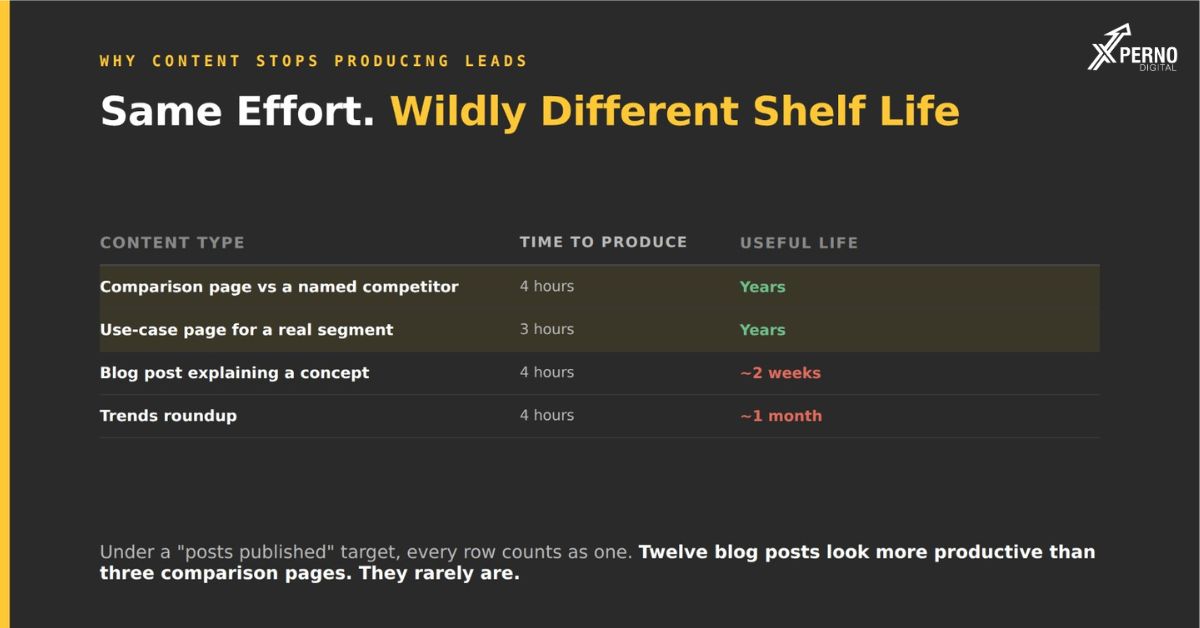
Both metrics are inputs rather than outcomes, and both hide an asymmetry between content types:
- Content type: Time to produce Useful life
- Comparison page vs a named competitor: 4 hours Years
- Use-case page for a real segment: 3 hours Years
- Blog post explaining a concept: 4 hours / 2 weeks
- Trends roundup: 4 hours /1 month
Under a “posts published” target, every row counts as one. Twelve blog posts a quarter looks more productive than three comparison pages. It rarely is.
Why does nobody build comparison content?
Comparison pages require competitive knowledge that sits with sales, product detail that sits with product marketing, and writing capacity that sits with content and no single function owns the output.
This is an organisational problem wearing a content problem’s clothes.
Blog content has a clear owner and a clear process. Comparison pages have neither. The result is that the highest-value pages in the entire programme go unbuilt for years while the content calendar runs on schedule not because anyone decided against them, but because they were nobody’s job.
Comparison and alternatives pages are also the most-cited content type when AI engines answer vendor recommendation queries, which means this gap costs visibility as well as conversions.
Why does buyer language matter?
Content written from keyword tools uses the company’s vocabulary. Buyers use their own, and the two are frequently different enough that the content targets queries nobody types.
A company describes itself as a “revenue intelligence platform.” Its buyers say “know which deals are actually going to close.” A writer who has never heard a sales call has no way to know this.
The fix costs an afternoon: Give the content team twenty recorded sales calls and have them extract, verbatim, how prospects describe the problem before they know the category name. That transcript is a better keyword list than any tool produces.
What should change instead?
Change the brief, the ownership and the metrics. Not the team.
Rebalance the allocation: A typical B2B content programme runs roughly 70% top-of-funnel, 20% middle, 10% bottom. A more defensible split is 20/30/50, because bottom-of-funnel content converts better, faces less competition, and is finite rather than ongoing.
Build the bottom-of-funnel set first: Three to four comparison pages, one alternatives page, four to eight use-case pages, and indexable pricing. Six to ten pages, roughly 25 hours, then quarterly maintenance.
Assign it to one named person with a deadline: The ownership gap is why it has not happened. A project with an owner and an end date is easier to assign than an ongoing responsibility.
Change the reporting at the same time: Pipeline contribution by page, conversion rate by page type, appearance in AI citations. Asking a team to build comparison pages while still measuring posts published sets them up to fail at both.
What does the reallocation look like in practice?
For a team currently producing four posts a month at roughly sixteen hours:
Months 1–2: Stop publishing. Build three comparison pages and one alternatives page. Same sixteen hours, redirected.
Month 3: Four use-case pages, covering the segments that actually produce revenue.
Month 4 onward: Two substantial pieces a month one with original data or a specific comparison, one shorter. Roughly eight hours. The remaining eight go to distribution: review requests, roundup outreach, and monthly measurement.
Same total effort. Output that keeps working after publication.
How should you raise this with the team?
State that the brief was wrong before saying anything else, then bring the team into the diagnosis rather than delivering it.
A team hearing that their work is not producing results will hear it as criticism of their execution. That produces defensiveness, slows the change, and frequently costs you people who were doing exactly what they were asked to do.
Be specific about what changed zero-click answers, AI-mediated shortlisting, the shift in which content types get cited — rather than asserting that content “is not working.”
Then have the team run five buyer-intent prompts for your category themselves. A writer who sees their company absent from every answer while three competitors appear will understand the problem faster than any explanation delivers it, and will usually arrive at the reallocation independently.
When does this diagnosis not apply?
When the output is genuinely weak thin pieces, no research, obvious AI drafts, missed deadlines.
The test: Is the work consistent, on time, and reasonable in quality, while producing nothing measurable? That is a brief problem.
Inconsistent, late or poor-quality output is an execution problem, and reallocating the brief will not fix it.
Frequently Asked Questions:
Should we replace our content team?
Almost never. The issue is usually the brief and the metrics rather than execution. A team producing consistent, decent work will produce the right work when asked for it.
How long before a rebalanced content strategy shows results?
Bottom-of-funnel pages typically convert within weeks of publishing, because they target buyers already searching. Broader visibility takes six to twelve months.
What if leadership expects a specific publishing cadence?
Reframe the target around output value rather than count. One comparison page plus one substantial piece is more defensible than four blog posts, provided you can state what each produces.
Who should own comparison content?
One named person, with input from sales on competitive detail. The failure mode is shared ownership rather than a lack of capability?
How do we know if this applies to us?
Run five buyer-intent prompts for your category in ChatGPT and Perplexity. If competitors appear consistently and you do not, despite a substantial content archive, it applies.
Should we stop blogging entirely?
No. Reduce volume, raise substance, and restrict top-of-funnel content to original data and defensible positions.