
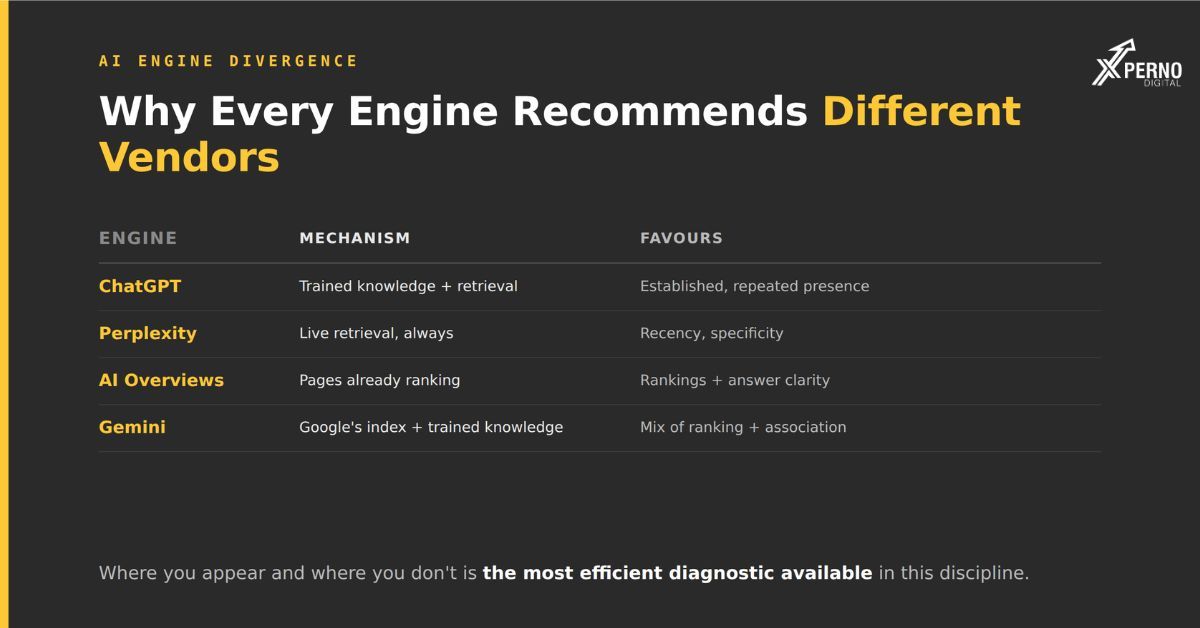
Different AI engines recommend different vendors because they retrieve from different sources, weight recency and authority differently, and blend trained knowledge with live retrieval in different proportions.
Ask “best project management tool for a 50-person agency” in Chat GPT, Perplexity and Google AI Overviews and you will typically get three overlapping but distinct lists. Two or three names appear everywhere. Several appear in only one.
Most people treat this as noise. It is not the pattern of where you appear and where you do not is the most efficient diagnostic available in this discipline. It tells you which part of your visibility is working and which is not, without any other analysis.
How do the major engines differ?
Four engines, four different mechanisms:
- Primary mechanism Favours Responds to new content.
- ChatGPT Trained knowledge, plus retrieval when browsing triggers Established, repeated presence across many sources Weeks (retrieval) / model release (trained).
- Perplexity Live retrieval, always Recency, specificity, retrievable pages Weeks.
- Google AI Overviews Pages already ranking for the query Search rankings plus answer clarity Weeks.
- Gemini Google’s index plus trained knowledge Mix of ranking signals and trained association Weeks to model release.
ChatGPT: Carries the largest audience and the strongest bias toward brands with accumulated mention volume. It is the hardest to move quickly and the most valuable to be in.
Perplexity: Retrieves live for every query and shows its sources, which makes it both the fastest to respond to new content and the only engine that tells you where it looked.
Google AI Overview: Draw predominantly from pages already ranking, which makes traditional SEO a prerequisite here in a way it is not elsewhere.
Gemini: Sits between the two Google-adjacent behaviours and in practice tracks reasonably closely with AI Overviews.
What does the divergence tell you?
Where you appear and where you do not maps directly onto which part of your visibility is weak.
This is the practical core of the post. Run your buyer prompts across all four and match your pattern against these:
Present in AI Overviews, absent from ChatGPT and Perplexity.
Your on-site SEO is working and your off-site presence is thin. You rank, so Google’s summary can find you, but nothing outside your domain corroborates you.
Fix: Review platforms, roundup inclusion, comparative content on third-party sites.
Present in Perplexity, absent from ChatGPT.
You have recent coverage but little established, repeated presence. Common for newer companies or those who recently started producing content.
Fix: time plus sustained third-party presence. This one cannot be rushed trained knowledge updates on model releases.
Present in ChatGPT, absent from Perplexity.
Historical presence is good, current retrieval is not. Usually a crawler access problem, a rendering problem, or content that has gone stale.
Fix: Check robots.txt and CDN settings first, then content freshness.
Absent everywhere.
The simplest diagnosis and the largest project. Nothing comparative about you exists in retrievable form.
Fix: Comparison pages, extractable facts, then off-site presence.
Present everywhere but described inconsistently.
Your entity is unclear different sources categorise you differently and each engine picked a different consensus.
Fix: entity work before anything else.
Should you optimise for a specific engine?
No. Optimise for the underlying characteristics all of them reward, and test across all of them.
The engines differ in retrieval mechanics but converge on what they need from a source: extractable claims, comparative framing, third-party corroboration, current facts, clear structure.
Nothing meaningful in this discipline is engine specific. There is no ChatGPT technique that does not also help in Perplexity. The differences are in weighting and speed, not in kind.
One partial exception. Because AI Overviews draw from ranking pages, traditional SEO is a stronger prerequisite there. If Google AI Overviews matter most to your audience which is plausible if your buyers are not heavy ChatGPT users maintaining rankings deserves more weight in your allocation. That is a difference of emphasis rather than a different strategy.
Why does the same engine give different answers on different runs?
These models generate variable output by design, which means a single result tells you very little.
Ask the same question three times in three fresh sessions and you will frequently get three different vendor lists with substantial overlap.
Why: The generation process is probabilistic, retrieval can surface different sources on different runs, and personalisation and session context influence the output.
What this means for measurement:
- Run each important prompt three times in separate sessions and record the pattern
- Treat a single result as an anecdote
- A vendor appearing in one run of three is weakly present; one appearing in three of three is strongly present
- Movement of a few percentage points between months is within the margin
A practical scoring approach. Rather than binary appeared/did not appear, score each prompt out of three runs. A brand at 3/3 across ten prompts is in a genuinely different position from one at 1/3 across the same ten, even though a binary count would show both as “appeared.”
Which engine should you prioritise?
Test in Perplexity for diagnosis, and care most about wherever your buyers actually are:
Test in Perplexity: Because it shows sources. The citation list tells you not just whether you appeared, but which pages fed the answer which is the difference between knowing you have a problem and knowing what to do about it.
Care about ChatGPT: Because of audience size. It has by a wide margin the largest user base, so absence there costs the most.
Do not ignore AI Overview: Because they reach people passively. A buyer doing an ordinary Google search encounters them without choosing to use an AI tool at all, which means they reach buyers the standalone tools do not.
A workable monthly routine: All four engines, fifteen to twenty fixed prompts, three runs each on your five most important prompts. About forty-five minutes.
Does this change over time?
The engines change frequently and independently, so a pattern that holds this quarter may not hold next quarter.
Model releases shift trained knowledge. Retrieval systems get updated. Google adjusts which queries trigger AI Overviews and how sources are selected.
What this means practically:
- Record which engines you tested and when a change in your numbers may reflect an engine update rather than your work
- Do not build a strategy around a current quirk of one engine
- Re-run the full diagnostic quarterly rather than assuming last quarter’s pattern still holds
- Treat all of this as directional rather than precise
And be sceptical of confident claims about engine mechanics, including inferences drawn here. These systems are opaque, they change without notice, and much of what circulates as established fact is inference from limited observation. The diagnostic patterns above are useful heuristics, not laws.
Frequently Asked Questions:
Which AI engine is most accurate about software recommendations?
None is reliably more accurate. They reflect the sources available to them, so accuracy depends on what has been published about a category rather than on the engine.
Why does ChatGPT not know about my company?
Either you were not present in its training data, or retrieval is not surfacing you. If Perplexity finds you and ChatGPT does not, the first explanation is more likely and time is the main remedy
Should I test all four engines every month?
Test ChatGPT, Perplexity and AI Overviews monthly at minimum. Adding Gemini is cheap since the prompts are already written.
How many runs per prompt is enough?
Three for your most important prompts. One is enough for the rest, provided you accept those results are noisier.
Do the engines copy each other?
Not directly, but they draw on overlapping public sources, which is why the most-cited vendors tend to appear across all of them.
If I appear in one engine, will I eventually appear in the others?
Not automatically. The gap usually reflects a specific weakness thin off-site presence, blocked crawlers, weak rankings and closing it requires addressing that weakness.