
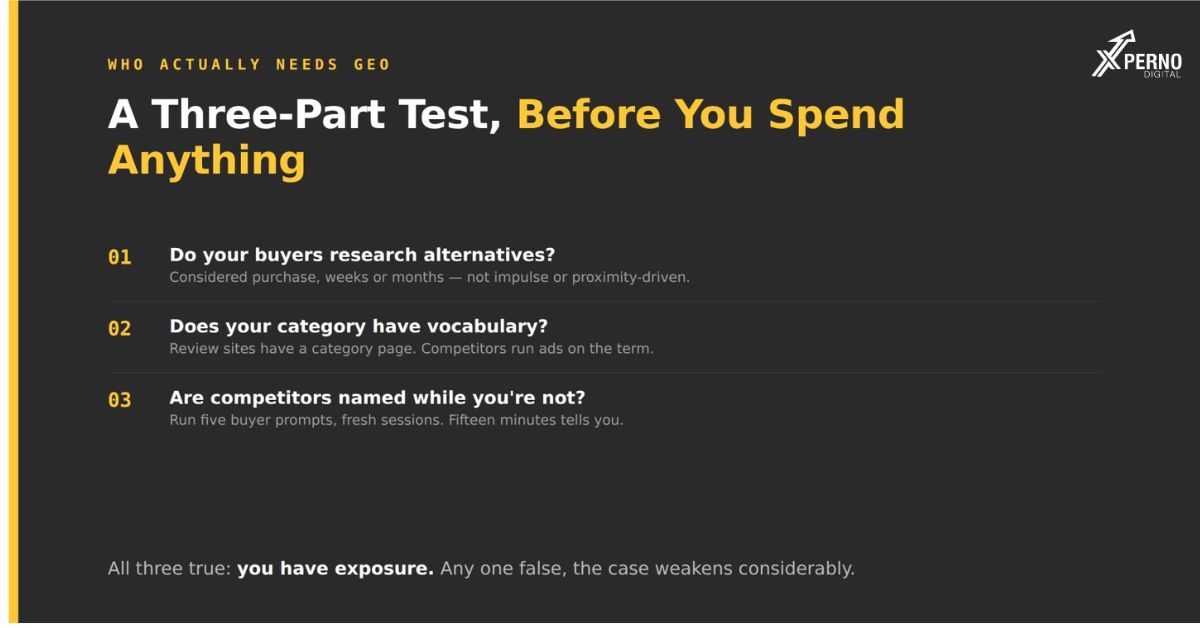
GEO is worth investing in when your buyers research alternatives before purchasing, your category has established vocabulary, and competitors are being named in AI answers while you are not.
If all three are true, you have exposure. If any is false, the case weakens considerably.
This post is written to help you decide, including the cases where the answer is no. We sell this work, so weigh that accordingly but the qualification criteria below are checkable, which is the point.
The Three-part test:
Run this before spending anything.
1. Do your buyers research alternatives?
Yes if: The purchase is considered, involves comparison, and takes weeks or months. B2B software, professional services with a real evaluation, anything with an established competitive set.
No if: The purchase is transactional, impulse-driven, or decided primarily on proximity and availability.
2. Does your category have vocabulary?
Yes if: Review sites have a category page for what you do. Competitors run ads on the category term. Comparison articles exist. Searching your term returns relevant competing results.
No if: Searching your term returns unrelated results, no review-site category exists, and prospects have no words for the problem until you give them some.
Why this one is decisive. Buyers cannot ask an AI about a category they cannot name. If you are creating demand rather than capturing it, AI search cannot deliver you to them not because the work is poor, but because the queries do not exist.
3. Are competitors being named while you are not?
Run five buyer-intent prompts in Chat GPT and Perplexity, in fresh sessions. Fifteen minutes.
If competitors appear consistently and you do not: Confirmed exposure.
If you appear consistently: This is not your most urgent problem. Recheck quarterly and spend the attention elsewhere.
If nobody in your category appears: Either the category is too new, or buyers do not ask about it this way. Either points at demand creation rather than capture.
Strong fit:
Five situations where the case is clear:
B2B SaaS with a defined competitive set: Buyers compare, comparison content is the most-cited type, and the queries exist. The strongest fit by a distance.
Companies whose content ranks but does not convert: You have traffic and no pipeline. Frequently this means you rank for informational queries and are absent from the commercial ones where the shortlist forms.
Categories with many similar options: The harder filtering is, the more buyers lean on a synthesised recommendation to do it for them.
Technical products with poor documentation.: Common, and unusually fixable. The product is good, the docs are gated or thin, and nothing extractable exists about it anywhere.
Companies where organic traffic is flat but demo requests are falling: The signature pattern of discovery moving upstream while branded traffic holds steady.
Weak fit:
Four situations where the return is limited:
Transactional or low-consideration purchases: If the decision takes minutes, there is no research phase to be present in.
Highly local services: Where proximity dominates the decision, local search and reviews matter more than AI vendor recommendations.
Relationship-led enterprise sales: Where deals come through existing networks, procurement processes and analyst relationships. Some early-stage influence exists, but it is not where the deal is decided.
Categories with no established competitive set: If buyers cannot name a category, they cannot ask about it.
Worth a caveat on the last two. Both are matters of degree rather than absolutes. Enterprise buyers still do individual research before formal processes begin. New categories eventually acquire vocabulary. The question is whether it is your most valuable use of budget now, not whether it will ever matter.
Too early:
Four situations where the honest answer is to do something else first:
Pre-product-market-fit: If you do not yet know who your ideal customer is or what makes you different, you cannot know what you want to be visible for. Comparison pages require knowing which competitors you beat and for whom. Building visibility for unsettled positioning is worse than building none.
No functioning website: Broken technical health, no content, nothing crawlable. Fix the foundation. Anyone selling AI visibility work on a broken site is selling something that will not work.
Organic is not your constraint: If deals stall at proposal, if your close rate dropped, if your sales cycle doubled — more top-of-funnel visibility makes that worse rather than better. Diagnose which constraint is actually binding.
Fewer than three customers in your target segment: You do not yet know enough about the buyer to write content that addresses them specifically, and it will read as guessing.
What about company size?
Size is a poor predictor. Category structure matters far more.
Where smaller companies do well?: Fragmented categories, narrow use-case queries, technical products where documentation quality separates vendors more than brand does. A forty-person company with strong comparison content routinely outperforms a larger competitor with none.
Where smaller companies struggle?: Categories with one or two entrenched brands that have accumulated a decade of coverage. The head term may not be winnable at any realistic budget though the specific queries usually are.
The practical version?: heck whether the head query in your category returns the same two names every time. If it does, target the modifier layer instead industry, company size, integration, specific job. That is where a smaller company competes, and it converts better anyway.
How much does it cost to find out?
Fifteen minutes and no tools:
The five prompts:
1. Best [category] tool for [your ideal customer’s specific situation]
2. Compare the top [category] platforms for [company size or industry]
3. [Your largest competitor] alternatives
4. What should I look for when choosing a [category] platform?
5. Is [your product] good for [your primary use case]?
Run each in a fresh session in ChatGPT and Perplexity. Record which brands appear.
Three possible outcomes:
You appear consistently: Not your priority. Recheck quarterly.
Competitors appear, you do not: Exposure confirmed. Diagnose the cause before acting usually no comparative content exists, nothing external corroborates you, or your facts are not extractable.
You appear but described inaccurately: Fix that before anything else. Increasing the reach of a wrong description makes it worse.
What to do if the answer is no?
Say so and spend the budget on whatever your actual constraint is.
That sounds obvious and it is the least common outcome of an agency conversation.
If your category is demand creation: Outbound, community, founder-led content and partnerships work better than search. Revisit GEO once the category has vocabulary.
If organic is not your constraint: Fix the constraint. A longer sales cycle or a falling close rate is not solved by more visibility.
If your positioning is unsettled: Settle it first. It is cheaper than building visibility around a message you will change.
If you already appear consistently: Maintain a quarterly check and move on.
The reason this matters commercially: An engagement that should not have been sold ends badly, consumes the team, and produces a client who tells people. Establishing fit in the first conversation is worth more than the deals it costs.
Frequently Asked Questions:
Is GEO worth it for a small company?
Frequently yes, in fragmented categories and for narrow queries. Size matters less than category structure and whether the queries exist.
What if my category is brand new?
Then buyers cannot ask about it and AI search cannot deliver you to them. Demand creation channels work better until the category has vocabulary.
Do B2C companies need GEO?
Less so for impulse and transactional purchases. More so for considered ones software, travel, insurance, anything where buyers compare before deciding.
How do I know if organic is my real constraint?
Look at where deals fail. If they stall at proposal or close rate has fallen, the problem is downstream and more visibility will not help.
Is it too late to start?
No. Most companies in most categories have done nothing here, which is why the advantage is currently available. That narrows as the practice becomes routine.
What if we already appear in AI answers?
Then this is not your priority. Recheck quarterly and spend the attention on your actual constraint.