
Share of voice in AI search is your brand’s mentions as a proportion of all vendor mentions across a fixed set of buyer-intent prompts.
If twenty prompts produce 160 total vendor mentions and 18 of them are yours, your share of voice is 11.25%.
It is the more honest of the two available metrics, because it controls for movement that has nothing to do with your work.
Why Isn’t Appearance Rate Enough?
Appearance rate rises and falls for reasons unrelated to your performance, so it can show improvement while you are losing competitive ground.
Appearance rate is the percentage of tested prompts that name you. Simple, intuitive, and the number everyone reaches for first.
Its weakness: AI engines change. Categories gain coverage. Models get better at naming more vendors per answer. When any of that happens, everyone’s appearance rate rises together and you conclude your content strategy is working.
A concrete example. Over one quarter:
- Start / End
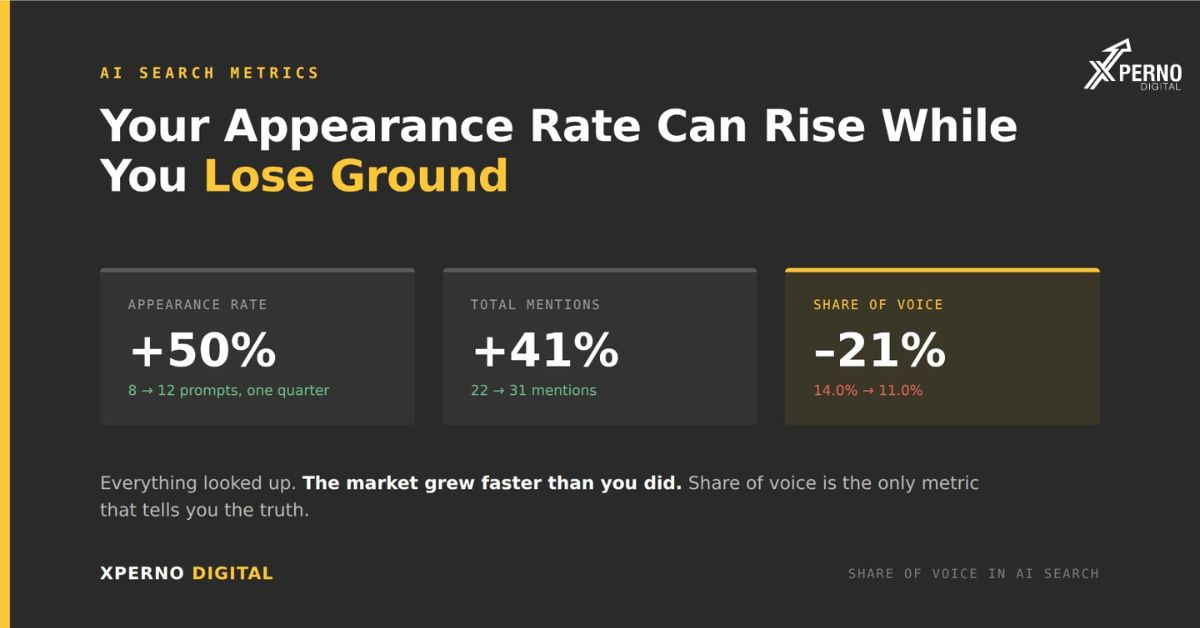
- Your appearance rate 8 / 40 12 / 40
- Your total mentions 22 / 31
- All vendor mentions 157/ 282
- Your share of voice 14.0% / 11.0%
Your appearance rate rose 50%. Your mentions rose 41%. And your competitive position deteriorated, because the total pool grew faster than you did.
Only the second metric tells you that. A report leading with appearance rate would have described a successful quarter.
How Do You Calculate It?
Count every vendor mention across your prompt set, then divide yours by the total:
Step 1: Fix your prompt set: Fifteen to twenty buyer-intent prompts covering core buying questions, comparisons, alternatives and direct brand queries. Write them down and never change the phrasing.
Step 2: Run them consistently: Fresh session every time, same engines, same week each month, three runs for your most important prompts.
Step 3: Record every vendor named: Not just whether you appeared every brand mentioned in every answer, in order.
This is the step people skip, and it is the one that makes share of voice calculable. If your tracking sheet only has a Y/N column for your own brand, you cannot compute this later.
Step 4: Calculate:
Share of voice = your mentions ÷ total vendor mentions across all prompts
A worked example:
- Prompt Vendors named Yours?
- Best tool for X A, B, C, You 1
- Compare top platforms A, B, You, D 1
- A alternatives B, C, D, E 0
- What to look for A, B 0
- Is [you] good for X You 1
Total vendor mentions: 18. Yours: 3. Share of voice: 16.7%.
What Is a good Share Of Voice?
It depends entirely on how many credible vendors exist in your category, so compare against equal share rather than an absolute benchmark.
Equal share = 100 ÷ number of credible vendors in your category.
- Category with 5 vendors → equal share is 20%
- Category with 20 vendors → equal share is 5%
- Category with 40 vendors → equal share is 2.5%
Being at or above equal share is a strong position. Being at half of equal share means you are being named roughly half as often as an average competitor.
Rough interpretation, once adjusted for category density:
- Relative to equal share Read
- Below 0.3× Effectively invisible
- 0.3–0.7× Present but not prominent usually specific queries only
- 0.7–1.3× Competitive, in the consideration set
- Above 1.3× Category leader position
A 15% share sounds strong until you learn the category has four vendors.
Which Competitors Should You Track?
Track your top three to five competitors individually and group the rest.
This turns share of voice from a single number into a competitive picture, which is what makes it useful in a board conversation.
- Vendor Share of voice Change
- Competitor A: 24% / +2%
- Competitor B: 19% / –1%
- You: 11% / +3%
- Competitor C: 9% / –2%
- All others: 37%
This tells a founder three things at once: Where you stand, who is ahead, and whether the gap is closing. A single share of voice figure with no comparison tells them almost nothing.
How Should You Report It?
Lead with share of voice and the competitive gap. Track appearance rate underneath.
A workable one-page structure:
- Share of voice, this month vs three months ago. One number, one trend line.
- Competitive table. You against your three closest competitors.
- Where you gained and where you did not. By prompt type specific queries usually move before broad ones, and saying so prevents flat head-term numbers reading as failure.
- Appearance rate, as a secondary metric.
- What we did, and what is next.
What to leave out: Rankings, impressions, keyword counts. If the report needs a glossary, it will not be read.
Include what did not move: A report with no misses makes the gains less believable, and in a channel where the client cannot independently verify most of what you tell them, that credibility is the whole relationship.
What Are The Limits Of This Metric?
Four limitations worth stating rather than hiding.
- Output is variable: The same prompt produces different answers. Multiple runs reduce noise but do not remove it. Treat movement under a few percentage points as within the margin.
- Your prompt set is a sample, not a census: Real buyers phrase things in ways you have not tested. A rising share of voice on your twenty prompts is evidence, not proof.
- Personalisation affects results: What you see may differ from what a buyer elsewhere, with different history, sees.
- Attribution is imperfect: If share of voice rises, you cannot cleanly separate your content work from a competitor’s decline, an engine update, or a third party publishing a roundup that happened to include you.
- None of this makes the metric worthless: It makes it directional. Which is considerably better than the alternative, which is no visibility at all into a channel affecting your pipeline.
- A note on precision: Share of voice calculated from twenty prompts across two engines is a sample with real error bars. Reporting it to one decimal place implies a precision the method does not have. Round to whole numbers and describe direction rather than magnitude.
Frequently Asked Questions:
How is this different from traditional SEO share of voice?
Traditional share of voice weights rankings by search volume across a keyword set. AI share of voice counts brand mentions across a prompt set. Similar logic, different unit of measurement.
How many prompts do I need for a reliable figure?
Fifteen to twenty. Fewer produces noise; more becomes a burden that stops getting done consistently.
Should I weight prompts by importance?
You can, and it produces a more commercially meaningful number weight alternatives and high-intent queries more heavily. Document the weighting so month-to-month comparisons stay valid.
Do I count multiple mentions of the same brand in one answer?
Count once per answer per brand. Counting repetitions rewards verbose answers rather than actual prominence.
How often should I calculate it?
Monthly. More frequently produces noise from output variability rather than signal.
What if the total vendor pool keeps growing?
That is exactly what share of voice is designed to reveal. A growing pool with static mentions means your relative position is declining even as your raw numbers hold.