
An AI citation is when an AI engine draws on your content to answer a question, either naming your brand in the response or listing your page as a source.
Two distinct things fall under the term, and conflating them causes confusion:
Being named as a vendor: A model asked “what’s the best tool for X” lists your product among its recommendations. This is what most companies mean when they say they want AI visibility.
Being cited as a source: Your page appears in the citation list visible in Perplexity, in Google AI Overviews, and in ChatGPT when it browses as one of the pages the answer was assembled from.
These often but not always coincide. You can be cited as a source for an answer that recommends someone else. You can be named as a vendor based on third-party sources without any of your own pages being cited.
Both matter, for different reasons. Being named puts you in the consideration set. Being cited as a source means your content is doing the work, which is the earlier signal that your content strategy is landing.
How is it different from a backlink?
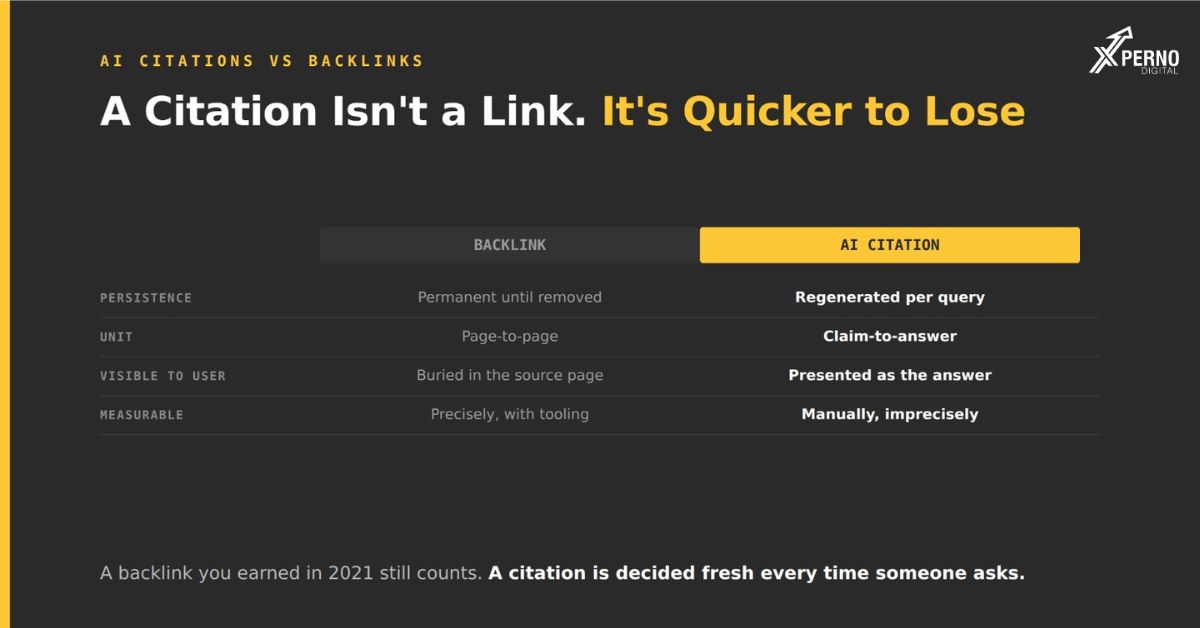
A backlink is a durable structural signal that a page exists and is worth referencing. A citation is a moment-by-moment decision to use a specific claim in a specific answer.
- Backlink: AI citation
- Persistence: Permanent until removed Regenerated per query
- Unit: Page-to-page Claim-to-answer
- Visibility to the uses: Buried in the source page Presented as part of the answer
- What it signals: This page is worth referencing This claim is worth using now
- Consistency: Fixed Varies run to run
- Measurable: Precisely, with tooling Manually, and imprecisely
The most important difference is persistence. A backlink you earned in 2021 still counts. A citation is decided fresh every time someone asks, which means it can be gained or lost without anything on your site changing a competitor publishes better content, a third-party article updates, an engine updates its retrieval.
That makes citation more volatile and more responsive. It also means you cannot bank it the way you bank links.
Why does a citation matter more?
Because it reaches the buyer at the moment of decision, in a format that reads as advice rather than as advertising.
A backlink’s value is indirect: It contributes to a page ranking, which contributes to visibility, which might produce a click, which might produce a lead. Several steps, each with drop-off.
A citation is direct: The buyer asked which tool to use, and your brand is in the answer with reasoning attached. There is no ranking step, no click step, no discovery step. You are in the consideration set.
And it carries borrowed credibility: A vendor named in a synthesised answer starts the evaluation with trust that paid placement cannot buy because the recommendation has no visible commercial motive.
Worth a caveat: That trust is partly misplaced. These systems measure how consistently you are described across sources, not whether your product is good. A well-documented average product gets cited over a better one nobody wrote about. The buyer does not know this, which is precisely why the citation is valuable and why it is worth being honest about the mechanism.
Do backlinks still matter?
Yes, indirectly. Links help pages rank and be discovered, which affects whether they enter the retrieval candidate set at all.
The relationship is worth stating precisely, because both “links are dead” and “links are the same as ever” are wrong.
Where links still work:
- They contribute to ranking, and several engines draw predominantly from ranking pages Google AI Overviews and Gemini especially
- A page that ranks nowhere is unlikely to be retrieved
- They remain a discovery mechanism for crawlers
Where they matter less than they used to:
- Link volume does not directly determine citation. A page with many links and no extractable claims will not be cited
- The direct citation signal is corroboration across independent sources, which is related to but distinct from links
- A mention without a link, in a source these systems read, can be more valuable than a link from a page nobody reads
The practical reframing: Stop optimising for links as the unit and start optimising for being described. A third-party article that describes you accurately without linking contributes more to citation than a link from a directory nobody reads.
What produces citations?
Five things, and only one of them is on your own domain:
1. Extractable claims on your pages: A specific, self-contained, attributable statement. Without this, nothing on your site can be lifted regardless of how well it ranks.
2. Comparative content: Buyer queries are comparative. Pages describing only your product cannot answer them.
3. Third-party corroboration: Review platforms, category roundups, community discussion, independent comparison articles. A vendor’s claim about itself is weak evidence; multiple independent sources describing you consistently is strong.
4. Entity clarity: Whether the system holds a coherent representation of what you are. Ambiguity here means being cited for the wrong queries.
5. Recency: Sources that describe a product as it currently exists carry more weight than sources from three years ago.
Notice the split: Points 1 and 2 are on your domain and you control them completely. Points 3, 4 and 5 depend substantially on sources you do not own. That balance is why on-site work alone plateaus.
How do you track citations?
Manually, with a fixed prompt set there is no equivalent to a link index.
What to record monthly:
- Prompt Fixed wording, never changed
- Engine ChatGPT, Perplexity, AI Overviews
- Named as vendor? Y/N, plus position
- Your page cited as source? From Perplexity’s citation list
- Which other sources were cited The most actionable column
- Competitors named Feeds share of voice
The “other sources cited” column is the one people skip and the one that pays off. Over a few months you learn which three or four sources dominate answers in your category. That is your distribution strategy, derived from evidence rather than from general advice.
Two metrics worth calculating:
Appearance rate: How many prompts name you. Simple baseline.
Share of voice: Your mentions as a proportion of all vendor mentions. More honest, because it controls for category-wide movement
Is the comparison to backlinks useful at all?
Partly. It helps people understand that off-site signals matter and it misleads if pushed too far.
Where the analogy holds: Both are third-party signals, both reflect something other people did rather than something you published, and both reward being genuinely worth referencing.
Where it breaks:
Citations are not accumulative in the same way Ten thousand backlinks is a durable asset. Being cited ten thousand times is a record of past queries, not a stock of anything.
You cannot build citations directly. You can build the conditions content, corroboration, clarity and citations follow. There is no equivalent to outreach for a link.
Quality is judged differently. Link quality is roughly about the linking domain. Citation likelihood is about whether a specific claim is usable and corroborated, which is a property of the content rather than the domain.
The safer framing: Stop thinking about citations as links and start thinking about them as being quoted. You get quoted when you have said something specific, useful and checkable, and when other credible people say something consistent with it.
Frequently Asked Questions:
Do AI citations pass any SEO value?
Not in the way links do. Their value is direct visibility at the moment of decision, plus the branded search that frequently follows.
Can I buy AI citations?
No. Some platforms are testing advertising formats, but cited sources are currently earned rather than purchased.
Should I stop building links?
No. Links contribute to ranking, and several engines draw predominantly from ranking pages. Reduce the weight on link volume; increase it on being described accurately by sources these systems read.
How do I see if my page has been cited?
Perplexity displays sources for every answer. Google AI Overviews link cited pages. ChatGPT shows sources when it browses. Run your prompt set and read the citation lists.
Why did I lose a citation I used to have?
A competitor published something better, a third-party source updated, or the engine changed. Citations are regenerated per query rather than banked.
Which matters more, being named or being cited as a source?
Being named puts you in the consideration set, so it matters more commercially. Being cited as a source moves earlier, so it is the better leading indicator that your content work is landing.