
Yes, in one specific way: AI answers are assembled from consensus across existing sources, and a new category has no consensus to draw on. Buyers cannot ask about something they cannot name.
This creates a genuine problem for category creators. The mechanism that increasingly delivers vendors to buyers a synthesised recommendation in response to a described situation requires that the situation map onto an established category with established language.
If your category does not exist yet:
Buyers do not know to ask about it
No sources describe it, so nothing can be synthesised
Any query they do run returns adjacent categories, not yours
The result: The channel that is becoming central for demand capture is structurally unavailable for demand creation. That is not a temporary gap in the technology it follows from how these systems work.
What actually happens to a new category?
Buyers describe their problem, and the model answers with the nearest established category.
Say you have built something genuinely new a tool that sits between two existing categories and does something neither does well.
A buyer with that problem opens an AI interface and describes it in the vocabulary they have. They do not know your category name because it does not exist. So they say something like “we need something to manage this handoff between our sales and support systems.”
What comes back?: Recommendations from the nearest established categories. CRM tools. Helpdesk tools. Integration platforms. Not you, because there is no category for a model to place you in.
Two things follow:
The buyer evaluates products that do not solve their problem, concludes nothing does, and continues with the manual process.
The nearest adjacent categories absorb the demand, which is what makes category creation expensive you are educating a market that then buys from an incumbent.
Is this genuinely new?
Not really. Category creation was always slow and expensive. AI search adds one more channel that does not work until the category exists.
Worth resisting the temptation to overstate this.
What was always true:
Buyers searched using the vocabulary they had, which meant adjacent categories
Review sites had no category page for you
Analysts had no quadrant
Content marketing against nonexistent search volume produced nothing
What AI search adds?: The same problem in one more channel but a channel that is increasingly where the shortlist forms, which raises the cost of being absent.
What it does not change?: The fundamentals of category creation. You still have to teach the market a new word, and that still happens through people rather than through search.
How do you know if you are in this situation?
Four checks, ten minutes:
Does a review site have a category page for what you do?? If G2 and Capterra have no category, buyers have no place to browse alternatives and no shared vocabulary.
Do competitors run ads on your category term? If nobody is bidding, nobody is searching.
Does searching your term return relevant results? If it returns unrelated content or definitions of individual words, the term is not established.
Ask an AI directly: “What category of software does [your product] belong to?”* If the answer places you in an adjacent category, or says it does not know, you have your answer.
One useful nuance: You may be creating a category name while operating in an established *space*. If buyers have the problem and search for solutions using older vocabulary, you are in demand capture with a positioning problem — which is very different from genuine category creation and much cheaper to solve.
What should you do instead?
Build awareness through channels attached to people rather than to search, and capture the demand that exists in adjacent categories.
Where awareness forms when search cannot deliver it?
Founder and executive presence. A person with a view reaches people no content page can. This is the primary channel for category creation and always has been.
Podcasts and long-form conversation. Not summarised away by an answer engine, and the format carries the explanation a new category requires.
Communities. Where practitioners discuss the problem before it has a name. This is where category vocabulary actually forms.
Original research. Naming and quantifying a problem is how a category acquires legitimacy. It is also the most reliable route to earned coverage.
Partnerships and integrations. Being present in an established ecosystem borrows its vocabulary.
Direct outbound. Unfashionable and effective. If buyers cannot find you, you find them.
Should you capture adjacent demand meanwhile?
Yes. Position against the nearest established category while building your own vocabulary in parallel.
This is the pragmatic move most category creators resist, and it is usually right.
What it looks like: Build comparison and alternatives content against the adjacent categories buyers currently search. “Alternatives to [adjacent tool] for [your specific problem]” is a real query with real volume, and it reaches exactly the buyers who tried the nearest thing and found it lacking.
The objection: It dilutes the category story. Positioning yourself against CRMs when you are not a CRM undermines the thing you are trying to build.
The counter: You can hold both. The comparison content captures buyers now, using vocabulary they have. The category story is built through founder content, research and community, using vocabulary you are teaching them. Different audiences, different stages, both necessary.
A practical version: Comparison pages that name the adjacent category explicitly and then explain the distinction. “If you are using [adjacent tool] for [problem], here is where it breaks and what we do differently.” That captures the query and teaches the category in the same page.
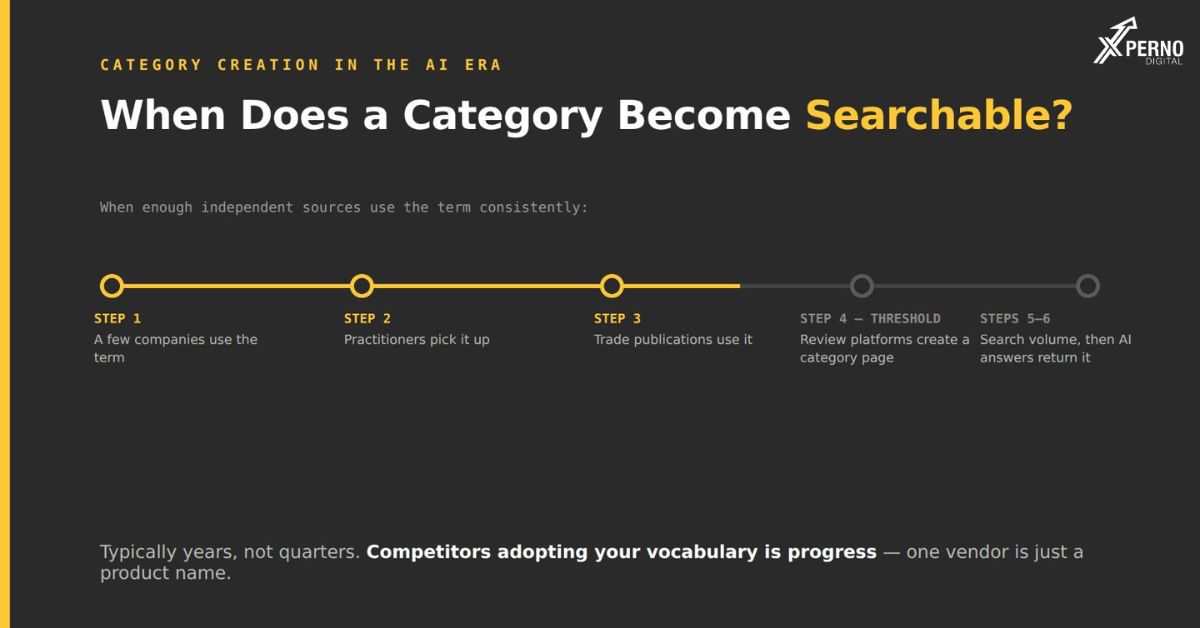
When does a category become searchable?
When enough independent sources use the term consistently usually when review platforms create a category page.
The sequence, roughly:
1. A few companies use the term in their own content
2. Practitioners pick it up in communities and conversation
3. Trade publications start using it in articles
4. Review platforms create a category page
5. Search volume becomes measurable
6. AI answers begin returning the category
Step 4 is the practical threshold. A review-site category page means shared vocabulary, a browsable set of alternatives, and structured comparative data which is exactly what these systems need.
How long?: Typically years, not quarters. Categories that appear to have emerged quickly usually had a long period of practitioner-level usage before anyone noticed.
What accelerates it?: Multiple companies using the same term. A category with one vendor is a product name. Counterintuitively, competitors adopting your vocabulary is progress a category needs several players before anyone treats it as a category.
When should you revisit AI search?
Once your category term returns relevant results and a review platform has created a page for it.
Signals it is time:
- G2 or Capterra creates the category
- Third parties use the term without prompting
- Buyers arrive already using your vocabulary
- Searching the term returns competing vendors rather than definitions
At that point the standard approach applies fully: comparison content, extractable facts, third-party corroboration, measurement. And you should have a substantial advantage, because you will have been describing the category consistently for years while everyone else is starting.
Until then, run the check quarterly and spend the budget where awareness actually forms.
Frequently asked questions:
Can I create a category through SEO?
No. Search captures demand that exists. Category creation requires teaching a market a new word, which happens through people rather than through search.
How do I know if I’m creating a category or just badly positioned?
If buyers have the problem and search for solutions using older vocabulary, you are in demand capture with a positioning problem much cheaper to solve.
Should I use my category name or the established one?
Both. Established vocabulary in comparison and capture content; your own in founder content, research and community.
How long does category creation take?
Typically years. Categories that appear to have emerged quickly usually had a long period of practitioner usage first.
Does it help if competitors adopt my category name?
Yes. A category with one vendor is a product name. Several players using the same term is what makes it a category.
What is the single most effective channel for this?
Founder and executive presence, consistently, over years. It has always been the answer and AI search does not change it.