
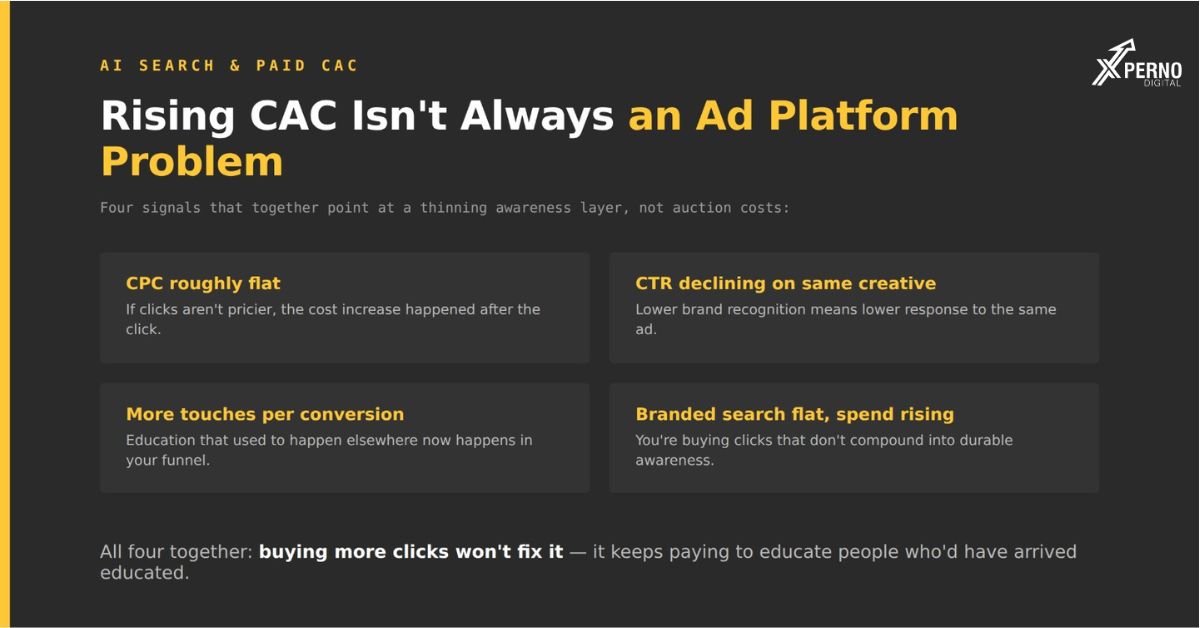
AI search raises paid acquisition costs indirectly: when fewer buyers arrive already aware of your brand, paid campaigns carry more of the education burden, which lengthens the path to conversion and raises cost per acquisition.
The mechanism is not that ad auctions became more expensive because of AI. It is that the free awareness layer beneath paid acquisition thinned, and paid has to compensate.
Most teams see the symptom CAC rising, conversion rates on paid softening and attribute it entirely to platform costs. Platform costs did rise. That is not the whole explanation, and the part that is missing is measurable
Why does brand awareness affect paid efficiency?
An ad shown to someone who already recognises the brand converts materially better than the same ad shown to someone encountering it for the first time.
This is well established and it is the mechanism that matters here.
The prospect who knows you sees your ad, recognises the name, and clicks with existing context. They convert faster, need fewer touches, and cost less to acquire.
The prospect who does not sees an unfamiliar name. They need the ad, the landing page and several subsequent touches to do the work that recognition would have done instantly.
Where recognition used to come from?: Organic search. A buyer researching a problem found your content, learned you existed, and encountered your ad weeks later with prior context.
What changed?: More of that early research now happens inside AI interfaces. If you are named there, the recognition still forms. If you are not, it does not and the buyer meets your ad cold.
What does this look like in the numbers?
Four patterns that together suggest the awareness layer thinned rather than the ad platform simply getting more expensive.
1. CPC roughly flat, CAC rising: If you were paying more per click, that would explain rising CAC. If click costs are stable and CAC still rose, the cost increase happened after the click.
2. Click-through rates declining on the same creative: Lower recognition means lower response to the same ad.
3. More touches required per conversion: The path lengthened because education that used to happen elsewhere now happens inside your funnel.
4. Branded search volume flat or falling while paid spend rises: The clearest signal. If you are spending more and branded search is not growing, the spend is not producing durable awareness it is buying clicks that do not compound.
The distinguishing test: Compare non-branded organic traffic over the same period. If it declined while branded held steady, fewer new people are discovering you organically, which is exactly the condition that makes paid work harder
What are the other explanations?
Several things raise CAC, and this one should be diagnosed rather than assumed.
Rule these out first:
- Genuine platform cost increases: Auction density in your category may have risen. Check CPC trends directly.
- Increased competition: New entrants bidding on your terms.
- Creative fatigue: The same ads shown too long to the same audience.
- Landing page or funnel degradation: A redesign, a longer form, a changed CTA.
- Targeting drift: Campaigns broadened over time and are now reaching lower-intent audiences.
- Sales capacity or process changes: Longer cycles, higher qualification thresholds, slower follow-up.
The signature for the AI-mediated explanation specifically: stable CPC, declining CTR, more touches per conversion, and declining non-branded organic all at once. Any one of these alone points elsewhere.
How do you check whether this applies to you?
Three checks, about forty-five minutes total:
1. Run the buyer prompts (15 min): Ask ChatGPT and Perplexity, in fresh sessions, for the best tool for your ideal customer’s situation and for alternatives to your largest competitor. Note which brands appear.
If competitors are named consistently and you are not, the awareness layer explanation is live.
2. Segment branded and non-branded organic (15 min): In Search Console, filter for queries containing your brand and compare that trend against everything else over twelve months.
Branded flat with non-branded declining is the pattern.
3. Check paid diagnostics (15 min): CPC trend, CTR trend on stable creative, average touches to conversion. Stable CPC with declining CTR and lengthening paths points at recognition rather than auction cost.
What the combination tells you? If all three point the same way, you have a brand awareness problem that is showing up on your paid line, and buying more clicks will not fix it it will keep paying to educate people who would previously have arrived educated.
What should you do about it?
Treat organic visibility as a paid efficiency lever, not only as a traffic channel and make the case in CAC terms rather than in ranking terms.
The reframing that matters for a budget conversation: organic visibility work is usually argued for as traffic acquisition, which puts it in direct competition with paid for the same budget. Arguing it as a paid efficiency lever changes the comparison entirely, because it makes existing spend work harder rather than replacing it.
What to build, in priority order:
Comparison and alternatives content: The content types cited when buyers ask which vendor to use. This is where recognition now forms.
Third-party presence: Review platforms, category roundups. Four of the most-cited source types are not on your domain.
Extractable facts. Pricing, target customer, integrations, stated plainly. A model cannot recommend what it cannot describe.
What not to do? increase paid spend to compensate. If the underlying issue is thinning recognition, more spend buys more expensive clicks against the same problem, and the cost per acquisition keeps climbing.
How do you make the case internally?
Frame it as CAC payback rather than as an SEO investment.
A CFO or founder evaluating a marketing budget compares options on return. “We should invest in SEO” competes poorly against a paid channel with attributable conversions.
A more defensible framing:
“Our CAC rose X% while CPC stayed flat, which means the increase happened after the click. Non-branded organic discovery declined over the same period, and our three main competitors appear in AI vendor recommendations where we do not. The organic work is a paid efficiency investment it should reduce the education burden currently sitting on our paid campaigns.”
What makes that credible: It names the alternative explanations, cites the specific diagnostics, and states an expected mechanism rather than a promised outcome.
Be honest about attribution: You will not be able to cleanly attribute a CAC improvement to organic visibility work too many variables move at once. Say so upfront. A stated expectation with acknowledged uncertainty survives scrutiny better than a projected number that does not hold.
Frequently Asked Questions:
Is AI search directly making ads more expensive?
Not directly. The effect is indirect less free awareness means paid campaigns carry more education cost, which raises cost per acquisition even when click costs are stable.
Should I reduce paid spend?
Not automatically. Diagnose first. If the awareness layer thinned, cutting paid without building organic visibility reduces volume without fixing efficiency.
How long before organic visibility work affects CAC?
Six to twelve months, and the attribution will be imperfect. This is a compounding investment, not a lever with a quick payback.
Can I measure the effect precisely?
No. Too many variables move simultaneously. Track the directional indicators — branded search volume, non-branded discovery, CTR on stable creative rather than expecting a clean attribution.
Does this affect every category?
Most in categories where buyers research extensively before contacting vendors. Less in transactional purchases or where proximity and relationships dominate.
What if our CAC is fine?
Then this is not your problem. Check the diagnostics rather than assuming either way, and spend your attention on whatever your actual constraint is.