
Much of it is inference from limited observation presented as established mechanics. These systems are opaque, they change without notice, and almost nobody publishing about them has access to how they work.
We sell this service. Stating that a large share of the advice in our own field is speculative is not a comfortable position, and it is the accurate one.
What is genuinely known?: Almost nothing about the internal mechanics. No major AI provider publishes how retrieval decisions are made, how sources are weighted, or what determines which vendors appear in a recommendation.
What everyone in this field actually has?: Observation. You run prompts, record which brands appear and which sources are cited, change something, wait, and run them again. That is a reasonable method for producing working heuristics. It is not the same as knowing the mechanism.
The problem is not the inference. It is the confidence with which inference gets presented.
What is actually established?
Four things, with reasonable confidence:
Crawler access is binary and consequential: If `GPTBot` is disallowed, you cannot be retrieved from during live browsing. This is documented behaviour, not inference.
Content must exist in the served HTML: If it only appears after JavaScript executes, crawlers that do not execute scripts see nothing. Testable directly.
Perplexity shows its sources: You can observe which pages fed an answer. This is the closest thing to direct evidence available in the field.
Output is variable: The same prompt produces different answers across runs. Anyone can verify this in five minutes, and it undermines a great deal of confident measurement.
That is roughly the extent of it. Everything below is inference of varying quality.
What is plausible but unproven?
Five widely-held beliefs that are probably right and are not established.
Comparison content gets cited more than explainer content: Consistent with observation across categories. Also consistent with what a system assembling a comparative answer would need. Not proven.
Third-party corroboration carries more weight than self-published claims: Plausible, matches observed citation patterns, and matches how any evidence-weighing system would sensibly behave. Inferred.
Recency matters more in retrieval-heavy engines: Consistent with Perplexity’s behaviour. The magnitude is unknown.
Extractable, self-contained claims are preferred: Strongly consistent with observation. The mechanism is plausible. Still an inference.
Entity consistency reduces mis categorisation: Observed frequently. Causation unproven it could be that companies with consistent descriptions differ in other ways too.
These are worth acting on: Working heuristics with consistent observational support are the best available basis for decisions. They should be described as such rather than as mechanics.
What is guesswork being sold as fact?
Six claims that appear in proposals and have no evidential basis:
“llms.txt improves AI visibility: ” No confirmed evidence any major provider reads it. It is a community proposal with no adopted standard behind it. Costs an hour, does no harm, is not a lever.
“AI-optimised formatting” as a distinct technique: Clear structure helps extraction. There is no separate formatting system for AI, and the recommendations sold under this label are usually 2015 SEO advice relabelled.
Precise AI visibility scores: Composite numbers from tools whose methodologies are undisclosed, produced from samples that vary. Directional at best. Frequently presented as measurement.
“Ranking” in ChatGPT: There is no stable ordered list in a generated answer. Position varies between runs of the same query. “We got you to position two in ChatGPT” describes one run of one prompt.
Guaranteed citation: Nobody controls these systems. A guarantee is either meaningless or implies something you would not approve of.
Engine-specific optimisation techniques: The engines weight the same signals differently. There is no ChatGPT technique that does not also help elsewhere, and segmenting effort by engine is selling complexity.
Why is there so much of it?
Because there is commercial pressure to sound certain, and no mechanism for being contradicted.
Three structural reasons:
Certainty sells: A prospect choosing between an agency that says “these are working heuristics with observational support” and one that says “here are the seven ranking factors for AI search” frequently picks the second. Hedged language reads as weak in a sales context even when it is accurate.
There is no feedback loop: In traditional SEO, a claim can be tested against rank tracking and eventually contradicted. Here, output is variable, measurement is manual, and attribution is poor. A wrong claim can survive indefinitely because nothing disproves it cleanly.
The field is new enough that nobody has been caught: Give it two years and some of what is currently sold confidently will look obviously wrong. Nothing will have surfaced it yet.
And an uncomfortable fourth: This content is largely written by people selling the service, including this post. That does not make it wrong. It does mean the incentive runs toward overstating the problem and the solution, and a reader should weight it accordingly.
How do you tell the difference?
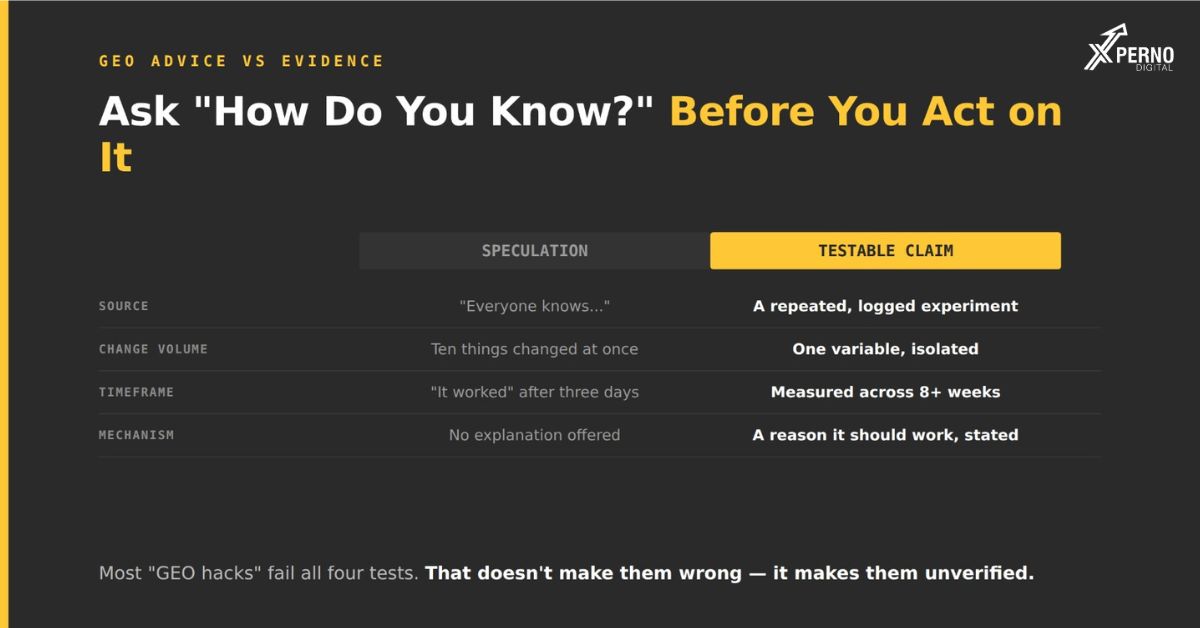
Four questions. Ask them of any GEO claim, including ours:
“What evidence supports that?” A specific answer observed citation patterns across a sample, a documented behaviour, a testable claim is different from “it makes sense that it would work.”
“How did you measure it?” If the answer is vague, the number is decorative. Ask about sample size, engines tested, number of runs per prompt.
“What would falsify this?” A claim that cannot be wrong is not a claim about the world. If nothing would count as evidence against it, treat it as marketing.
“What are you uncertain about?” Someone who has genuinely done this work has a list. Someone who does not have a list has not thought about it, or is not telling you.
A practical test on a sales call: Ask what they think is overhyped in their own field. Enthusiasm for everything means either they are not paying attention or they sell whatever is currently easiest.
Does this mean GEO is not worth doing?
No. The observable part is real, and the underlying work is defensible regardless of mechanism.
Worth being clear, because the scepticism above could reasonably be read as dismissal.
What is definitely true?: Buyers are asking AI tools which vendors to use, those tools name a small number, and being absent from that set has a commercial cost. You can verify all three yourself in fifteen minutes.
What is worth doing regardless of the mechanism?: Comparison content, extractable facts, third-party presence, entity consistency, review recency. Every one of those improves your position with buyers and in traditional search whether or not the AI-specific reasoning holds.
That is the defensible position: The work is not a bet on a specific theory of how these systems operate. It is work that was always sound, reprioritised because the returns changed.
What is not worth doing?: Anything whose only justification is an unproven mechanism. If the reason to do something is “AI engines prefer this,” and there is no evidence they do, and it has no other benefit do not do it.
Frequently Asked Questions:
Is GEO a real discipline or marketing hype?
The underlying problem is real and verifiable in fifteen minutes. Much of the advice around it is inference presented as mechanics.
Should I trust AI visibility tools?
Treat their numbers as directional. Methodologies are usually undisclosed and results frequently diverge from what users see.
Is llms.txt worth implementing?
It costs an hour and does no harm. There is no confirmed evidence major systems read it, so do not treat it as a lever or pay for it as a deliverable.
Can anyone guarantee AI citation?
No. Nobody controls these systems. A guarantee is either meaningless or implies tactics you would not approve of.
How do I evaluate a GEO proposal?
Ask what evidence supports each claim, how it was measured, what would falsify it, and what they are uncertain about. Vagueness on all four is the signal
Why should I trust this post?
You should not, entirely. It is written by an agency selling this service. Check the specific claims — most of them are verifiable in under an hour.