
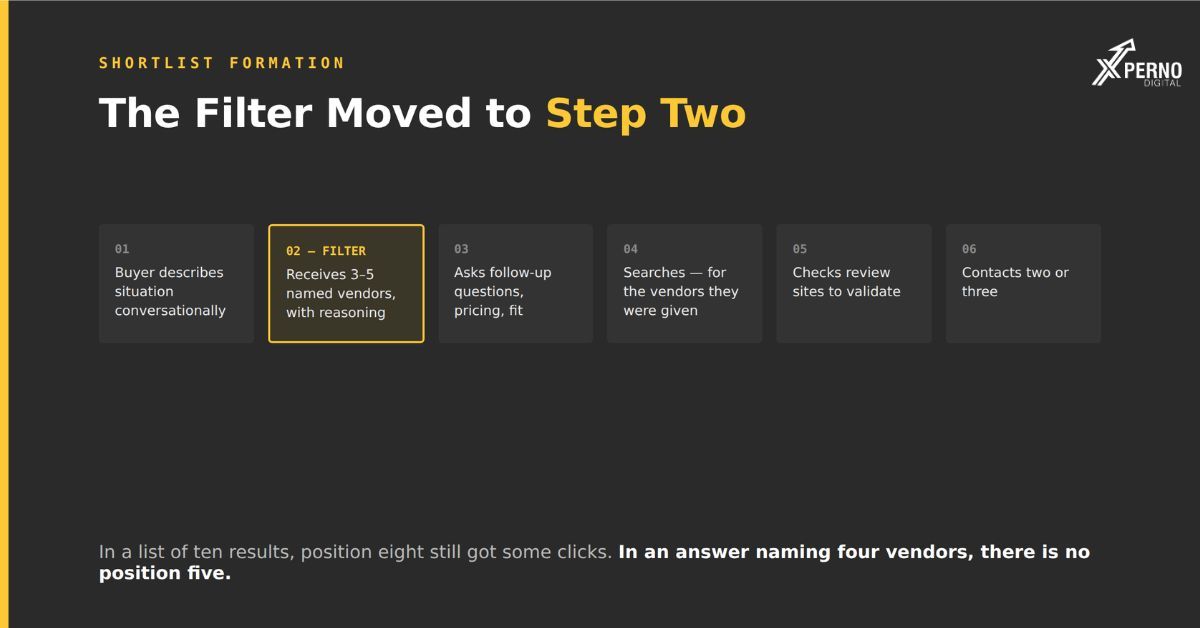
The vendor shortlist now frequently forms inside an AI interface before the buyer runs a single search, which moves the decisive filtering step earlier than most go-to-market strategies assume.
The old sequence put filtering on a search results page. A buyer searched, scanned ten results, opened four, and built a mental list. Being ranked eighth still meant being seen.
The current sequence puts filtering in a generated answer. A buyer describes their situation, receives three to five named vendors with reasoning, and searches for those names. Being absent from that answer means not being considered at all.
The step that matters moved, and it moved to a place with no partial credit.
What does the new sequence look like?
Six steps, with the filter now at step two rather than step three:
1. The buyer describes their situation conversationally. “We’re a 60-person logistics company running fleet maintenance in spreadsheets. It’s breaking. What should we look at?”
2. They receive three to five named vendors, with justification attached. ← the filter
3. They ask follow-up questions. Pricing. Suitability for their size. How two of the names compare.
4. They search for the vendors they were given.
5. They check review sites to validate what they were told.
6. They contact two or three.
Two consequences follow from the filter being at step two
The vendors named at step two receive branded search traffic at step four, which looks like healthy brand awareness in their analytics. The vendors not named receive nothing, and nothing is invisible there is no line in any report for buyers who never learned you exist.
And the list arrives with reasoning attached, which is qualitatively different from ten blue links. It reads as advice rather than as a results page
Why is this worse than ranking poorly?
Ranking poorly produced reduced visibility. Absence from a generated shortlist produces no visibility, and there is no gradient between the two.
In a ranked list of ten results, positions one through ten all existed on the same page. Position eight got fewer clicks than position one, but it got some and a buyer building a longlist frequently scrolled.
In an answer naming four vendors, there is no position five. You are one of the four or you are not in the process.
This changes the shape of the outcome distribution. Incremental improvement matters less; crossing the threshold into the answer matters more. A company that moved from position fifteen to position nine gained something in search terms and nothing here.
It also compounds. Vendors who get named accumulate mentions, reviews and third-party coverage, which makes them more likely to be named next time. Vendors who are absent accumulate nothing.
How much of the market actually buys this way?
There is no reliable independent measurement, and figures circulating with confidence should be treated sceptically.
What can be said with more confidence:
- Adoption of AI assistants among knowledge workers has grown quickly and continues to
- The behaviour is more common among technical buyers and younger decision-makers
- It appears more often in early research than in final vendor selection
- It is more prevalent in categories with many similar options, where filtering is genuinely difficult
The more useful question is not what percentage of the market does this. It is whether it is happening in you category which you can determine in fifteen minutes.
Open ChatGPT and Perplexity in fresh sessions. Ask for the best tool for your ideal customer’s specific situation. Ask for alternatives to your largest competitor. Note which brands appear.
If three competitors are named consistently and you are not, the market-wide percentage is academic. The exposure is real and it compounds.
Why doesn’t this show up in the numbers?
Traffic stays flat because branded and returning visits mask the decline in new discovery.
Split your organic traffic into two groups.
People who already know you: They search your brand name, return to a bookmarked page, come back after a sales conversation. This group is stable and often growing, because it reflects customers and prospects accumulated over previous years.
People discovering you: They had a problem, found a page, learned you exist. This is where new pipeline originates.
When AI-mediated discovery takes share, the second group shrinks. But in most established B2B companies the first group is the majority of organic sessions, so the total looks unchanged.
How to see it? in Search Console, filter queries containing your brand name and compare that trend against everything else over twelve months. Branded flat or rising while non-branded declines is the signature.
And check first-touch, not last-touch attribution. Last-touch credits whatever closed the session, which is frequently branded search or direct. First-touch tells you where people originally learned you existed.
What does this mean for a go-to-market leader?
It means there is a channel where you may be losing to competitors, it does not appear in any of your reporting, and checking takes fifteen minutes.
That framing is more useful than “you should optimise for AI search,” because it is a risk assessment rather than a marketing proposal.
The sequence that makes sense:
Check first. Fifteen minutes, five prompts, two engines. Do not commission a strategy for a problem you have not confirmed.
If you appear consistently, this is not your most urgent problem. Recheck quarterly and spend your attention elsewhere. That is a legitimate outcome.
If competitors appear and you do not, diagnose the cause before acting. In almost every case it is one of three things: no comparative content about you exists anywhere, nothing outside your own domain corroborates you, or your basic facts are not stated in extractable form.
Then fix content type, not content volume. The common error is responding by publishing more. If twelve months of content did not produce this visibility, more of the same will not either.
What is the timeline on the damage?
Discovery problems surface in closed revenue three to four quarters after they begin, which is why they are usually diagnosed late.
- Months 1–3: Fewer new buyers learn you exist. Nothing visible changes pipeline is still fed by earlier discovery.
- Months 4–6: Top-of-funnel volume softens. Usually attributed to seasonality or a campaign underperforming.
- Months 7–12: Closed revenue reflects it. By now the cause is a year old and the analysis is archaeological.
This lag is the argument for checking now rather than waiting for evidence. By the time the effect is unambiguous in your revenue numbers, you have lost a year of pipeline formation and your competitors have accumulated a year of compounding presence.
The check costs fifteen minutes. The delay costs considerably more.
Frequently Asked Questions:
Does this affect enterprise buying as much as SMB?
Less at final selection, where procurement processes and analyst relationships dominate. More in early research, where individual stakeholders form initial views before any formal process begins.
Can I influence which vendors appear in the shortlist?
Yes, though not directly or quickly. The answer is assembled from comparative content, third-party sources and review data. Building presence in those sources is the mechanism.
How do I know if my category is affected?
Run five buyer-intent prompts in ChatGPT and Perplexity in fresh sessions. If competitors are named consistently and you are not, it is affecting you.
Is this replacing search entirely?
No. Search volume remains substantial. What changed is that more of it is buyers looking up vendors they were already given rather than discovering vendors for the first time.
How long does it take to get into the shortlist?
Specific and comparative queries typically move in eight to fourteen weeks. Broad category queries take six to twelve months, and in entrenched categories may not be winnable.
Should we reduce SEO investment?
No reprioritise within it. Broad category terms return less; comparative content, extractable facts and third-party presence return more.