
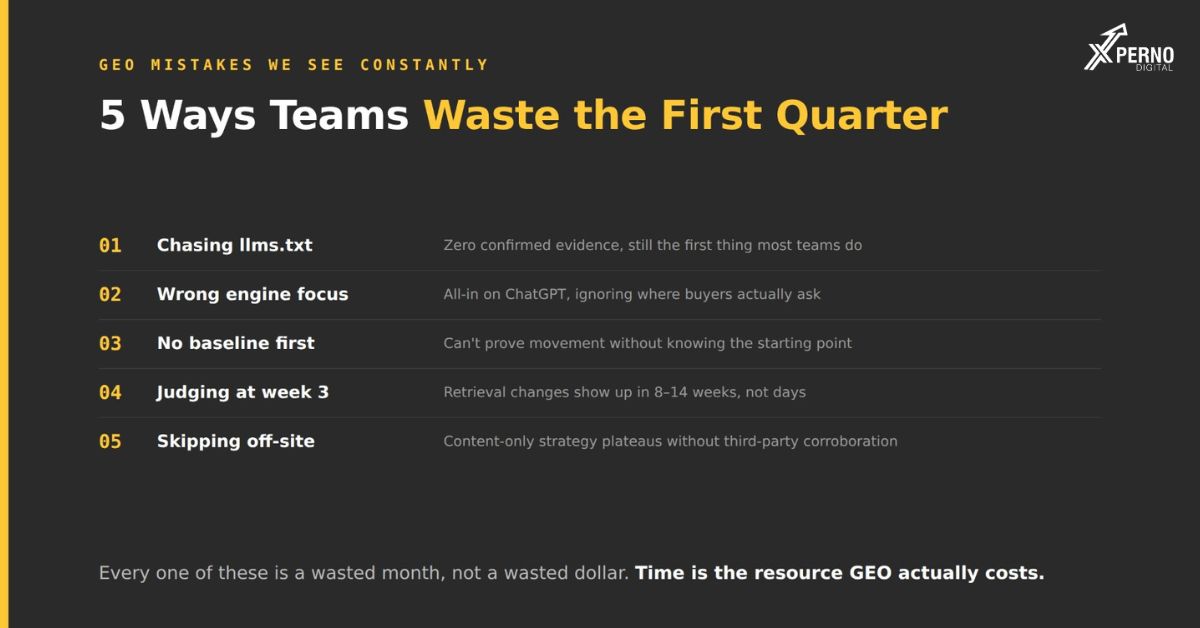
Every mistake below is a real, common failure pattern in this work:
Mistake 1: We measured appearance rate instead of share of voice:
What we did?: Tracked how many prompts named the client, month over month. The number went up. We reported progress.
What was wrong?: The whole category was gaining coverage. Everyone’s appearance rate was rising. The client’s competitive position had actually worsened they gained in absolute terms while two competitors gained faster.
How we found out?: A client asked how they compared to a named competitor. We had not been recording every vendor mentioned, only whether the client appeared, so we could not answer without re-running three months of tests.
What we do now: Record every vendor named in every answer. Calculate share of voice. Report the competitive table first and appearance rate second.
Mistake 2: We skipped the crawler check on a large client:
What we did?: tarted with content strategy on a company with a substantial site and a good technical team. We assumed the basics were covered.
What was wrong?: `GPTBot` had been disallowed during a security review eighteen months earlier. Nobody had revisited it. Six weeks of content work went into a site that could not be retrieved from during live browsing.
How we found out?: A colleague ran the two-minute check while looking at something unrelated.
What we do now?: Robots.txt, CDN settings and WAF rules are checked in the first hour of every engagement, before anything else is discussed. It takes two minutes and it has changed the diagnosis more than once.
Mistake 3: We promised movement on the head term:
What we did?: Included the broad category query in a scope without checking whether it was contestable.
What was wrong?: Two incumbents appeared in every run of that query, across every engine, with a decade of accumulated coverage behind them. It was not winnable at the budget available, and probably not at any budget.
How we found out?: Month nine, when the client asked why the number that mattered to them had not moved.
What we do now?: Run the head query three times in fresh sessions across three engines in week one. If the same names appear every time, we say so in the proposal and exclude it from scope. It costs us the occasional deal. It costs less than the alternative.
Mistake 4: We built comparison pages that were too flattering:
What we did?: Wrote comparison pages where the client won every row. It felt like the obvious way to write them.
What was wrong?: They did not get cited. When a system cross-references multiple sources on the same comparison, a page where every judgement favours the publisher is weak evidence. Human readers discounted them too.
How we found out?: A client’s page had been live for four months with no citations, while a competitor’s more balanced page appeared repeatedly.
What we do now?: Every comparison page names at least one segment where the competitor is genuinely the better choice. It is the hardest conversation in the engagement and it is the change that made those pages work.
Mistake 5: We started off-site work too late:
What we did?: Sequenced content first, distribution second build the pages, then start outreach.
What was wrong?: Off-site work has a four-to-six-month lead time. Starting it in month three meant nothing landed until month eight, well past the point where the client was assessing whether the engagement was working.
How we found out?: Two engagements in a row where the content moved specific queries and the broader position did not shift until much later than we had led the client to expect.
What we do now?: Review programme and roundup outreach start in week two, in parallel with content, even though nothing is visible for months. The sequencing is now: diagnose, then content and distribution simultaneously.
Mistake 6: We reported activity instead of outcomes:
What we did?: Monthly reports listing pages published, outreach sent, technical fixes made.
What was wrong?: It answered “what did you do” rather than “did it work.” Clients read it, learned we had been busy, and drew no conclusion about whether to continue.
How we found out?: A client said the report was thorough and asked, separately, whether the work was succeeding. Those two things should not have been separable.
What we do now?: One page. Share of voice and the competitive gap first. Pipeline contribution with the attribution method stated. What moved and what did not. Deliverables last.
Mistake 7: We did not check accuracy before working on visibility:
What we did?: Treated the goal as getting the client named more often.
What was wrong?: On one engagement, the descriptions circulating about the client were partly wrong outdated pricing and a discontinued feature listed as current. Increasing their visibility increased the reach of the wrong description.
How we found out?: The client’s sales team started getting objections based on pricing that had not been current for two years.
What we do now?: The diagnostic includes checking every factual claim the engines make about the client. If anything is wrong, correcting it comes before any visibility work.
What we would tell someone starting:
Five things, condensed:
- Check the boring technical things first: Crawler access and server-side rendering are two-minute checks that occasionally explain everything.
- Establish what is not winnable in month one: Saying it early is a service. Saying it in month nine is a failure.
- Start the slow work immediately: Off-site distribution has the longest lead time. It should begin before anything is visible.
- Measure relatively, not absolutely: Share of voice against competitors, not appearance rate alone.
- Fix accuracy before amplifying: More visibility for a wrong description makes things worse.
What we are still uncertain about:
Three things we do not have good answers to, stated because a post about lessons learned should include the ones not yet learned:
How much of the effect comes from which input?: When share of voice rises after we have done content, technical and off-site work simultaneously, we cannot cleanly attribute it. Nobody can.
How durable citation is?: Positions gained can be lost when a competitor publishes or an engine updates. We do not know how much of a gain is structural and how much is transient.
Whether the current heuristics will hold?: These systems change without notice. Some of what works now will stop working, and we will find out the same way everyone else does by running the prompts and seeing the numbers move.
Frequently Asked Questions:
Why publish your mistakes?
Because in a field where clients cannot easily verify what you tell them, the willingness to report a failure is one of the few credibility signals available.
Are these mistakes common?
Yes. Every one is a pattern rather than an anomaly, which is why they are worth documenting.
What is the most expensive mistake on this list?
Promising movement on an unwinnable head term. It wastes months of budget and it is entirely avoidable with a fifteen-minute check.
What is the cheapest to avoid?
The crawler check. Two minutes, first hour of any engagement.
How do you know your current approach is right?
We do not, entirely. The heuristics have observational support and these systems change. That is why measurement is monthly rather than quarterly.