
Because a lot of the vocabulary in this space is new, some of it is used inconsistently, and a few terms are marketing language dressed as technical concepts.
Each definition below states what the term means and, where relevant, whether it describes something real or something being sold. Four are flagged as largely marketing terms, and one is flagged as genuinely unsettled.
Core concepts:
Generative Engine Optimization (GEO):
The practice of increasing the likelihood that AI engines cite and recommend your brand. Distinct from SEO in what it optimises for, though they share foundations.
Retrieval:
The process by which an AI system pulls relevant content to construct an answer. Operates on claims within pages rather than on pages as units.
Ranking:
Ordering documents by relevance to a query. What traditional search does. Related to retrieval several engines retrieve predominantly from ranking pages but not the same thing.
Citation:
When an engine draws on your content to answer a question, either naming your brand or listing your page as a source. Regenerated per query rather than banked.
Extractability:
Whether a specific claim can be lifted from your page and attributed without surrounding context. The cheapest signal to improve and the one most B2B content fails.
Grounding:
Anchoring a model’s answer in retrieved sources rather than in trained knowledge alone. Reduces fabrication and makes recency matter.
Trained knowledge:
What a model learned during training. Updates only when a new model version ships, which is outside anyone’s control.
Live retrieval:
Searching the web at query time. Responds to new content in weeks rather than waiting for a model release.
Consensus signal:
Agreement across independent sources about what you are. The strongest citation signal and the slowest to build.
Entity:
A model’s internal representation of your brand as a thing with attributes category, function, customers, price, competitors. Can be wrong without you knowing.
Measurement:
Appearance rate:
The percentage of tested prompts naming your brand. Simple baseline, but it rises when the whole category gains coverage, which can mislead.
Share of voice:
Your mentions as a proportion of all vendor mentions across a prompt set. More honest than appearance rate because it controls for category-wide movement.
Equal share:
100 divided by the number of credible vendors in your category. The reference point that makes an absolute share interpretable.
Prompt set:
A fixed group of buyer-intent queries, run monthly in identical wording. Changing the wording destroys the comparison.
Citation rate:
How often your pages appear as cited sources. Distinct from being named as a vendor — you can be cited for an answer that recommends someone else.
Claim density;
The proportion of sentences on a page stating something specific and checkable. Under one in ten means the page is mostly connective tissue.
Content types:
Comparison page:
A page comparing your product against a named competitor. The most-cited content type in B2B software answers and the one most companies have not built.
Alternatives page:
A page listing options for someone leaving a specific vendor. Highest commercial intent in B2B software.
Answer-first structure:
Stating the complete answer in the first sentence beneath each heading, then expanding. The cheapest change with the largest effect on retrieval
Use-case page:
Your product addressed to one specific situation an industry, company size, or job. Where smaller companies beat incumbents.
Original benchmarks or testing nobody else has. The only content advantage competitors cannot copy
Technical:
Schema markup
Structured data declaring facts about your page in machine-readable form. Removes ambiguity; does not create visibility.
`sameAs
A schema property listing URLs of other profiles representing the same entity. Explicitly connects your presences rather than leaving it to inferencE
GPTBot / PerplexityBot / ClaudeBot
AI crawlers. Frequently blocked during security reviews and never revisited, which sometimes explains an entire visibility problem.
Google-Extended`
Controls whether Google uses your content for Gemini and AI training. Does not affect Google Search ranking or AI Overviews a common and consequential confusion
Server-side rendering
Delivering content in the initial HTML rather than requiring JavaScript execution. Content that renders client-side only may be invisible to some crawlers.
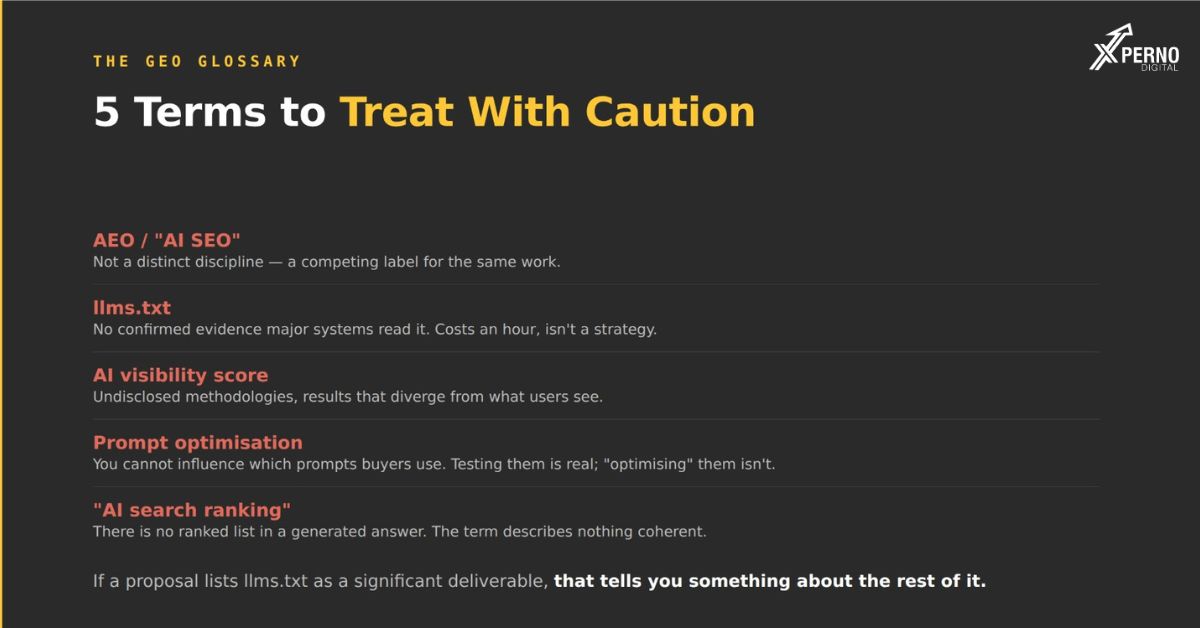
Terms to treat with caution:
AEO (Answer Engine Optimization)
Used interchangeably with GEO. Not a distinct discipline a competing label for the same work. If someone charges separately for GEO and AEO, that is worth questioning
AI SEO:
Same as above. Third label, same practice.
llms.txt:
A proposed file giving AI systems a structured guide to your content. No confirmed evidence that major systems read it, and no major provider has committed to supporting it. Costs an hour, does no harm, is not a strategy. Should not appear as a significant line item on an invoice.
AI visibility score:
Various vendors offer a single composite number. Methodologies vary widely, are usually undisclosed, and results frequently diverge from what users actually see. Treat as directional at best.
Prompt optimisation(in the GEO context):
Sometimes sold as a service the idea that you can influence which prompts buyers use. You cannot. Testing which prompts your buyers use is real work; optimising the prompts themselves is not a thing.
The term nobody can define usefully yet:
AI search ranking:
You will see this used constantly, and it does not describe anything coherent.
There is no ranked list in a generated answer. There is a set of named vendors, sometimes ordered, sometimes not, varying between runs of the same query. “Ranking third in ChatGPT” is not a stable property of anything.
What people usually mean when they say it?: Either position within a listed answer on one particular run, or a vendor tool’s composite score.
Why it matters that the term is loose?: It invites the assumption that AI visibility can be tracked with rank-tracker precision. It cannot. Movement of a few percentage points in share of voice is within the margin, and a single run tells you very little.
What to use instead?:ppearance rate and share of voice, measured across multiple runs, reported as direction rather than as position.
How to use this:
If you are evaluating an agency: The caution section is the useful part. A proposal treating GEO and AEO as separate services, or listing llms.txt as a significant deliverable, tells you something about the rest of it.
If you are briefing a team: The measurement section matters most. Getting appearance rate and share of voice defined consistently before you start is what makes three months of data comparable.
If you are new to this: Read the core concepts, then the content types. Those two sections cover most of what determines whether you get cited.
Frequently Asked Questions:
Is GEO the same as AEO?
Yes, in practice. Generative Engine Optimization, Answer Engine Optimization and AI SEO are competing labels for the same work.
Is llms.txt worth implementing?
It costs an hour and does no harm. There is no confirmed evidence major systems read it, so do not treat it as a lever or pay for it as a deliverable.
Can you rank in ChatGPT?
Not in any stable sense. Answers vary between runs and there is no persistent ordered list. Measure appearance rate and share of voice instead.
Are AI visibility scores from tools reliable?
Methodologies vary and are usually undisclosed. Results frequently diverge from what users see. Manual prompt testing remains more reliable.
What is the difference between being cited and being named?
Being named puts you in the consideration set as a vendor. Being cited means your page was used as a source — which can happen in an answer recommending a competitor.
Which term should I use internally?
GEO is the most widely adopted. What matters more is that your team defines appearance rate and share of voice consistently before measuring anything.