
Top-of-funnel content is not dead, but its economics broke the traffic it earns has fallen, the traffic it does earn converts worse, and it is the content type least likely to get you cited when a buyer asks an AI which vendor to use.
That is three separate problems arriving simultaneously, which is why the model that worked for a decade stopped working within about two years.
The honest version is more useful than the headline. Some TOFU content still works. Most of what B2B companies publish under that label does not, and the distinction between the two is specific enough to act on.
What actually changed?
Four things changed at once, and each independently reduced the return on awareness content :
1. Zero-click answers: Informational queries are exactly what AI Overviews and featured snippets answer completely. “What is X” no longer produces a click, because the answer is on the results page.
2. The shortlist forms elsewhere: Buyers increasingly build their vendor list inside an AI interface before searching. Awareness content that would have introduced them to your brand never enters the process.
3. Explainer content is the least-cited type: When a model answers a vendor recommendation query, it needs comparative and factual sources. A guide explaining what the category is contributes nothing to that answer.
4. Everyone published the same thing: A decade of content marketing produced enormous duplication. There are two hundred adequate explanations of any B2B concept. Adding the two hundred and first gives no source a reason to prefer yours.
The compounding effect: Any one of these would have reduced returns. Together they removed most of the mechanism by which awareness content produced pipeline.
Why did this model work before?
The old model worked because organic traffic was cheap, abundant and convertible through nurture.
The logic was sound at the time:
1. Publish content answering the questions people ask early
2. Rank for those queries and earn traffic
3. Capture emails with a gated asset
4. Nurture until they enter the market
5. Some proportion converts
Each step has weakened. Traffic is scarcer. Gating converts worse than it did. Email nurture faces saturated inboxes. And the buyer who would have been captured at step three now gets their answer without visiting.
The model has not become worthless. It has become expensive relative to what it returns, which is a different problem and it changes the allocation rather than the existence of the activity.
What kind of TOFU content still works?
Content that adds something to the category rather than restating it original data, a defensible position, or a genuinely narrower perspective.
Three types survive:
- Original data: Research, benchmarks, surveys, systematic testing. Nobody can substitute for it, so it gets cited by name and picked up by third parties. This is the strongest surviving TOFU format by a considerable margin.
- Defensible positions: Content arguing something a competent person might dispute. Consensus content is uncitable because every source says it; a position is citable because it is attributable to you.
- Genuinely narrow specificity: Not “guide to inventory management” but “how multi-warehouse ecommerce operators handle stock allocation during Q4.” Narrow enough that the generic explanation does not substitute.
What does not survive?: The comprehensive category explainer, the trends roundup, the “ultimate guide” to a concept with two hundred existing guides, and anything whose primary distinguishing feature is being longer than the competition.
Should you stop publishing awareness content?
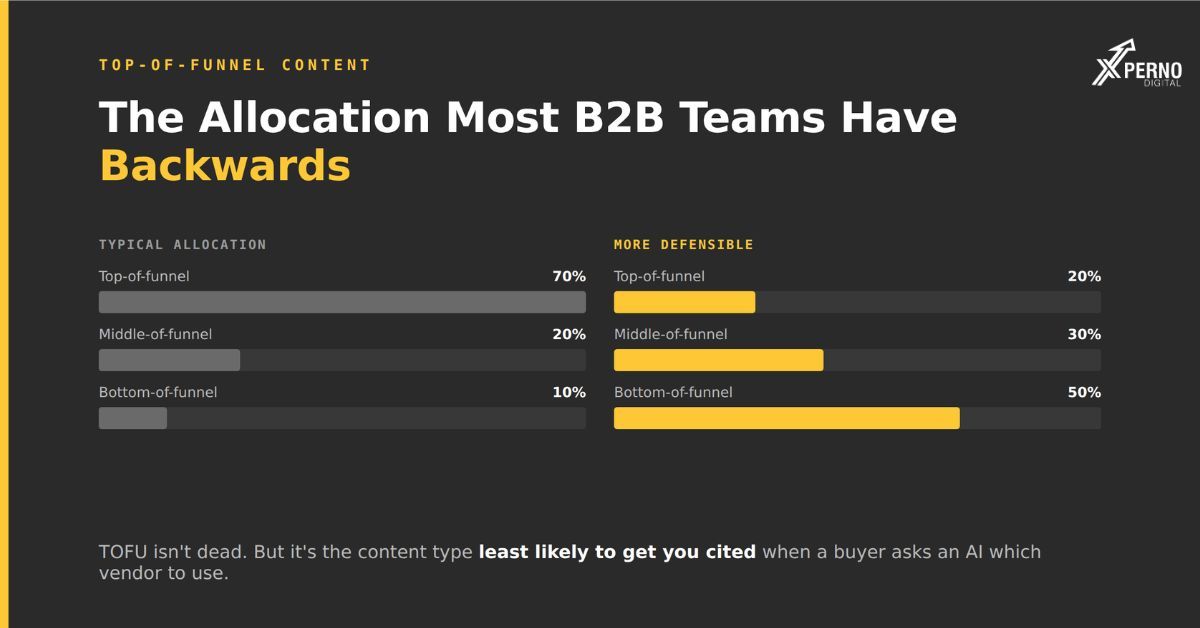
Reallocate rather than stop. The ratio most B2B companies run is inverted relative to what now works.
A typical current allocation:
- 70% top-of-funnel explainer content
- 20% middle-of-funnel
- 10% bottom-of-funnel
A more defensible allocation:
- 20% top-of-funnel, restricted to original data and positions
- 30% middle-of-funnel use-case and evaluation content
- 50% bottom-of-funnel comparison, alternatives, integration, pricing
What that looks like in practice for a small team. Instead of four explainer posts a month, publish one substantial piece with original data and build two comparison pages. Roughly the same hours. Substantially different return.
The immediate move: If you have no comparison or alternatives pages, build those before writing another blog post. Six to ten pages, finite, targeting the highest-intent queries in your category, and the most-cited content type in AI answers. That is where the reallocated effort belongs first.
What about brand and demand creation?
Awareness still matters the mechanism moved from search to other channels.
This is where the “TOFU is dead” framing overshoots, and it is worth being precise about.
Buyers still need to learn your category exists. What changed is that search is a worse channel for teaching them than it was.
Where awareness formation now happens:
- Founder and executive presence on LinkedIn: A person with a view reaches people a blog post does not.
- Podcasts and video: Not summarised away by an AI answer, and the format carries personality that text does not.
- Communities: Where practitioners discuss the problem before they know the category name.
- Original research that gets covered: One good dataset produces more awareness than a year of explainers, because third parties distribute it for you.
- Partnerships and integrations: Being present in someone else’s ecosystem.
- The pattern: awareness moved from content that answers questions toward content and presence attached to a person or an unrepeatable asset: Both are harder to produce and harder to copy.
What do you do with the archive you already have?
Audit it, consolidate the thin pages, fix the ones with real substance, and stop measuring it by traffic.
Most companies have three to five years of explainer content. It is not worthless and it should not be deleted wholesale.
Sort it into four actions:
Fix: Pages with real substance and poor structure. Rewrite headings as buyer questions, put the answer in the first sentence. Twenty minutes each, and this is where the return concentrates.
Consolidate: Several thin pages on overlapping topics. Merge into one substantial page and redirect.
Update: Pages that still rank and drive relevant traffic but contain outdated facts.
Leave: Content that ranks, brings some traffic, and costs nothing to maintain. It is not doing harm.
And change the metric. If you measure your blog by sessions, it will look like a failing channel. If you measure by which pages appear in AI citations and which contribute to pipeline, you will get a truer picture and make better decisions about what to publish next.
Frequently Asked Questions:
Is blogging dead for B2B?
No. Publishing on a cadence as a visibility strategy has stopped working. Publishing fewer pieces with original data, specific comparisons or defensible positions still works.
Should I delete my old blog posts?
Consolidate rather than delete. Merging thin pages into stronger ones with proper redirects generally helps; deleting pages that rank without redirecting does not.
What replaces top-of-funnel content for demand creation?
Founder presence on LinkedIn, podcasts, community participation, original research and partnerships. Awareness moved toward channels attached to a person or an unrepeatable asset.
How much content should I publish now?
Two substantial pieces a month with genuine claim density beats eight thin ones. If choosing between four mediocre posts and one good one, choose the one.
Does this apply to every category?
Less so in emerging categories where buyers genuinely need educating and few explanations exist. More so in mature categories where every concept has two hundred adequate guides.
How do I know if my TOFU content is still working?
Check whether it appears in AI citations and whether it contributes to pipeline. Traffic alone will not tell you, and it is the metric most likely to mislead.