
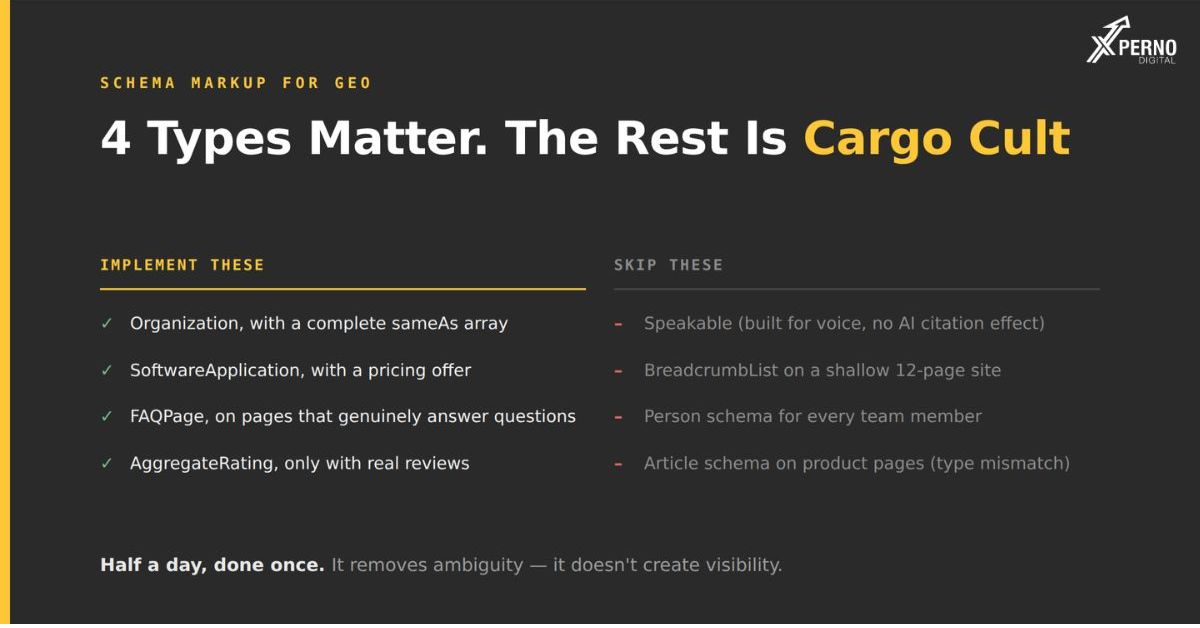
Schema markup does not function as a direct ranking factor for AI answers. What it does is remove ambiguity about your basic facts, which reduces the chance of being described incorrectly or omitted because a model could not parse what you are.
This distinction matters because it sets expectations correctly. Implementing schema will not make you appear in answers you were absent from. It will make the facts you do have unambiguous, which supports everything else.
Think of it as reducing friction rather than creating visibility. A model that can parse your category, pricing and target customer without inferring them from marketing prose is less likely to get them wrong.
Which means schema is worth about half a day, once not a recurring project, and not a line-item worth significant money on an agency invoice.
Which schema types matter for B2B SaaS?
Four types do the work: Organization, Software Application, FAQ Page and Aggregate Rating. Everything else is optional or cargo cult:
1. Organization who you are?
The foundation. Establishes your brand as an entity and connects your various web presences to each other.
jason
- “@context”: “https://schema.org”,
- “@type”: “Organization”,
- “name”: “Your Company”,
- “URL”: “https://yourcompany.com”,
- “logo”: “https://yourcompany.com/logo.png”,
- “description”: “Field service scheduling software for HVAC and plumbing contractors with 10–200 technicians.”,
- “founding Date”: “2019”,
- “same As”:
- “https://linkedin.com/company/your company”,
- “https://x.com/your company”,
- “https://crunchbase.com/organization/your company”,
- “https://g2.com/products/your company/reviews”
The `sameAs` array is the part most implementations omit and the part that matters most. It explicitly declares that these profiles all refer to the same entity. Without it, systems have to infer the connection, and inference sometimes fails particularly if your name is common or similar to another company’s.
The `description` should be your canonical description, used verbatim everywhere else. Category, function and target customer in one sentence.
Place site-wide, typically in the site footer or head.
2. Software Application what you sell?
The type most SaaS sites skip, and the one that actually describes your product.
json
- “@context”: “https://schema.org”,
- “@type”: “SoftwarApplication”
- “name”: “Your Product”,
- “application Category”: “Business Application”,
- “application Sub Category”: “Field Service Management”,
- “operating System”: “Web, iOS, Android”,
- “description”: “Scheduling, dispatch and invoicing for field service teams.”,
- “offers”: {
- “@type”: “Offer”,
- “price”: “49.00”,
- “price Currency”: “USD”,
- “price Specification”: {
- “@type”: “Unit Price Specification”,
- “price”: “49.00”,
- “price Currency”: “USD”,
- “unit Text”: “per user per month”
- “aggregateRating”: { “@type”: “AggregateRating”,
- “ratingValue”: “4.6”,
- “reviewCount”: “127”
On the `offers` block: if your pricing is genuinely custom, you can use `Price Specification` with a `min Price` instead of a fixed figure. What you should not do is omit pricing entirely that leaves no extractable price fact about your product anywhere, which removes you from every query comparing options on cost.
Place on your product and pricing pages.
3. FAQ Page your answers:
Only on pages that genuinely answer questions. Not stuffed onto pages that do not.
- Json
- “@context”: “https://schema.org”,
- “@type”: “FAQ Page”,
- “main Entity”: [{
- “@type”: “Question”,
- “name”: “How long does implementation take?”,
- “accepted Answer”: {
- “@type”: “Answer”,
- “text”: “Implementation takes four to six weeks for teams under 50 users, and eight to twelve weeks for larger deployments requiring custom integrations.”
This pairs directly with answer-first writing. If your page already has question-based headings answered completely in the first sentence, FAQ Page markup is close to free you are declaring in structured form what the page already says in prose.
The answer text should match your visible content. Divergence between markup and page content is a policy violation and can result in structured data being ignored entirely.
4. Aggregate Rating your reviews
Only where you have legitimate reviews. Fabricating these is both detectable and a clear policy violation, and the consequences include losing all rich result eligibility.
Usually nested inside Software Application rather than standalone, as shown above.
What is cargo cult?
Six things commonly implemented that do little or nothing for B2B SaaS:
- Elaborate nested markup on every page: More schema is not better. Four types correctly implemented beats fourteen implemented partially.
- Speak able: Intended for voice assistants, minimally supported, no meaningful effect on AI citation
- Bread crumb List` on a shallow site: Useful for large sites with deep hierarchies. On a twelve-page SaaS marketing site it does nothing.
- How To` on non-instructional content: Google deprecated How To rich results in search. It remains valid markup but the benefit has narrowed considerably.
- Person schema for every team member: Occasionally useful for genuine subject-matter authority signals. Usually not.
- Article` schema on product pages: Type mismatch. Product pages are not articles, and mismatched types create ambiguity rather than removing it.
- The general rule: If you cannot explain what a specific markup type is disambiguating, do not implement it. Schema exists to remove uncertainty about facts. Markup that declares nothing factual adds nothing
How do you implement it?
Use JSON-LD in a script tag, validate it, and check it renders in the live page source.
Format.: JSON-LD is the recommended format and the easiest to maintain. Microdata and RDF a work but are harder to manage.
html
script type=”application/ld+json”
your schema
/script
Platform notes:
WordPress: Yoast, Rank Math or Schema Pro handle Organization and FAQ Page. Software Application usually needs a custom block.
Web flow: Add via the custom code field in page settings or site-wide settings.
HubSpot: Site header HTML in settings, or a custom module.
Custom builds: Render server-side. If schema is injected client-side by JavaScript, some crawlers will not see it.
That last point matters more than it used to. Schema added by a client-side script may be invisible to crawlers that do not execute JavaScript. Check by viewing the raw page source not the rendered DOM in dev tools and confirming your JSON-LD is present.
Validate:
- Google Rich Results Test: Checks eligibility and syntax
- Schema.org Validator: Checks structural validity
- View source and search for `application/ld+json: Confirms it is actually in the served HTML
How much does this matter relative to everything else?
Schema is worth half a day and belongs in the first week, but it is not what produces visibility.
Ordering it honestly against the other work:
- Effort Impact on AI visibility
- Comparison and alternatives pages Highest
- Third-party presence and reviews High
- Extractable facts in page copy High
- Answer-first structure Medium-high
- Schema markup Medium removes friction, does not create visibility
- Core Web Vitals Low
- llms.txt No confirmed effect
A company with perfect schema and no comparison content will not appear in recommendations. A company with strong comparison content and no schema frequently will.
Do it because it is cheap, fast and removes a category of avoidable error. Do not do it expecting it to move the metric on its own
Frequently Asked Questions:
Does schema markup directly improve AI search rankings?
No. It removes ambiguity about your facts, which reduces the chance of being described wrongly or skipped because a model could not parse your page.
Which schema type is most important for SaaS?
Organization with a complete `sameAs` array, followed by SoftwareApplication with a pricing offer. Those two carry most of the value
Can I add schema without a developer?
On WordPress, Web flow and HubSpot, yes plugins or custom code fields handle it. Custom builds usually need developer involvement to render it server-side.
Will incorrect schema hurt me?
Invalid schema is generally ignored rather than penalised. Schema that contradicts your visible page content, or fabricated ratings, can result in structured data being disregarded entirely and rich result eligibility being lost.
Do I need schema on every page?
No. Organization site-wide, SoftwareApplication on product and pricing pages, FAQPage where you genuinely answer questions. That is sufficient.
How often should I update it?
When facts change pricing, categories, new profiles for `same As`. Otherwise, it is set once. Add a check to your quarterly review.