
Review velocity is the rate at which you accumulate new reviews over time, as distinct from your total review count.
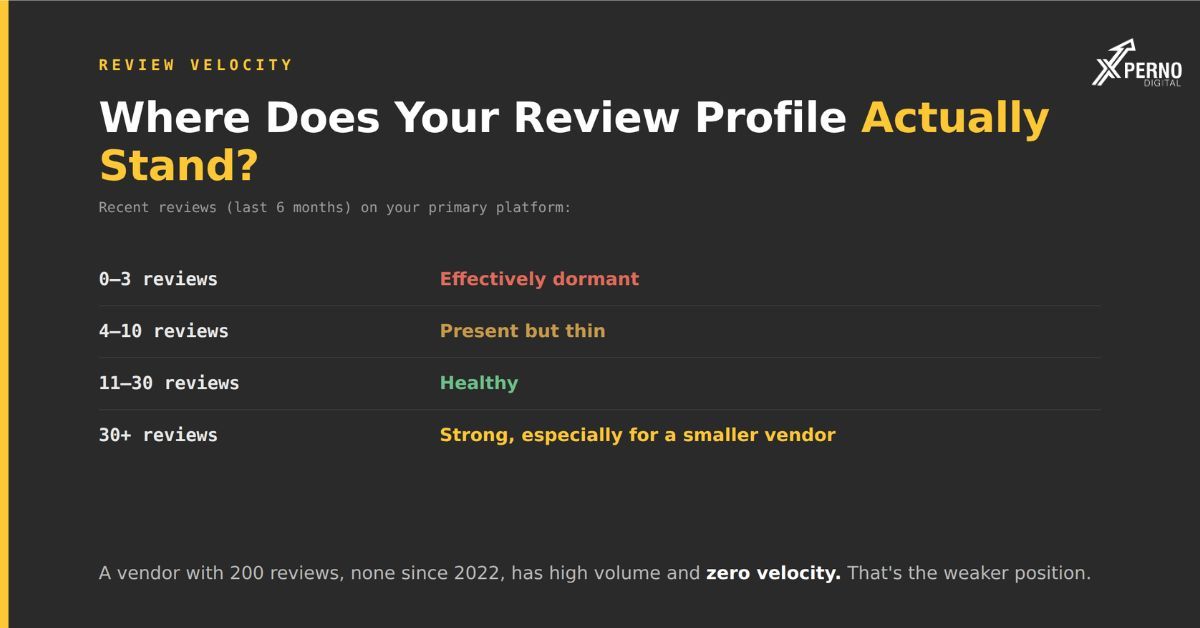
A vendor with 200 reviews, none since 2022, has high volume and zero velocity. A vendor with 45 reviews, twelve of them from the last quarter, has lower volume and healthy velocity.
For AI vendor recommendations, the second position is stronger and for a straightforward reason.
Why does recency matter more than volume?
Recent reviews describe a product that currently exists, and a system assessing current suitability has reason to weight them more heavily.
Software changes continuously. A review from 2021 describes an interface, a feature set and a pricing model that may no longer exist. A model answering “is this good for my situation” needs current information, and old reviews are a weak source for that.
Recency also signals something about the company: A review profile that stopped two years ago suggests a product that may have stopped too declining usage, a company in difficulty, or a team that stopped asking. Neither buyers nor systems weighting sources read that favourably.
Three practical implications:
- Twenty reviews from the last six months does more work than two hundred from four years ago
- A steady flow beats an occasional campaign, even at the same annual total
- A profile that goes quiet loses ground without anything negative happening
How many recent reviews are enough?
There is no threshold, but a rough working target is five to ten new reviews per month on your primary platform.
That produces sixty to a hundred a year, which sustains a healthy profile without requiring a campaign.
More useful than an absolute number: compare against your competitors: Open your category on G2 or Capterra and count how many reviews your three closest competitors received in the last six months. That is your benchmark, because relative position is what determines who gets named.
A Quick Aiagnostic:
- Recent reviews (last 6 months) Position.
- 0–3 Effectively dormant.
- 4–10 Present but thin.
- 11–30 Healthy.
- 30+ Strong, particularly for a smaller vendor.
How do you build steady velocity?
Trigger review requests from events in the customer lifecycle rather than running periodic campaigns.
Campaigns produce a spike followed by silence, which is the pattern you are trying to avoid. Triggered requests produce a flow.
Four triggers that work, in order of response rate:
1. Successful onboarding completion: The customer has just experienced the product working. Satisfaction is at its peak and the experience is fresh enough to write about specifically.
2. A resolved support ticket rated positively: Counterintuitive, but a well-handled problem generates stronger goodwill than no problem at all and it produces reviews that mention responsiveness, which buyers weight heavily.
3. An in-product milestone: They hit a usage threshold, completed a project, saw a result. Ask at the moment of visible value.
4. Renewal: They have just decided you are worth paying for again. The decision is made and top of mind.
Automate it: Most CS and support platforms can trigger an email or in-app prompt on these events. A manual quarterly push will not survive a busy quarter, which is exactly how profiles go dormant.
Make it frictionless: Link directly to the review form for a specific platform, not to the platform homepage. Every additional click loses a meaningful share.
Ask one platform at a time: Sending someone to three sites produces reviews on none.
What about incentives?
Small tokens of appreciation are generally permitted where disclosed. Payment tied to positive sentiment is not, and it is detectable.
Platform rules vary and change, so check the current terms rather than assuming. Broadly:
Generally acceptable: A small gift card or charitable donation offered to everyone who leaves a review, regardless of what they write, with the incentive disclosed.
Not acceptable: Incentives conditional on a rating, incentives offered only to customers you expect to be positive, or reviews written by employees without disclosure.
Why selective solicitation fails even when it is not caught. Asking only your happiest customers produces a rating distribution that is visibly abnormal. A profile of exclusively five-star reviews reads as filtered to buyers, who discount it, and as a source, where uniform sentiment carries less information than a spread.
A 4.4 average with some critical reviews is a stronger asset than a 4.9 with none. It is more credible, it is more useful to a system weighing sources, and it survives scrutiny
Should you ask unhappy customers?
Ask everyone. A negative review handled well is worth more than its absence.
This is uncomfortable advice and it is correct for three reasons.
Selective solicitation is against most platform policies and produces the abnormal distribution described above.
Negative reviews make positive ones believable. A buyer reading only praise assumes filtering. A buyer reading a fair criticism followed by a substantive vendor response learns something about how the company operates.
Your response is crawlable content. A model reading your listing sees both the criticism and the handling. “That was a real problem, we fixed it in March, here is the changelog” or “that is still true and it is not on our roadmap” does more for credibility than any marketing copy.
How to respond: acknowledge the specific issue, state what changed or honestly that it has not, no defensiveness, no explaining why the customer was wrong. Respond to every negative and neutral review.
How do you track it?
Track new reviews per month per platform, and compare against your three closest competitors quarterly.
What to record monthly:
- Metric Why?
- New reviews this month, per platform The input you control
- Rolling six-month count Smooths monthly variation
- Rating distribution Watch the shape, not just the average
- Competitor six-month counts Relative position is what matters
- Response rate to negatives Your handling, visible publicly
What not to expect? direct referral traffic from review platforms to correlate with AI visibility gains. The mechanism runs through the model rather than through a click, so referral numbers will understate the effect considerably.
Timeline: review presence takes four to six months to affect AI visibility meaningfully. Reviews need to accumulate, be indexed, and shift the aggregate picture. This is slow work with a durable result, which is why most companies skip it and why it stays available.
Frequently Asked Questions:
How many reviews do I need to be recommended by AI?
There is no threshold. Relative position matters more compare your last six months against your closest competitors’ last six months.
Is it better to have reviews on one platform or several?
Two platforms done properly beats five done thinly. Check which platforms appear in AI citations for your category and concentrate there.
Can I ask customers to leave positive reviews?
You can ask customers to leave reviews. Specifying positive ones, or asking only customers you expect to be happy, violates most platform policies and produces a distribution that reads as filtered.
What if we get a wave of negative reviews?
Respond to each substantively, address the underlying cause, and keep asking everyone. A dip followed by recovery and visible responses reads better than a profile that went silent.
Do paid platform tiers improve AI visibility?
Not directly. Paid tiers affect placement on the platform itself. Citation likelihood depends on the review data volume, recency, ratings, written content.
How long before review velocity affects AI recommendations?
Four to six months. It is the slowest component of off-site work and the most durable.