
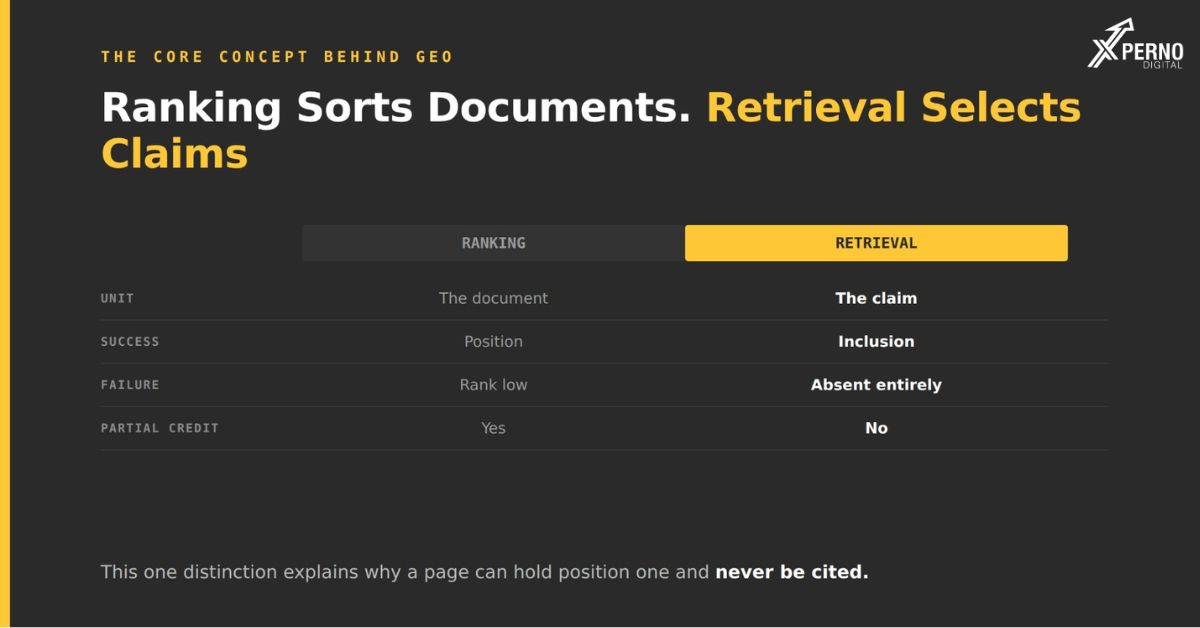
Ranking sorts documents by relevance to a query and returns an ordered list. Retrieval selects specific claims from documents and uses them to construct an answer.
The unit is different. Ranking operates on pages; retrieval operates on statements within pages.
That single distinction explains most of what otherwise looks arbitrary why a page can hold position one and never be cited, why comprehensive guides underperform narrow ones, and why the same content strategy produces good rankings and no AI visibility
How does ranking actually work?
Ranking evaluates whether a document as a whole is a good answer to a query, then orders documents against each other.
The mental model is a sorted list. A system assesses hundreds of signals relevance, authority, engagement, freshness, technical health and produces an ordering.
What this rewards:
Comprehensiveness, because covering the query fully signals a good answer
Authority at the domain level, since trust transfers across a site
Being better than other documents, since the output is comparative
Matching the intent behind the query as a whole
The failure mode: Ranking low. You are still on the page, still visible, still gettable. Position eight produces fewer clicks than position one, but it produces some.
How does retrieval work?
Retrieval selects passages that contain claims usable for constructing an answer, then synthesises across them.
The mental model is different. The system is not asking “which document is best.” It is asking “which specific statements can I extract, attribute and combine into a response.”
What this rewards:
- Self-contained claims that make sense without surrounding context
- Specificity a number, a boundary, a condition
- Corroboration across independent sources, since synthesised answer weighs evidence
- Direct match to the specific question, not the general topic
The failure mode: Absence. In an answer naming four vendors there is no position five. You are in or you are not, and there is no gradient.
Why does a top-ranking page get skipped?
Because the page is a good document and does not contain a good claim.
Four specific ways this happens:
The answer is distributed. Your page answers the question thoroughly across four paragraphs. No single sentence states it completely, so nothing can be lifted cleanly.
The page covers the topic, not the query: It ranks for “project management software” because it covers the category well. The query asked was “best project management tool for a 50-person agency,” and nothing on the page addresses that specific situation.
The claims are hedged into uselessness: “Costs vary depending on your requirements” is accurate and unusable. A competitor stating “$15–$60 per user per month depending on seat count and tier” gets cited instead.
Nothing corroborates it: A claim existing only on your domain is one self-interested data point. Retrieval systems weigh evidence, and a single unsupported source is weak evidence regardless of where the page ranks.
Do the two systems overlap?
Substantially. Retrieval usually operates on a candidate set that ranking helped assemble, which is why traditional SEO remains a prerequisite.
Worth being precise, because “GEO replaces SEO” and “GEO is just SEO” are both wrong.
Where they overlap:
- A page that cannot be crawled fails at both
- A page that ranks nowhere is unlikely to enter the retrieval candidate set at all
- Clear structure and genuine usefulness serve both
- Technical health is a shared foundation
Where they diverge:
- Ranking: Retrieval
- Unit: The document / The claim
- Success: Position /Inclusion
- Failure: Rank low / Absent entirely
- Rewards: Comprehensiveness / Extractability
- Authority from Domain signals, links / Consensus across sources
- Partial credit: Yes / No.
The engines differ in how much each mechanism applies. Google AI Overviews draw predominantly from ranking pages, so ranking matters most there. Perplexity retrieves live and weights recency and specificity more. ChatGPT blends trained knowledge with retrieval depending on the query.
What changes about how you write?
Write so that individual claims can be lifted, rather than so that the document as a whole is comprehensive.
Four practical consequences:
Structure by question, not by topic. Every heading a question a buyer would ask, answered completely in the first sentence beneath.
Prefer specific to safe. A hedged statement is unusable. If a figure varies, state the range and what drives the variation that is a claim; “it depends” is not.
Narrow beats broad. A page addressing one specific situation outperforms a comprehensive guide for the queries that describe that situation. This is where a smaller company can win.
Get corroborated. No amount of on-domain writing substitutes for independent sources describing you consistently. Retrieval weighs evidence across sources; you control one of them.
Does this mean comprehensive content is dead?
No. Comprehensive content still ranks. It simply needs to be comprehensive and extractable, which is a structural change rather than a length change.
The mistake is reading this as “write shorter.” Length is not the variable claim density is.
A well-built long page covers many sub-questions, each answered completely in a self-contained sentence, then expanded. It is long because there are many claims, not because each claim is padded.
A badly built long page restates one point at length, buries the answer, and hedges the specifics. It may still rank. It will not be cited.
The test: Cut the page by 30%. Did you lose any checkable claims? If not, that 30% was serving neither system.
Why does this concept matter?
Because it predicts which work will pay off, which is more useful than any tactic list.
Once you hold the distinction, most decisions resolve themselves:
- Should we publish twelve more blog posts? Only if they contain claims nothing else contains.
- Should we build a comparison page? Yes it contains exactly the comparative claims these queries need.
- Should we chase the category head term? Probably not; it rewards accumulated presence rather than any single document.
- Should we gate our pricing? Not without accepting that no extractable price fact will exist about you anywhere.
- Should we invest in review platforms? Yes corroboration is a retrieval signal that on-site work cannot replicate.
And it sets expectations correctly. Work that improves ranking shows up in weeks. Work that improves retrieval shows up in weeks for the on-site portion and months for the corroboration portion. A team expecting both on the same timeline will conclude the second half failed.
Frequently Asked Questions:
Is retrieval replacing ranking?
No. They coexist, and retrieval frequently operates on a candidate set that ranking helped assemble. Ranking remains the entry ticket for several engines.
Can I optimise for both at once?
Yes, and you should. Clear structure, specific claims and genuine usefulness serve both. The additions for retrieval are extractability, comparative framing and third-party corroboration.
Which engines rely most on ranking?
Google AI Overviews draw predominantly from ranking pages. Gemini grounds in Google’s index. Perplexity retrieves more independently and weights recency higher.
Does this mean short content is better?
No. Claim density matters; length does not. A long page with many self-contained claims works well.
Why is my comprehensive guide not cited?
Usually because it answers the topic rather than the specific query, or because the answer is distributed across paragraphs rather than stated in a liftable sentence.
How do I know if my content is extractable?
Copy the first sentence under any heading and read it alone. If it still states a complete, specific fact, it can be lifted.