
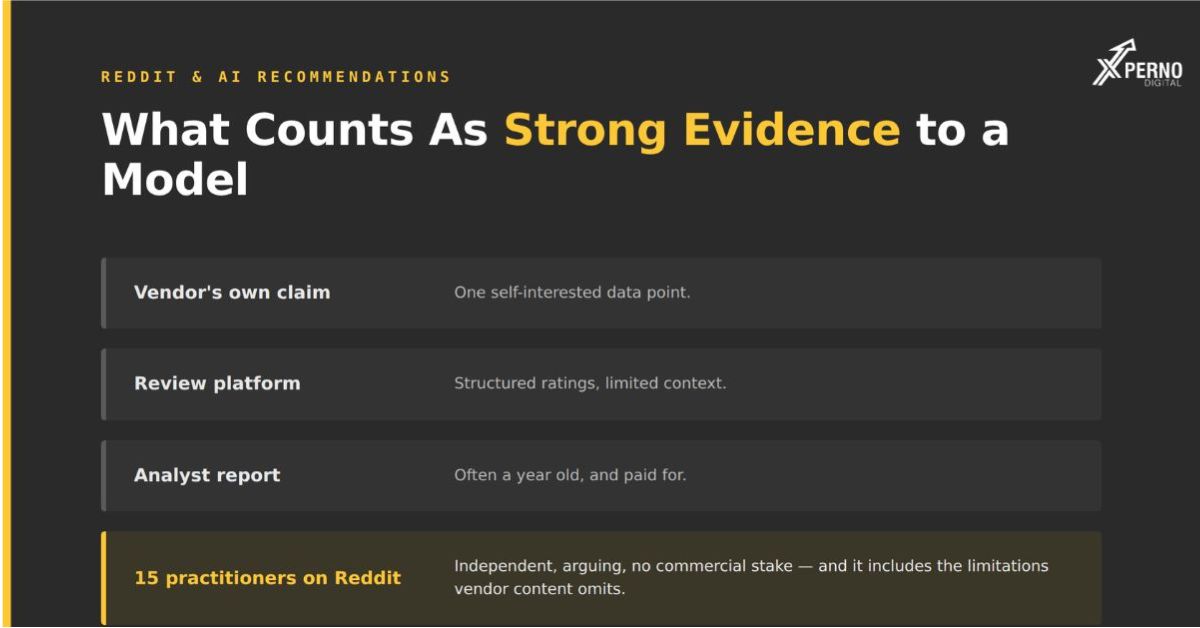
Reddit influences AI recommendations because multiple independent practitioners converging on the same view is unusually strong evidence for a system trying to assess which tool is actually good.
Consider what a model has to work with when deciding which software to recommend. A vendor’s own claim is one self-interested data point. A review platform gives structured ratings but limited context. An analyst report may be a year old and paid for.
A thread where fifteen people who use the product daily independently recommend it with caveats about who it does not suit, arguments between them, and specifics about their situations is a different quality of evidence entirely.
It is hard to fabricate at scale. The participants have no commercial stake. And it includes the limitations that vendor content omits, which is precisely the information a buyer needs.
That combination is why it gets weighted heavily.
Is Reddit actually cited that often?
Reddit appears frequently in citations for software recommendation queries, particularly in technical and developer-adjacent categories.
You can verify this in your own category in about ten minutes rather than taking it on faith.
Run five buyer-intent prompts in Perplexity which displays its sources and count how often Reddit threads appear among the cited URLs. Then do the same for two adjacent categories.
What you will typically find?
- Heavy presence in developer tools, technical infrastructure, and anything with a practitioner community
- Moderate presence in general B2B software
- Lighter presence in enterprise categories where discussion happens in private channels rather than public forums
If Reddit is not being cited in your category, this post matters less to you. Check before investing.
What makes a thread useful to a model?
Threads that get cited share four characteristics: specificity, disagreement, context and recency:
- Specificity: “We switched from X to Y for our 40-person field service team and here’s what broke” is far more useful than “Y is great.” The first contains extractable, conditional information. The second contains sentiment.
- Disagreement: A thread where people argue about which tool suits which situation is more informative than one where everyone agrees. Disagreement produces the boundary conditions who it works for and who it does not.
- Context about the person: Company size, industry, use case, what they were using before. This is what allows a model to match a recommendation to a specific asker’s situation.
- Recency: A 2021 thread about software describes a product that may no longer exist in that form. Recent threads carry more weight, and a subreddit where your category was last discussed three years ago contributes little.
Why astroturfing backfires?
Astroturfing is detectable, communities punish it severely, and the reputational damage exceeds the invisibility it was meant to fix.
The temptation is obvious. If threads influence recommendations, why not create them?
Three reasons it fails:
- It is detectable: New accounts, promotional language patterns, suspiciously similar phrasing, comment histories that exist only to recommend one product. Reddit users are unusually good at spotting this — it is close to a community sport — and moderators ban aggressively.
- The exposure is public and permanent: When astroturfing surfaces, it becomes its own thread. “Company X was caught faking recommendations” is now the content associated with your brand, and it will be cited too. You have converted invisibility into negative visibility.
- It produces the wrong content anyway: Fabricated recommendations read as promotional, which means they lack the specificity and caveats that make real threads useful. Even if undetected, they are weak input.
There is also a straightforward business argument: the effort required to astroturf convincingly, sustained over a year, is comparable to the effort of participating honestly and one of them carries no risk.
What actually works?
Have people who genuinely use and understand your product participate honestly, with affiliation disclosed, over a long period.
That is the whole method. It is slow, it does not fit a campaign structure, and it is why most competitors will not do it.
The practical version:
1. Identify where your category is actually discussed: Not just the obvious subreddit. Practitioner communities r/sysadmin, r/msp, r/accounting, r/ecommerce, r/devops are frequently more relevant than a category-specific sub with 4,000 members.
2. Have the right person participate: Ideally someone technical or customer-facing who genuinely knows the product and the problem space. A marketer who has never used the product will be obvious within two comments.
3. Disclose affiliation, always: Most subreddits permit vendor participation if it is disclosed and useful. Undisclosed participation is what gets banned. A flair or a line in the comment “disclosure: I work at X” is usually sufficient and costs nothing in credibility. It often gains some.
4. Answer questions where your product is not the answer: This is the part that makes the rest work. Someone asks about a problem your product does not solve; you tell them what would solve it. That single behaviour establishes you as a useful participant rather than a vendor account, and it is what earns the standing to mention your product when it genuinely fits.
5. Do not respond to every mention of your category: A pattern of appearing in every thread within an hour reads as monitoring, which it is. Selective, substantive participation is better than comprehensive presence.
6. Read the subreddit rules: They vary enormously. Some ban vendor participation entirely, some have designated self-promotion threads, some are permissive. Getting banned from the main community in your category is an expensive mistake.
What about the negative threads?
Respond to substantive criticism directly and honestly and leave the rest alone.
Your product will be criticised in these communities. Some of it will be fair, some outdated, some unfair.
Worth responding to: Factual inaccuracies (politely corrected, with evidence), a genuine problem you have fixed since, or a criticism you can acknowledge honestly.
Not worth responding to: General dislike, competitor employees, anything where the response would be defensive.
How to respond: Acknowledge the specific issue, state what changed or that it has not, no marketing language. A vendor who says “that was a real problem, we fixed it in March, here’s the changelog” or “that’s still true and it’s not on our roadmap” does more for credibility than any amount of promotion.
This matters beyond the individual thread. The response is part of the crawlable content. A model reading a critical thread sees both the criticism and how the company handled it.
How long does this take to matter?
Twelve months, realistically. This is the slowest component of off-site work.
Community presence cannot be accelerated. Accounts need history. Contributions need to accumulate. Threads need to age and be indexed. A vendor who appears in a community and starts recommending their product in week two has achieved nothing except suspicion.
A realistic sequence:
- Months 1–3: Participate, answer questions, mention your product rarely or never. Build standing.
- Months 4–8: Established as a useful participant. Product mentions where genuinely relevant become normal rather than notable.
- Months 9–12+: Organic mentions by other users begin which is the actual goal. Your participation was never the point; making the product known to people who then recommend it independently is.
The last point is worth emphasising. The value is not your comments. It is other people’s. Your participation makes the product known to practitioners; their independent recommendations are what carries weight with these systems.
Is this worth doing?
- Worth it if: Your buyers are technical or practitioner-level, your category has an active community, and Perplexity cites Reddit threads when you run your buyer prompts.
- Probably not worth it if: Your buyers are enterprise executives who do not participate in public forums, your category has no meaningful community presence, or your prompt testing shows Reddit is not being cited in your space.
- The honest assessment: This is a twelve-month effort with no guaranteed return, and it competes for attention with comparison pages and review presence, which produce results faster and more predictably. If you have limited capacity, do those first. Add community participation when the faster work is done.
It depends on whether your category is discussed on Reddit at all, which you should check before investing.
Frequently Asked Questions:
Can I pay Reddit users to recommend my product?
No. It violates platform rules, it is detectable, and when it surfaces it becomes the content associated with your brand.
Should I create a subreddit for my product?
Only if you have enough users to sustain it. An empty branded subreddit signals a product nobody discusses. Participating in existing practitioner communities is more valuable.
Do Reddit comments get indexed and cited?
Yes. Public Reddit content is crawled and appears in AI citations, particularly for practical and comparative questions.
How do I know if Reddit matters in my category?
Run five buyer prompts in Perplexity and count Reddit threads in the cited sources. Ten minutes, and it answers the question for your specific market.
What if we get criticised unfairly?
Respond once, factually, without defensiveness or not at all. Arguing publicly with a critic produces a longer thread about the criticism, which is the opposite of the goal.
Is this faster than other off-site work?
No, it is the slowest. Review platform presence and roundup inclusion produce results in four to six months. This takes twelve.