
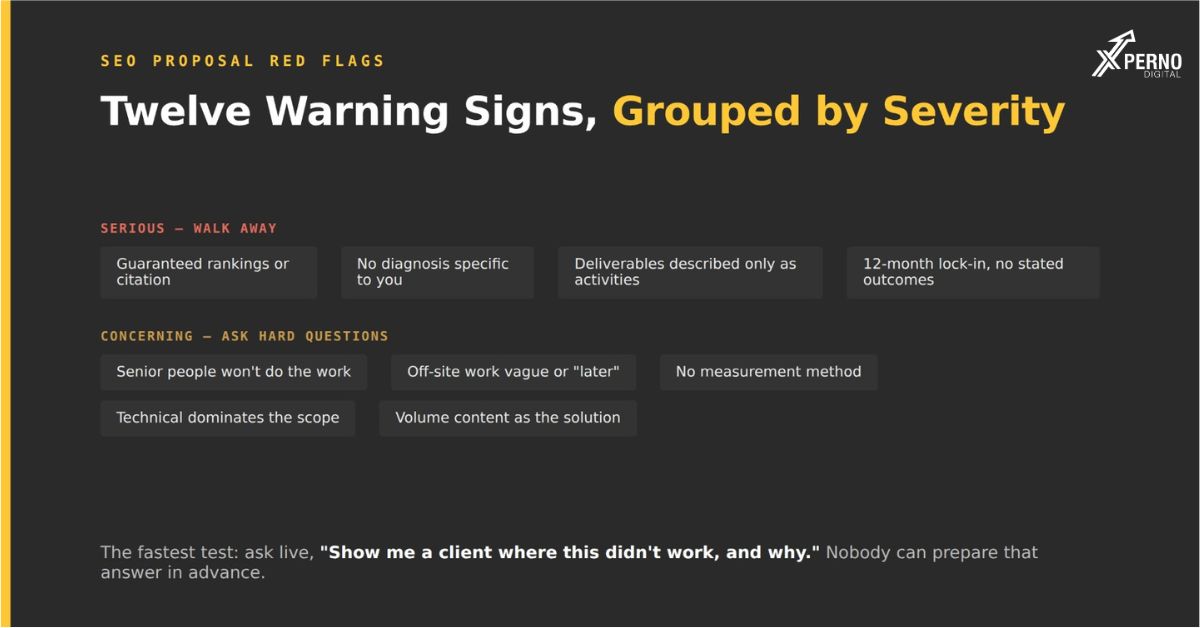
The clearest warning signs in an SEO or GEO proposal are guarantees, vague deliverables, and an absence of anything specific to your business because all three indicate the proposal was templated rather than scoped.
Twelve specific red flags follow, grouped by severity. For each there is a note on why it matters and what a defensible version looks like.
We write these proposals, so this is not disinterested advice. It is, however, correct, and the same tests apply to us.
Serious: walk awa:
1. Guaranteed rankings or guaranteed AI citation:
Nobody controls Google’s index or Chat GPT’s outputs. A guarantee is either meaningless guaranteeing rankings for terms nobody searches or it implies tactics you would not approve of.
A defensible version: Stated expectations with a timeline and stated uncertainty. “Movement on alternatives and comparison queries within 8–14 weeks; the generic category query is not realistic in your category and here is why.”
2. No diagnosis specific to your business:
If the proposal could be sent to any company in any category with the name changed, nobody looked at your situation.
The test for GEO specifically: Does it contain screenshots of actual AI outputs for your actual category? If not, nobody ran the check they wrote about the concept.
A defensible version: A diagnosis specific enough that it could not apply to another company. “You are absent from all four comparison prompts; competitors A and B appear in every one; the sources feeding those answers are these three roundups and G2, and you are missing from all four.”
3. Deliverables described only as activities:
“Ongoing SEO optimisation.” “Content creation.” “Link building.” These describe effort, not output. You cannot tell whether you received them.
A defensible version: Countable deliverables. “Four comparison pages, one alternatives page, schema implementation, ten outreach approaches per month, monthly prompt testing across 20 queries.”
4. A twelve-month lock-in with no stated outcomes:
Some commitment is reasonable this work takes months. A year with no exit and no defined outcomes is a commercial structure rather than a delivery requirement.
A defensible version: A six-month initial term with a stated notice period, and defined deliverables per month so you can tell whether it is working.
Concerning: ask hard question:
5. The senior people in the room will not do the work:
Common enough to be near-universal. Senior people sell; junior people deliver; the client discovers this in month three.
Ask: Who specifically works on this account, what is their experience, and how much of their time do we get?
6. Off-site work is vague or scheduled for “later”
Four of the six most-cited source types in AI recommendations are not on your domain. Off-site work has a four-to-six-month lead time. If it does not start in month two, it will not land within a year.
Ask: What off-site activity happens, in which month does it start, and how is it measured?
7. No described method for measuring AI visibility:
This is the most revealing current question. Most agencies have not built a method yet, and saying so honestly is far better than pretending.
A defensible version: A fixed prompt set, run in fresh sessions across named engines, with share of voice calculated and a sample tracking sheet they can show you.
Concerning: We use a tool” with no further detail, or precise-sounding figures with no stated methodology.
8. Technical work dominates the scope:
If technical is more than about 15% of the effort, you are buying a technical audit with GEO branding. Technical work removes blockers; it does not create citation.
Ask: How does effort split across diagnosis, content, technical, off-site and reporting?
9. Volume content as the primary solution:
Twelve blog posts a month will not fix absence from comparison queries. If your existing content did not produce visibility, more of it will not either the constraint is content type, not quantity.
A defensible version: Fewer pieces, weighted toward comparison, alternatives, use-case and original data.
Worth Noticing:
10. Speculative deliverables priced as significant line items
llms.txt implementation is the current example. There is no confirmed evidence major AI systems read it. It costs an hour and does no harm but if it appears as a meaningful line item, that tells you something about the rest of the proposal.
11. No mention of what will not work:
Every category has queries that are not winnable and tactics that will not apply. A proposal presenting universal success has not engaged with your specific competitive position.
A defensible version: A section stating what is out of scope, what is unlikely to move, and why.
12. Case studies with no numbers or no context:
“Increased traffic by 300%” without a starting point, a timeframe, or a category tells you nothing. Three visitors to twelve is 300%.
A defensible version: Starting position, timeframe, what was done, what moved, and honestly what did not.
What does a good proposal contain?
Seven elements. A proposal missing several has not been scoped.
1. A diagnosis specific to you, including evidence screenshots, citation analysis, competitor comparison
2. Countable deliverables, month by month
3. A stated effort split across diagnosis, content, technical, off-site and reporting
4. An honest timeline, including the phase where nothing visible happens
5. A named measurement method, with a sample of what reporting looks like
6. What is out of scope , and what is unlikely to work in your category
7. Named people who will do the work
What matters less than people think: Length, design, the number of slides, award badges, and logo walls. A four-page proposal with all seven elements beats a forty-page deck with three
What questions expose a weak proposal fastest?
Three Questions, asked live rather than in writing:
“Show me a client where this did not work, and tell me why.” Everyone has failures. An agency claiming a perfect record is either new or not being straight. The explanation reveals how they diagnose problems.
“What would make you tell us not to hire you?” An inability to name any condition suggests either no judgement or no willingness to exercise it.
“What do you think is overhyped right now in this field?” Someone who genuinely works in this has opinions about what is being oversold. Enthusiasm for everything means either they are not paying attention or they sell whatever is currently easiest.
The value of asking these live is that they cannot be prepared for in the way a proposal can.
Frequently Asked Questions:
Is a low price itself a red flag?
Not necessarily, but ask what is excluded. Cheap quotes typically omit off-site work, genuine diagnosis, or content production the components that matter most.
Should an agency provide a free audit?
A short diagnostic is reasonable and many do. A complete strategy for free is not, and an agency giving one away before any commitment may be undervaluing the work.
How long should a proposal be?
Long enough to contain the seven elements. Four to eight pages is typical. Length correlates poorly with quality.
Is it a red flag if they cannot promise results?
The opposite. Honest uncertainty about outcomes, paired with specific commitments about deliverables, is what a well-scoped proposal looks like.
Should I get multiple proposals?
Three is usually enough and ask each to price the same defined scope, or the quotes will not be comparable.
What if the proposal looks fine but something feels off?
Ask the three live questions above. Proposals are the most rehearsed artefact in the process; live answers are the least.