
Evaluate an SEO agency on the specificity of their answers to uncomfortable questions, not on the quality of their case studies or the polish of their proposal.
Case studies are selected. Proposals are templated. What is difficult to fake is a detailed, specific answer to a question the agency did not prepare for particularly a question about their own limitations.
The questions below are grouped by what they reveal. For each one there is a note on what a good answer sounds like and what should concern you.
We are an agency. Several of these are questions we would find uncomfortable, and we have flagged which ones. Ask them of us too.
Questions About The Work Itself:
1. What specifically will change in the first 90 days, and how will I know?
Good answer: A distinction between output and outcome. “In 90 days, you will have six comparison pages built, schema implemented and a measurement baseline established. You should see movement on alternatives queries, not on head terms. Here is how we will show you.”
Concerning: A list of activities with no expected outcomes attached, or outcomes promised on a timeline that ignores how retrieval works. Anyone promising the generic category query in 90 days is telling you what you want to hear.
2. Who is actually doing the work?
Good answer: Named people, their role, and how much of their time you get.
Concerning: Vagueness. The common failure pattern is senior people selling and junior people delivering, with the client discovering this in month three. Ask directly whether the person in the room will be on the account.
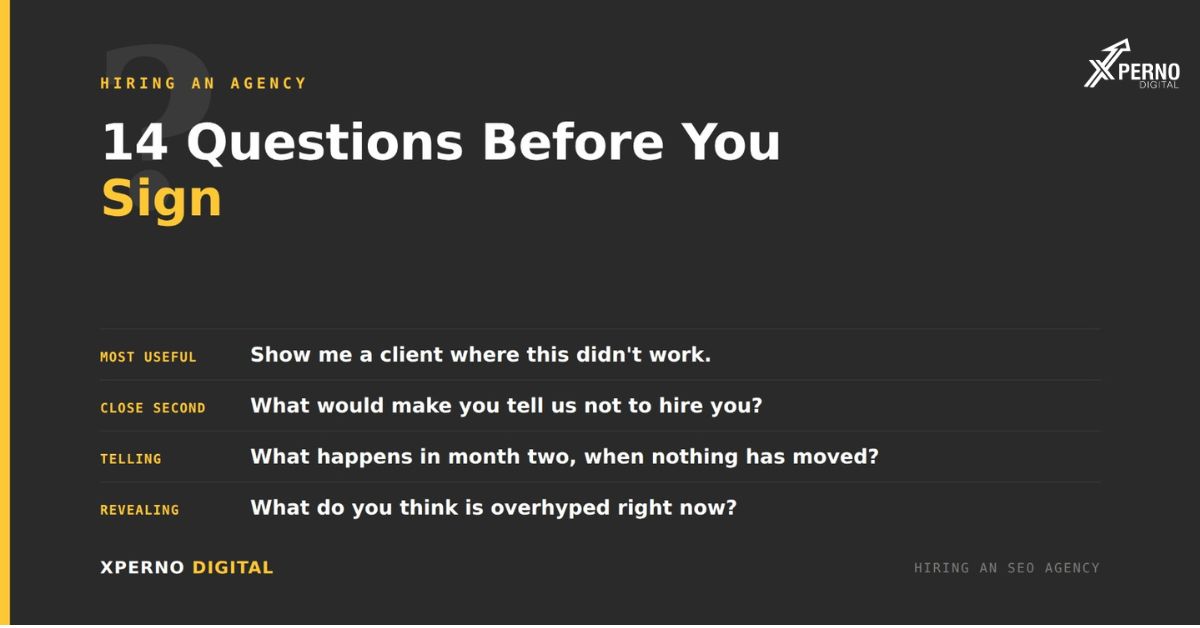
3. What does your process look like in month two, when nothing has moved yet?
Good answer: An acknowledgement that this phase exists, and a plan for what you will see during it evidence of output rather than evidence of results.
Concerning: Denial that the flat phase exists. Content and structural work takes weeks to be crawled and incorporated. An agency that has not warned you about this in advance will face the same conversation in month two with less credibility.
4. How do you measure AI visibility specifically?
Good answer: A described method. A fixed prompt set, run in fresh sessions, across named engines, with share of voice calculated. They should be able to show you a sample tracking sheet.
Concerning: “We use a tool” with no detail about method, or precise-sounding figures with no stated methodology. This is a current, revealing question most agencies have not built a method yet, and admitting that is far better than pretending.
5. What off-site work happens, and when does it start?
Good answer: Specific activities with a start date in the first two months. Review platform strategy, roundup outreach, community participation.
Concerning: Off-site work described vaguely or scheduled for “later.” Third-party presence has a four-to-six-month lead time. If it does not start in month two, it will not land within a year.
Questions About Their Track Record:
6. Show me a client where this did not work, and tell me why?
This is the most useful question on the list.
Good answer: A specific story. The category was too entrenched, the client would not build comparison content, the product had no genuine differentiation, the engagement ended early. The explanation reveals how they diagnose problems.
Concerning: A claim of a perfect record. Everyone has failures. An agency that will not name one is either new or not being straight, and both are worth knowing.
7. What kind of company are you a bad fit for?
Good answer: A real answer. Pre-product-market-fit companies, categories with entrenched incumbents, businesses that will not name competitors, clients wanting results in eight weeks.
Concerning: “We work with everyone.” An agency with no disqualification criteria has not thought about where they add value and will take your money regardless of fit.
8. Have you worked in our category, and what did you learn?
Good answer: Either relevant experience with specifics, or an honest “no, and here is how we would get up to speed.” Category experience is useful but not essential.
Concerning: Claimed expertise that dissolves under a follow-up question. Ask what the buying cycle looks like in your category, or who the main players are. The answer tells you quickly.
9. Can I speak to a current client not a reference you selected?
Good answer: Yes, with an introduction to someone mid-engagement rather than a completed success story.
Concerning: Only completed case studies, or reluctance. A client in month four, in the flat phase, will tell you more about the experience than one who finished happily two years ago.
Questions About The Commercial Relationship :
10. What happens if we want to leave?
Good answer: Clear terms. Notice period, who owns the content, who owns the accounts, what documentation you receive.
Concerning: Long lock-ins, ambiguity about content ownership, or accounts created under the agency’s name that do not transfer. Get all of this in writing.
11. What is the notice period, and why that length?
Good answer: A reason connected to the work. “Ninety days because content in production needs to complete, and we would rather hand over finished work.”
Concerning: Twelve-month minimums with no justification. Some lock-in is reasonable given the timeline of this work; a year with no exit is a commercial structure, not a delivery requirement.
12. What would make you tell us not to hire you?
The second most useful question.
Good answer: Genuine conditions. “If your positioning is not settled.” “If you are not willing to publish comparison content.” “If the budget is better spent on outbound this year.”
Concerning: an inability to name any. It suggests either no judgement or no willingness to exercise it.
Two Questions That Reveal the Most:
13. What do you think is overhyped right now in this field?
Good answer: A specific, defensible view. Someone who genuinely works in this will have opinions about what is being oversold llms.txt as a strategy, GEO as a total reset, precise AI visibility figures with no stated method.
Concerning: Enthusiasm for everything. An agency with no critical view of their own industry is either not paying attention or is selling whatever is currently easiest to sell.
14. Walk me through your last engagement that ended?
Good answer: Why it ended, whether it went well, what they would do differently. Engagements end for many legitimate reasons.
Concerning: Discomfort with the question, or an account where nothing was learned.
What To Ignore?
Four things that look like signals and are not.
Award badges: Most are paid or peer-voted within industry bodies. They tell you about marketing budget.
Client logo walls: A logo means a contract existed, not that it went well or that the same team is still there.
Certifications: Google Partner status and similar reflect spend thresholds and exam completion, not judgement.
A polished proposal: Proposals are templated. The specificity of live answers to unprepared questions tells you more than forty slides.
What To Look For Instead
They ask you difficult questions: An agency that spends the first call diagnosing rather than pitching is doing the work correctly. If nobody asks about your pipeline, your close rates or who else has to approve the decision, they are selling a package rather than solving a problem.
They tell you something you did not want to hear: The most reliable positive signal. An agency willing to say the head query is not winnable in your category, or that organic is not your constraint this year, is prioritising being right over being hired.
Their answers are boring and specific: Real expertise usually sounds mundane. “Comparison pages, schema, review velocity, then wait” is less exciting than a proprietary framework, and it is what the work actually is.
Frequently Asked Questions?
How many agencies should I talk to?
Three is usually enough. The variation in answers to questions 6 and 12 will separate them quickly.
Should I ask for a free audit?
A short diagnostic is reasonable and many agencies offer one. A full strategy for free is not, and an agency that gives away a complete plan before any commitment may be undervaluing the work.
Is a specialist better than a generalist?
For SEO and GEO specifically, usually yes. Generalist agencies spread across paid, social and organic rarely have depth in any of them.
What should this cost?
It varies widely by market and scope. The more useful question is what you are buying — a defined outcome with deliverables, or a monthly subscription to activity. If you cannot articulate the former, the engagement is misspecified regardless of price.
Should I hire in-house instead?
Below roughly 50 employees, a defined project plus a small ongoing effort usually beats a full-time hire who will be underused.
What is the biggest mistake companies make when hiring?
Choosing on proposal quality rather than on the specificity of live answers. The proposal is the most rehearsed artefact in the process and the least informative.