
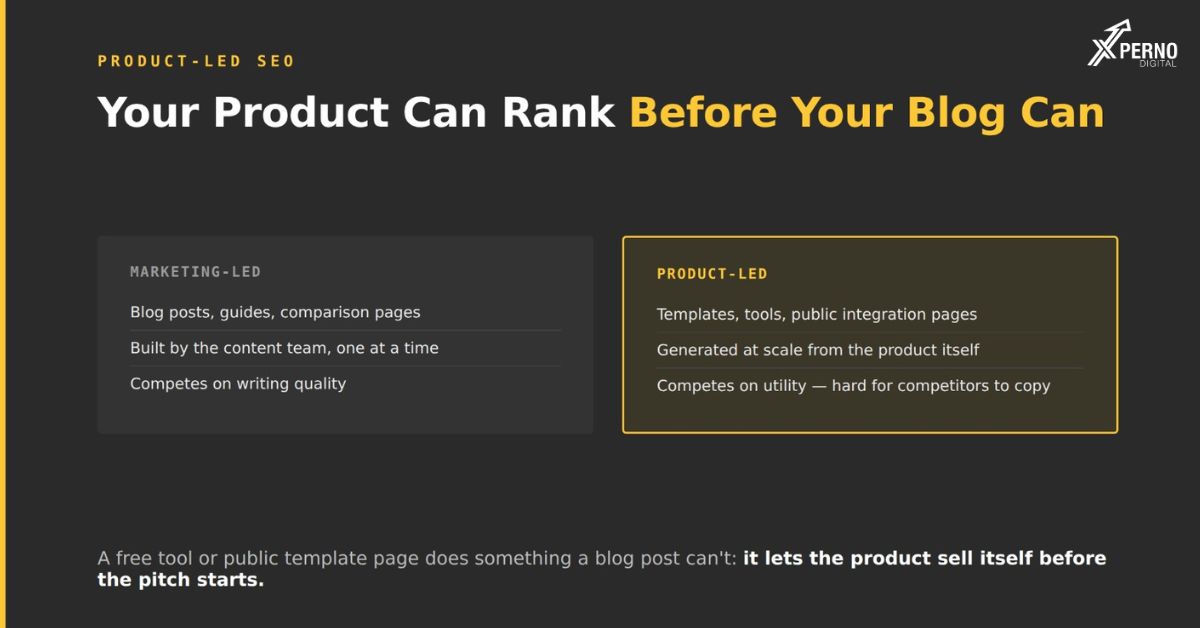
Product-led SEO means building something usable a free tool, a template library, a calculator, a data set that ranks for a query and demonstrates your product in the process.
It is distinct from content marketing in that the asset does something rather than explaining something. A page telling you how to calculate field service margins is content. A calculator that does it is product-led SEO.
Why it works when it works:?
Fewer competitors: Anyone can write a blog post about a topic. Building a working tool requires engineering time, which most competitors will not spend.
It demonstrates rather than claims: Someone who uses your calculator has experienced a small piece of your product’s thinking.
It earns links and mentions naturally: Useful tools get referenced. Blog posts mostly do not.
And for AI citation specifically: These assets frequently contain structured, factual, checkable output which is more extractable than most marketing content.
What actually works?
Four types, each suited to a different situation:
1. Calculators:
Works when: Your buyers do a calculation before purchasing and currently do it in a spreadsheet.
Pricing calculators, ROI models, sizing tools, cost comparisons.
Why it converts?: Someone calculating whether the numbers work is in an active evaluation, not browsing.
The requirement: The calculation must be genuinely useful independent of your product. A “calculator” that returns “contact us for a quote” is a form wearing a costume, and it gets treated as one.
2. Template and asset libraries:
Works when?: Your buyers repeatedly build the same documents or workflows.
Contract templates, checklist libraries, workflow templates, report formats.
Why it works for search?: Each template targets its own query, which makes this a legitimate programmatic play provided each one genuinely differs.
The requirement: The templates must be usable without your product. Gated or partial templates convert worse and earn no links.
3. Free tools:
Works when: There is a discrete job adjacent to your product that people currently do manually.
Validators, converters, generators, analysers.
Why it works?: These earn genuine links, get bookmarked, and produce recurring visits from people in your market.
The requirement: Engineering time, and ongoing maintenance. A free tool that breaks is worse than none.
4. Public data and benchmarks:
Works when: You hold aggregated data your market wants and cannot get elsewhere.
Benchmark reports, index pages, public statistics from your usage data.
Why it is the strongest for AI citation?: Original data is the only content advantage competitors cannot replicate, and it gets cited by name.
The requirement: Enough data to aggregate meaningfully, and honesty about the sample
What is the trap?
Building something useful that has nothing to do with what you sell.
This is the most common failure and it is seductive, because the asset works it ranks, it gets traffic, it earns links.
What it looks like?: A project management SaaS builds a free invoice generator. It ranks well. It brings 8,000 monthly visitors. None of them are buyers, none convert, and the team spends two years maintaining a tool that produces nothing.
The test before building: Would someone who finds this asset genuinely useful also be someone who might buy your product?
If yes: proceed.
If no: You are building a traffic asset for an audience you cannot sell to. Traffic is not the objective.
A stricter version of the test: Does using the asset make your product more obviously relevant? A field service margin calculator makes scheduling software relevant. An invoice generator does not.
How much does it cost?
Considerably more than content, which is both the barrier and the reason it works:
- Asset: Build effort / Maintenance
- Calculator: 2–5 days engineering + design / Low |
- Template library: 1–2 days per template / Low
- Free tool: 1–4 weeks engineering / Ongoing
- Data / benchmark: 1 day analysis, recurring / Annual refresh
The honest assessment for a small team: Free tools are usually out of reach. Calculators are achievable if you have any engineering capacity. Template libraries and data are achievable without engineering at all.
Which is why data is the best starting point for most B2B companies? It requires analysis rather than engineering, you already hold the raw material, and it is the strongest asset type for citation.
Does this work for AI visibility?
Better than most content, for two reasons and with one limitation.
why it works?
Structured, factual output: A benchmark page stating “median field service teams complete 4.2 jobs per technician per day” is extractable in a way that marketing prose is not.
It earns third-party mentions: Useful tools get referenced by others, which builds the corroboration signal that on-site content alone cannot.
The limitation: An interactive tool that generates output client-side may be invisible to crawlers. The tool itself cannot be cited only the content around it.
The fix: Publish the underlying information as static, server-rendered content alongside the tool. If you build a calculator, also publish a page explaining the calculation, the typical ranges, and what drives the variation. That page is what gets cited; the tool is what earns the links.
How do you decide whether to build one?
Four questions. If any answer is no, do not build it:
1. Would a user of this asset plausibly buy your product?
If not, you are building traffic for a non-audience.
2. Is it genuinely useful without your product?
Gated or crippled assets earn no links and convert worse than the honest version.
3. Can you maintain it?
A broken tool is worse than no tool. If nobody owns it in twelve months, do not ship it.
4. Is there an existing query?
Check whether people search for what it does. Building something nobody looks for produces a well-crafted asset nobody finds.
If all four are yes, build the smallest version that works and see whether it earns anything before investing further.
What should a small team do instead?
Start with data, which requires analysis rather than engineering.
For a company without spare engineering capacity, the sequence that works:
First: Publish a benchmark from data you already hold. Aggregated, anonymised, method stated. One day of analyst time, no engineering, and it is the strongest citation asset available.
Second: Build a template library if your buyers repeatedly create the same documents. No engineering, genuinely useful, each template targets its own query.
Third: A calculator, if you have any engineering capacity and there is a calculation your buyers actually do.
Only then: A free tool, and only if you can maintain it.
What not to do?: Start with the most ambitious version. A free tool built in four weeks and abandoned in six months costs more than it returns, and the maintenance burden is the part teams consistently underestimate.
Frequently Asked Questions:
Is product-led SEO better than content marketing?
Different, not better. It has fewer competitors and higher build cost. Most companies need both.
Should free tools require an email?
Gating reduces links, reduces usage, and reduces the mentions that build corroboration. Ungated generally works better unless lead capture is the sole objective.
Can interactive tools be cited by AI engines?
The tool itself usually cannot, if it generates output client-side. Publish the underlying information as static content alongside it that is what gets cited.
How long before a tool ranks?
Similar to any page three to eight months depending on competition. Tools tend to earn links faster, which helps.
What if a competitor copies my tool?
Frequently they will. The advantage is in being first, in maintaining it better, and in the links accumulated meanwhile.
What is the best starting point for a small team?
Original data from your own usage. It needs analysis rather than engineering, you already hold the material, and it is the strongest asset for citation.