
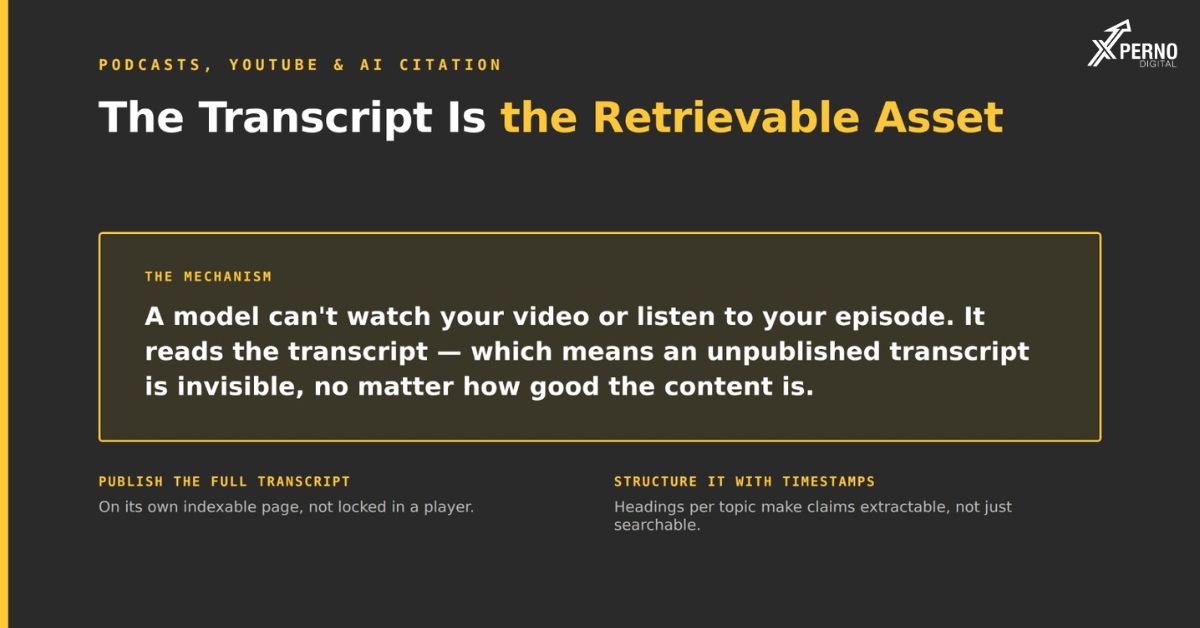
They can, but only through their text transcripts, show notes and descriptions. The audio and video themselves are not what gets cited.
This is the mechanism that determines whether an appearance is worth your time, and it is frequently misunderstood.
What gets indexed?: The transcript, if one is published and crawlable. The show notes. The episode description. Any accompanying article.
What does not?: The audio file. The video itself, in most cases.
The practical consequence: A podcast appearance with no published transcript contributes almost nothing to AI visibility. The same appearance with a full transcript on a crawlable page can be a genuine source particularly if you said something specific in it.
Which formats actually get cited?
Four, in descending order of reliability:
1. Podcast episodes with full published transcripts: The transcript is a text page containing your claims. If it is indexable, it is a source like any other article.
2. YouTube videos with substantial descriptions and accurate captions: YouTube auto-generates captions and they are accessible. Description text is indexed. Both can carry claims.
3. Video content with an accompanying written article: Increasingly common the video is embedded in a page containing a written version. That page is the citable asset.
4. Webinar recordings with published transcripts or summaries: Same mechanism, usually lower reach.
What contributes little?: Audio-only appearances with no transcript, video with auto-captions only and a thin description, and anything behind a registration wall.
Is a podcast appearance worth the time?
It depends almost entirely on whether a transcript gets published which you can find out before agreeing.
Before saying yes, ask three things
- “Do you publish full transcripts?” This single question determines most of the AI visibility value.
- “Is the episode page indexable?” Some podcast sites publish transcripts on pages blocked in robots.txt, which nullifies them.
- “Will the show notes include a description of what we do?” Show notes are short, indexed, and frequently contain the clearest available statement of who you are.
If the answer to the first is no, the appearance may still be worth doing for reach, for the relationship, for the audience but do not count it as visibility work.
A useful ask: Offer to supply a transcript yourself. Many small podcasts do not publish them because it is effort, not because they object. Providing one costs you an hour and turns a non-asset into an asset.
What should you actually say?
Specific, checkable claims because those are what can be extracted from a transcript.
This is the part that separates a useful appearance from a pleasant conversation.
What gets extracted?
“Implementation takes four to six weeks for teams under fifty, and the main variable is how many integrations you need.”
What does not?
“We really focus on making onboarding as smooth as possible for our customers.”
Three habits worth adopting on any recorded appearance:
State your category and customer plainly, once, early. “We do field service scheduling for HVAC contractors with ten to two hundred technicians.” This becomes a clean, extractable statement about what you are.
Use numbers. Any quantity you can state accurately is more usable than any adjective.
Name the boundary. “We are not the right fit for single-operator businesses.” Honest limitations get quoted, and they make everything else you said credible.
Does YouTube work differently?
Somewhat. Descriptions and captions are text, and YouTube’s own search is a discovery channel independent of AI citation.
Three text surfaces on a YouTube video:
The description: Fully indexed, entirely under your control, and usually wasted on a link list. Put a real paragraph describing what the video covers and who it is for.
Captions: Auto-generated ones are usable but imperfect, particularly with product names, technical terms and accents. Uploading a corrected transcript is worth the twenty minutes for anything substantial.
The title: Short, indexed, and the only part most people optimise.
A separate consideration: YouTube is a search engine in its own right, and for technical and how-to queries in B2B it carries real volume. That is a distinct benefit from AI citation and it may justify video work independently.
What does not follow?: That you should start a YouTube channel for AI visibility. The effort-to-return ratio is poor compared with comparison content or review presence.
How does this compare to other off-site work?
Lower reliability, higher effort, but occasionally high value when the transcript is good.
- Activity: Effort / Reliability / Lead time
- Review platform presence: Low, ongoing / High / 4–6 months
- Category roundup inclusion: Medium / High / 3–6 months
- Community participation: High, ongoing / Medium / 12 months
- Podcast with transcript: Medium per appearance/Medium /1–3 months
- Podcast without transcrip : Medium / Very low
Where podcasts genuinely win?: They are among the few formats where a founder can state a position at length and have it published as text. A well-transcribed hour-long conversation contains more specific claims than most companies publish in a quarter.
Where they lose?: Unpredictable, dependent on the host’s publishing practices, and hard to scale.
A reasonable position: Accept appearances that come to you, ask the transcript question, prepare properly. Do not build a podcast outreach programme as your primary distribution strategy.
Should you start your own podcast?
Rarely worth it for AI visibility alone. The written assets are cheaper and more reliable.
The honest maths: A weekly podcast is roughly four to six hours a week including recording, editing, publishing and promotion. That same time produces one substantial comparison page plus a month of outreach, both of which are more reliable.
Where a podcast does make sense?
Demand creation: If your category has no vocabulary, long-form conversation is one of the few ways to teach it. This is a genuine case and it is not about search.
Relationship building: Interviewing prospects and industry figures is a legitimate way to build a network. The content is almost secondary.
Founder positioning: If awareness in your market runs through individuals rather than companies, a podcast attaches a voice to your brand in a way content cannot.
What to do if you start one: Publish full transcripts on indexable pages,and treat the transcript as the primary asset rather than as an accessibility afterthought. That single decision determines whether the work contributes anything to visibility.
Frequently Asked QFDuestions:
Do AI engines listen to podcasts?
No. They read transcripts, show notes and descriptions. An episode with no published transcript contributes almost nothing to citation.
Should I ask podcasts to publish a transcript?
Yes, and offer to supply one. Many small shows skip transcripts because of effort rather than objection.
Do YouTube auto-captions count?
They are accessible and usable, but imperfect with product names and technical terms. Uploading a corrected transcript is worth the time for substantial videos.
Is a podcast appearance worth it without a transcript?
Possibly for reach and relationships. Not as visibility work count it in a different column.
Should I start my own podcast for SEO?
Rarely worth it for that reason alone. It makes sense for demand creation, relationships or founder positioning.
What should I say to maximise the value?
State your category and customer plainly once, use specific numbers, and name a boundary who you are not for. All three get quoted.