
Gemini draws on Google’s index alongside trained knowledge, which makes it the AI engine most closely aligned with traditional search rankings but alignment is not equivalence, and pages that rank well are frequently not the ones cited.
Two mechanisms operate together:
Grounding in Google Search: For queries needing current information, Gemini retrieves from Google’s index. This is why its answers correlate more closely with rankings than ChatGPT’s do.
Trained knowledge: For questions answerable without retrieval, it draws on what the model learned during training, which updates only on model releases.
The practical consequence: Ranking is a strong prerequisite here in a way it is not for Perplexity or ChatGPT. If you rank nowhere for a query, you are unlikely to be cited by Gemini for it. But ranking is the entry ticket rather than the decider among the pages that rank, the ones cited are those containing a clear, extractable answer to the specific question asked.
How is Gemini different from Google AI Overviews?
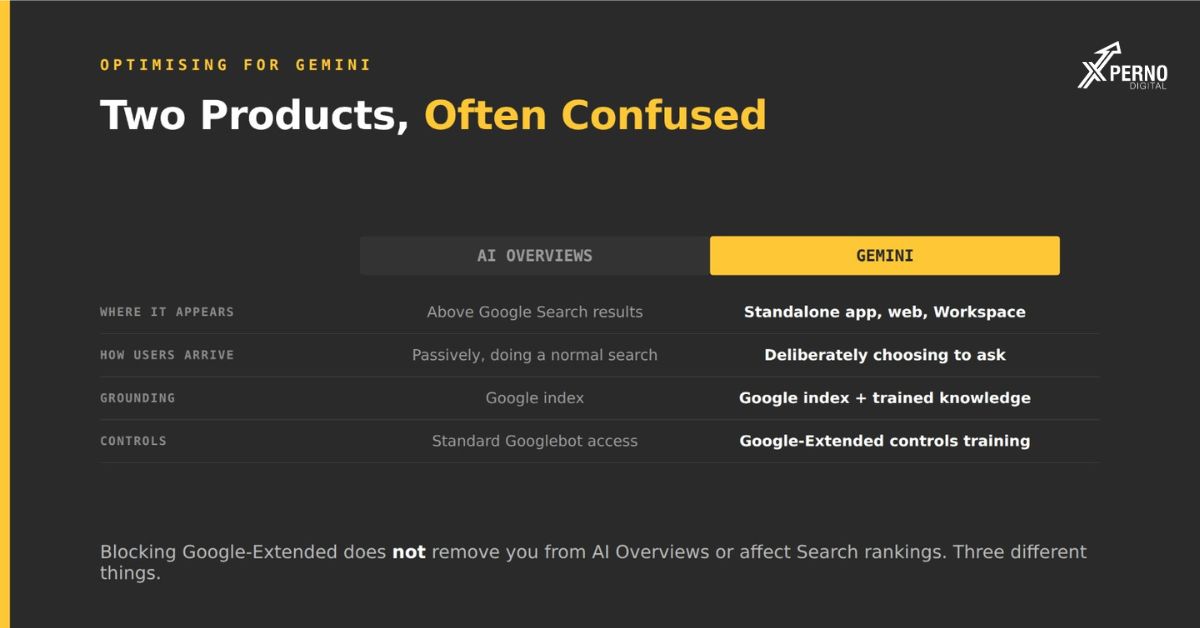
They are separate products drawing on overlapping infrastructure. AI Overviews appear inside Google Search results; Gemini is a standalone assistant.
- AI Overviews Gemini
- Where it appears Above Google search results Standalone app, web, Workspace
- How users arrive Passively, doing a normal search Deliberately, choosing to ask an assistant
- Query style Search-shaped fragments Conversational, longer, situational
- Grounding Google index Google index plus trained knowledge
- Controls Standard Googlebot access `Google-Extended` controls training use
Why the distinction matters practically? AI Overviews reach far more people because they require no deliberate choice. Gemini reaches fewer people but the queries are longer and more specific, which favours narrow, situational content.
The `Google-Extended` confusion is worth clearing up. Blocking `Google-Extended` excludes you from Gemini’s use of your content for training and grounding. It does not affect normal Google Search ranking, and it does not remove you from AI Overviews those use standard Googlebot access. These are three different things and they get conflated constantly.
What should you check first?
Check whether `Google-Extended` is blocked in your robots.txt, then check whether you rank at all for your target queries.
1. Crawler access: Open `yourdomain.com/robots.txt` and look for `Google-Extended`. It is frequently blocked during a legal or security review and never revisited and unlike blocking Googlebot, blocking this has no visible consequence in Search Console, so nobody notices.
Also check your CDN. Cloudflare and others have offered one-click AI crawler blocking, and it has been enabled on a lot of sites by people not thinking about marketing implications.
2. Baseline rankings: Because Gemini grounds in Google’s index, ranking is the prerequisite. If your target queries return nothing from your domain in the first two pages, that is the constraint not anything Gemini-specific.
3. Answer clarity on ranking pages: Where you do rank, check whether the specific question is answered in a self-contained sentence near a heading, or buried in paragraph nine.
What optimisation is genuinely Gemini-specific?
Almost none. Gemini rewards the same characteristics as the other engines, weighted slightly differently.
This is worth saying plainly, because a large volume of content exists claiming otherwise.
What all the engines reward?: Extractable claims, comparative framing, third-party corroboration, current facts, clear structure.
What Gemini weights more heavily than Perplexity or ChatGPT?: Traditional search rankings, and by extension everything that produces them technical health, topical authority, internal linking, links.
What it weights less heavily?: Recency. Perplexity retrieves live for every query and responds to new content faster.
The strategic conclusion: There is no separate Gemini strategy worth building. If you are doing the work that produces rankings and the work that produces citations elsewhere, Gemini is largely covered. What changes is emphasis if your audience skews toward Google Workspace users, traditional SEO deserves more weight in your allocation.
Does Workspace integration matter for B2B?
Gemini’s presence inside Google Workspace puts it in front of business users during their working day, which is a meaningful distribution advantage for B2B specifically.
A buyer researching software in Docs, Gmail or Chrome can ask Gemini without switching context. That lowers the friction of asking, which likely increases how often it happens.
Why this matters for a B2B audience specifically: Your buyers are working in these tools all day. A consumer might choose to open ChatGPT; a business user encounters Gemini in the flow of work.
How much this actually affects vendor discovery is unclear: There is no reliable public data on how often Workspace users ask Gemini vendor-selection questions, and anyone quoting a figure is overstating what is known. The mechanism is plausible and the distribution advantage is real; the magnitude is not established.
What to do about it: Nothing Gemini-specific. Test it monthly alongside the other engines and let the results tell you whether it matters in your category.
How do you test Gemini?
Add it to your existing monthly prompt set. Same prompts, same conditions, three runs on your most important queries
Testing conditions that matter:
- Fresh conversation each time. Prior context contaminates results.
- Signed out, or in a consistent account state. Gemini personalises based on account activity, which means your results as a logged-in user of your own product will differ from a prospect’s.
- Same phrasing every month. Changing wording destroys the comparison.
- Three runs on your top five prompts. Output is variable; a single result is an anecdote.
What to record?: Whether you appeared, position in the answer, which competitors appeared, and any factual claims made about your product.
One thing to watch: Because Gemini grounds in Google’s index, a change in your rankings will show up here before it shows up in ChatGPT. That makes it a useful early indicator movement in Gemini often precedes movement elsewhere
What if you appear in Gemini but not ChatGPT?
That pattern usually means your on-site SEO is working and your off-site presence is thin.
This is the most common divergence for companies with a decent content operation.
The reasoning: Gemini can find you because you rank. ChatGPT relies more on accumulated presence across many independent sources, and if nothing outside your domain corroborates you, it has little to work with.
The fix is off-site: Review platform presence, category roundup inclusion, community discussion, third-party comparison content. Four of the most-cited source types are not on your domain, and no amount of on-site work substitutes for them.
The reverse pattern present in ChatGPT, absent from Gemini usually points at rankings or at blocked crawler access. Check `robots.txt` first.
Frequently Asked Questions:
Does blocking Google-Extended affect my Google Search rankings?
No. Google-Extended` controls use in Gemini and AI training. Normal Search ranking and AI Overviews use standard Googlebot access and are unaffected.
Is Gemini the same as Google AI Overviews?
No. AI Overviews appear inside Search results; Gemini is a standalone assistant. They draw on overlapping infrastructure but are separate products with different controls.
Do I need a separate strategy for Gemini?
No. It rewards the same characteristics as other engines with more weight on traditional rankings. Doing the underlying work covers it.
Why does Gemini give different answers to ChatGPT?
Different training data, different retrieval, different weighting. Gemini grounds more heavily in Google’s index; ChatGPT relies more on accumulated presence across many sources.
Does Workspace integration make Gemini more important for B2B?
It puts it in front of business users during the working day, which is a real distribution advantage. How much it affects vendor discovery is not well established.
How often should I test Gemini?
Monthly, alongside your other engines. The prompts are already written, so the marginal cost is small.