
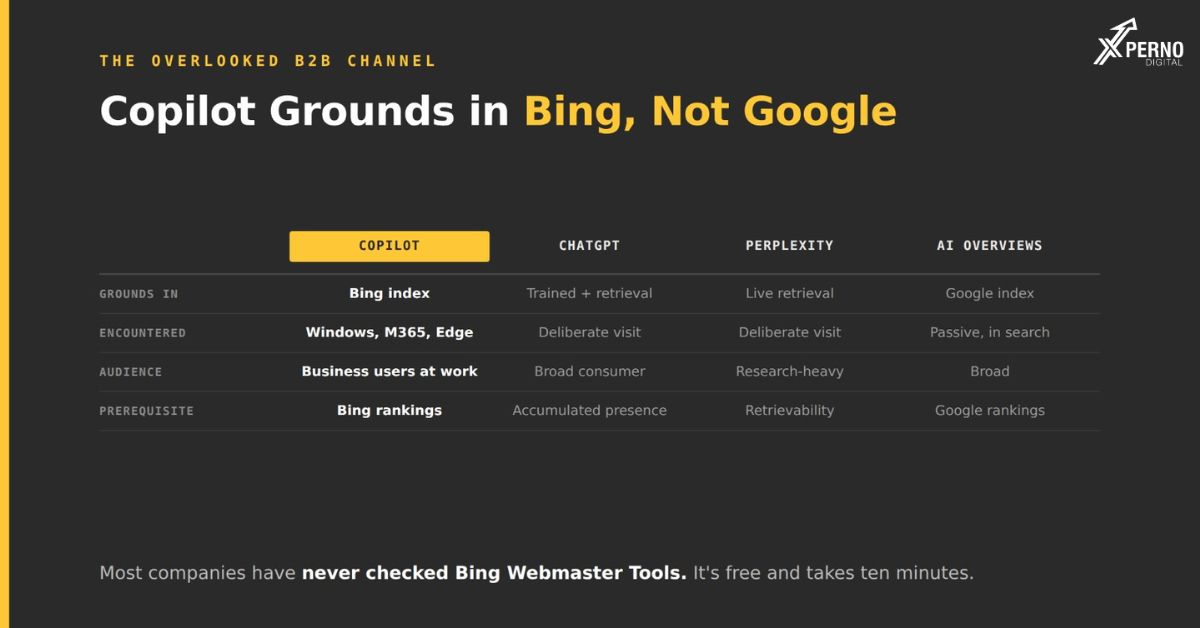
Copilot is embedded in Windows, Microsoft 365 and Edge, which puts it in front of business users during the working day rather than requiring them to choose to open an AI tool.
That distribution is the whole argument. A buyer researching software in Word, Outlook or Teams can ask Copilot without switching context. For consumer AI tools, someone has to decide to go there. For Copilot, it is already open.
Why this concentration favours B2B specifically?: Microsoft 365 penetration in enterprise and mid-market is extensive. The people using Copilot at work are, disproportionately, the people who buy business software.
And it is under-attended. Most AI visibility effort goes to ChatGPT and Perplexity. Copilot receives comparatively little attention, which means less competition for the same visibility.
How does Copilot source information?
Copilot grounds in Bing’s index rather than Google’s, which is the single most consequential difference from every other engine you are optimising for.
What that means practically?
Your Bing rankings matter here in the way your Google rankings matter for AI Overviews and Gemini. If you rank nowhere in Bing, you are unlikely to be retrieved.
And most B2B companies have never looked at their Bing performance. Bing Webmaster Tools is free, takes ten minutes to set up, and a meaningful number of sites find issues there that never surfaced in Search Console indexation gaps, crawl errors, pages Google indexed and Bing did not.
Two other inputs:
Trained knowledge, updating on model releases like every other assistant.
Microsoft Graph data in enterprise contexts a Copilot instance inside an organisation can draw on that company’s own documents and email. This does not affect your external visibility, but it explains why answers differ between a personal Copilot and one inside a company tenant.
What should you check first?
Set up Bing Webmaster Tools and verify your important pages are indexed there.
This is the highest-return action in this post and it is genuinely neglected.
The setup:
1. Verify your site at Bing Webmaster Tools
2. Submit your sitemap
3. Check the indexation report against your key pages
4. Review crawl errors
What people commonly find?: Pages indexed in Google and missing from Bing, sitemap submission never done, crawl errors that never surfaced elsewhere.
Bing also offers Index Now a protocol for pushing URL updates directly rather than waiting to be crawled. Supported by several CMSs through plugins. Modest benefit, low effort.
Check `Bing Bot` access in your robots.txt while you are there. Blocking it removes you from Bing and from Copilot.
How is it different from the others?
Four differences worth knowing:
- Copilot ChatGPT Perplexity AI Overviews
- Grounds in Bing index Trained + retrieval Live retrieval Google index
- Where users encounter it Windows, M365, Edge Deliberate visit Deliberate visit Passive, in search
- Audience skew Business users at work Broad consumer Research-heavy Broad
- Prerequisite Bing rankings Accumulated presence Retrievability Google rankings
The practical implication: Copilot is the only engine where Bing performance is the entry ticket. Everything else you do for AI visibility comparison content, extractable facts, corroboration applies equally here. What is additional is making sure Bing can find you.
Does Bing SEO differ from Google SEO?
The fundamentals are the same, with two modest differences worth knowing.
Where they overlap?: Technical health, useful content, clear structure, credible signals. A site that works for Google works for Bing.
Two documented differences:
Bing has historically weighted exact-match signals and on-page factors slightly more, and it is somewhat less sophisticated at interpreting intent from loosely matched content.
Bing’s index is smaller. Pages Google discovers through link discovery alone may not be indexed by Bing at all which is why explicit sitemap submission matters more here.
What does not require separate work?: Content strategy, comparison pages, entity consistency, off-site presence. Those serve both.
The honest summary: You do not need a Bing strategy. You need to check that Bing has indexed you, which most companies have never done.
What about the enterprise context?
Copilot inside a company tenant can draw on that organisation’s internal documents, which changes what its answers contain but not how you get into them.
Worth clarifying because it causes confusion.
What Graph grounding does?: A Copilot instance inside an enterprise can reference that company’s own emails, documents and SharePoint content when answering internal questions.
What does it not do?: Give you any route into those answers. Your visibility comes from the public web, exactly as elsewhere.
Where it does matter to you indirectly If a prospect’s company has internal documentation mentioning your product a vendor evaluation, a procurement note, an existing integration Copilot may surface it in their internal queries. You cannot influence this, but it is a reason existing customer within an organisation matter more than the seat count suggests.
Is it worth the effort?
The Bing setup is worth an hour. Beyond that, no separate effort is justified.
Do this:
- Bing Webmaster Tools setup and sitemap submission one hour, once
- Check `Bing Bot` access in robots.txt two minutes
- Add Copilot to your monthly prompt set the prompts already exist
Do not do this:
- Build a separate Copilot content strategy
- Pay for “Copilot optimisation” as a distinct service
- Segment your content approach by engine
Where it deserves more weight?: If you sell into enterprise or mid-market organisations running Microsoft 365, your buyers encounter Copilot passively during work. That is a different exposure profile from a category whose buyers deliberately open ChatGPT.
How to find out?: Test it monthly alongside the others. If you appear consistently in ChatGPT and are absent from Copilot, the likely cause is Bing indexation rather than anything about your content which is a fixable and unusually specific finding.
Frequently Asked Questions:
Does Copilot use Google or Bing?
Bing. It is the only major AI assistant grounded in Bing’s index, which makes Bing indexation a prerequisite.
Do I need a separate Bing SEO strategy?
No. The fundamentals overlap heavily. What you need is to verify Bing has indexed your key pages, which most companies have never checked.
Does Copilot see my company’s internal documents?
Inside an enterprise tenant, it can reference that organisation’s own content. This does not affect your external visibility.
Should I set up Bing Webmaster Tools?
Yes. It is free, takes an hour, and frequently surfaces indexation issues that never appeared in Search Console.
Is Copilot worth optimising for?
Not separately. Verify Bing indexation, then rely on the work that serves every engine.
Why do I appear in ChatGPT but not Copilot?
Most commonly a Bing indexation gap rather than a content problem. Check Bing Webmaster Tools first.