
Internal linking affects discoverability and topical coherence whether pages are found, and whether a group of them reads as coverage of a subject. It does not directly determine whether a specific claim gets cited.
Setting the ceiling honestly: Linking a set of pages that contain nothing extractable will not produce citations. What linking does is make sure pages that do contain usable claims are found, and that their relationship to each other is explicit rather than inferred.
Three things it genuinely does:
Discovery: A page nothing links to is crawled rarely or not at all.
Coherence: Fifteen linked pages on one subject read as coverage. The same fifteen scattered read as unrelated posts.
Context: When a model draws on one of your pages, links from it signal what else you have covered which supports corroboration across your own domain.
What pattern actually works?
Hub and spoke, linked in both directions, with descriptive anchor text.
The structure:
┌─────────────┐
│ PILLAR PAGE │
└──────┬──────┘
┌────────────┼────────────┐
▼ ▼ ▼
┌──────────┐ ┌──────────┐ ┌──────────┐
│ Support 1│◄┤ Support 2├►│ Support 3│
└──────────┘ └──────────┘ └──────────┘
The rules:
1. Every supporting page links up to the pillar within its first 200 words. This is the rule most sites break.
2. The pillar links down to every supporting page. Usually within the body, in context, rather than in a list at the bottom.
3. Related supporting pages link sideways to two or three siblings.
4. Anchor text describes the destination. “Comparison pages,” not “click here.”
Why the first-200-words rule matters?: Links appearing early in a page carry more weight than links buried in a footer, and a link in the opening paragraph establishes the relationship before anything else on the page.
What are the two most common failures?
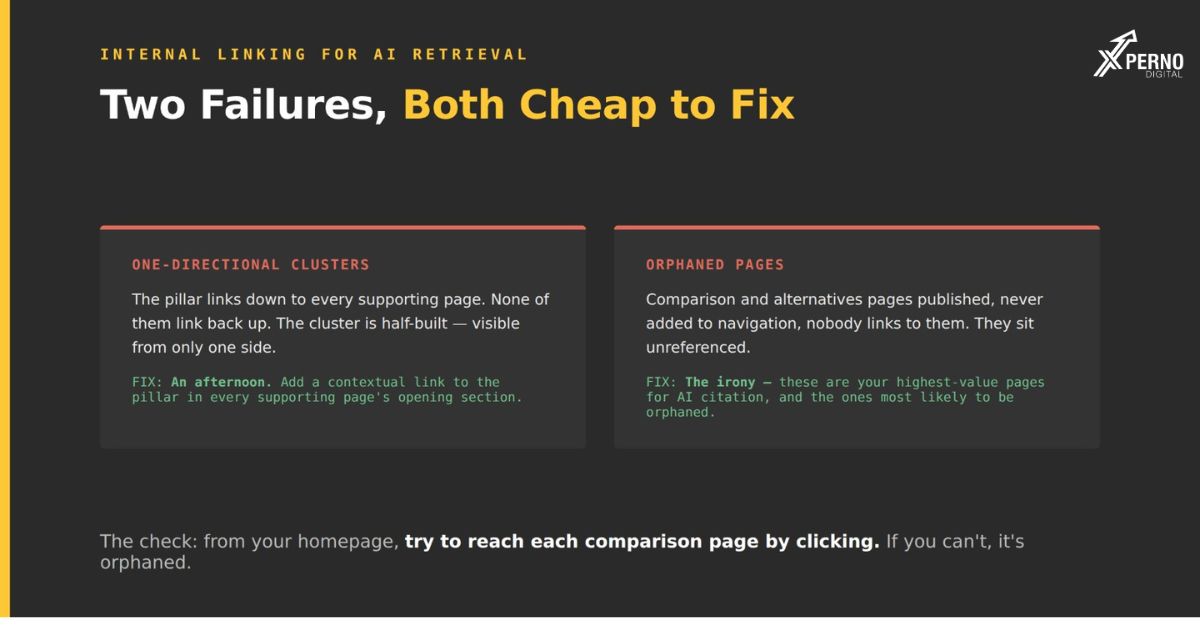
One-directional clusters and orphaned pages. Both are common and both are cheap to fix.
One-directional clusters:
The pillar links down to all its supporting pages. None of the supporting pages link back up.
Why this happens?: The pillar is written last, once the supporting content exists, so the downward links get added. Nobody goes back to add the upward ones.
The effect: The cluster is half-built. The pillar knows about its children; the children do not reference their parent, so the relationship is only visible from one side.
The fix: An afternoon. Open every supporting page, add a contextual link to the pillar in the opening section.
Orphaned pages:
Pages that exist, are in the sitemap, and have no internal links pointing at them.
Where this happens most?: Comparison pages and alternatives pages. They get published, they are not part of the main navigation, nobody links to them, and they sit unreferenced.
The irony: These are the highest-value pages you own for AI citation, and they are the ones most likely to be orphaned.
The check: Crawl your site with Screaming Frog or Site bulb and look for pages with zero inbound internal links. Or simpler — from your homepage, try to reach each comparison page by clicking. If you cannot, it is effectively orphaned.
How many internal links should a page have?
Three to eight relevant links for most pages. The number matters less than whether each one is genuinely relevant:
What works:
Links placed in context, where a reader would naturally want more depth
Each link genuinely relevant to the sentence containing it
Descriptive anchor text
What does not:
A “related posts” block of twelve links appended automatically
Mega-menus linking to sixty pages from every page
Linking to the same page four times from one article
Why volume dilutes?: If every page links to sixty others, no link signals anything. Linking to eight relevant pages concentrates the signal; linking to sixty spreads it thin.
One exception: A pillar page legitimately links to all its supporting pages, which might be ten or fifteen. That is the structure working as intended rather than link stuffing.
What about anchor text?
Descriptive and varied. Not exact-match repetition
- Poor Better
- Click here Comparison pages
- This article How to measure AI visibility
- Learn more The five prompts to test monthly
- SEO SEO SEO (exact-match everywhere) Natural variations describing the destination
Why exact-match repetition is a problem?: It reads as manipulation to ranking systems and it reads badly to humans. Using slightly different descriptive phrasing across links to the same page is both more natural and more informative.
A useful test: Read the anchor text alone, out of context. Does it tell you what page it leads to? If not, rewrite it.
Does this differ from traditional SEO advice?
The mechanics are the same. Cluster coherence carries more weight than it did for ranking alone.
What is unchanged?: Links aid discovery, distribute authority, and help systems understand relationships between pages. This has been true for two decades.
What matters more now?: Retrieval favours sources that corroborate each other. A tightly linked cluster where pages reference one another provides more context about what you have covered than the same pages standing alone.
What matters less?: Elaborate link sculpting, `no follow` on internal links to control authority flow, and the various technical manipulations that occupied SEO attention a decade ago. These were always marginal and are not worth attention now.
The practical summary: Build coherent clusters, link both directions, use descriptive anchors, and stop there.
What should you actually do?
Four checks, about two hours, then stop.
1. Find orphaned pages (30 min): Crawl the site or manually check whether each comparison, alternatives, use-case and integration page can be reached by clicking from the homepage. Add links to any that cannot.
2. Fix one-directional clusters (45 min): For each cluster, open every supporting page and check it links up to the pillar in its opening section. Add what is missing.
3. Add sideways links (30 min): Two or three links between genuinely related supporting pages.
4. Anchor text pass (15 min): Search your key pages for “click here,” “this article,” “learn more” and replace with descriptive text.
Then stop: Once pages are reachable, clusters are linked in both directions and anchors are descriptive, further linking work has sharply diminishing returns. The constraint moves to content type and off-site presence.
Frequently Asked Questions:
How many internal links per page?
Three to eight relevant links for most pages. Pillar pages legitimately link to all their supporting pages. Volume beyond that dilutes rather than concentrates.
Should I use exact-match anchor text?
No. Descriptive and varied works better for both systems and readers. Exact-match repetition reads as manipulation.
Do internal links pass authority like external ones?
They distribute it within your site rather than adding new authority. The larger benefit is discovery and topical coherence.
Should I add a “related posts” block?
Automated blocks tend to produce irrelevant links. Contextual links placed where a reader would want more depth work better.
How do I find orphaned pages?
Crawl with Screaming Frog or Sitebulb and filter for zero inbound internal links. Or check whether you can reach each key page by clicking from the homepage.
Does internal linking affect AI citation directly?
No. It affects whether pages are discovered and whether a topic reads as covered. Citation depends on whether the pages contain extractable claims.