
Auditing existing content is usually a better use of time than writing new content, because pages you already have are already indexed, already have some authority, and frequently fail on structure rather than substance.
The common assumption when a company discovers it is absent from AI answers is that it needs more content. In most cases it needs different content, and a meaningful share of what it needs is already written buried under a structure that makes it hard to extract from.
A page containing genuine expertise, arranged so no individual claim can be lifted, is a fixable problem. Rewriting its section openers takes twenty minutes. Writing an equivalent new page takes four hours.
Start with what you have. The returns concentrate heavily in a small number of pages.
Which pages should you audit?
Audit your top 20 pages by traffic plus every commercially important page, regardless of traffic.
Not your whole archive. A 300-post blog does not need a 300-page audit, and attempting one guarantees it never finishes.
The list to build:
- Category How to find them
- Top 20 by organic traffic Search Console, last 6 months
- Product and pricing pages You know these
- Any comparison or alternatives pages You may have none that is a finding
- Documentation index and key doc pages Cited more than blog content
- Top 5 converting pages Analytics goal completions
Usually 30–40 pages. That is a day of work at roughly fifteen minutes each, and it will surface more than a month of new writing
What are you scoring each page on?
Score each page on six criteria, each answerable in under two minutes:
1. Does it answer a question a buyer actually asks?
Read the page title and headings. Would a buyer type any of them into an AI interface?
“Our Approach to Customer Success” no. “How long does onboarding take?” yes.
Score: Yes / Partly / No
2. Is the answer in the first sentence under each heading?
Read the first sentence under each H2 in isolation. Does it state a complete fact with no dependency on what came before?
This is the criterion most pages fail, and the cheapest to fix.
Score: Most / Some / None
3. How many extractable facts does it contain?
Count sentences stating something specific and checkable a number, a boundary, a condition, a named integration, a price.
“Implementation takes four to six weeks for teams under 50” counts. “We pride ourselves on rapid deployment” does not.
Score: the count. Under three on a 1,000-word page is a problem.
4. Is there comparative framing?
Does the page position anything relative to alternatives, or does it only describe your own product in isolation?
Score: Yes / No
5. Is it current?
When was it last updated, and does it contain anything factually out of date pricing, features, integrations, team, claims about the market?
Score: Current / Needs update / Wrong
6. Is it accessible to crawlers?
Indexable, server-rendered, not blocked, not behind a form.
Score: Yes / No
How do you turn the scores into decisions?
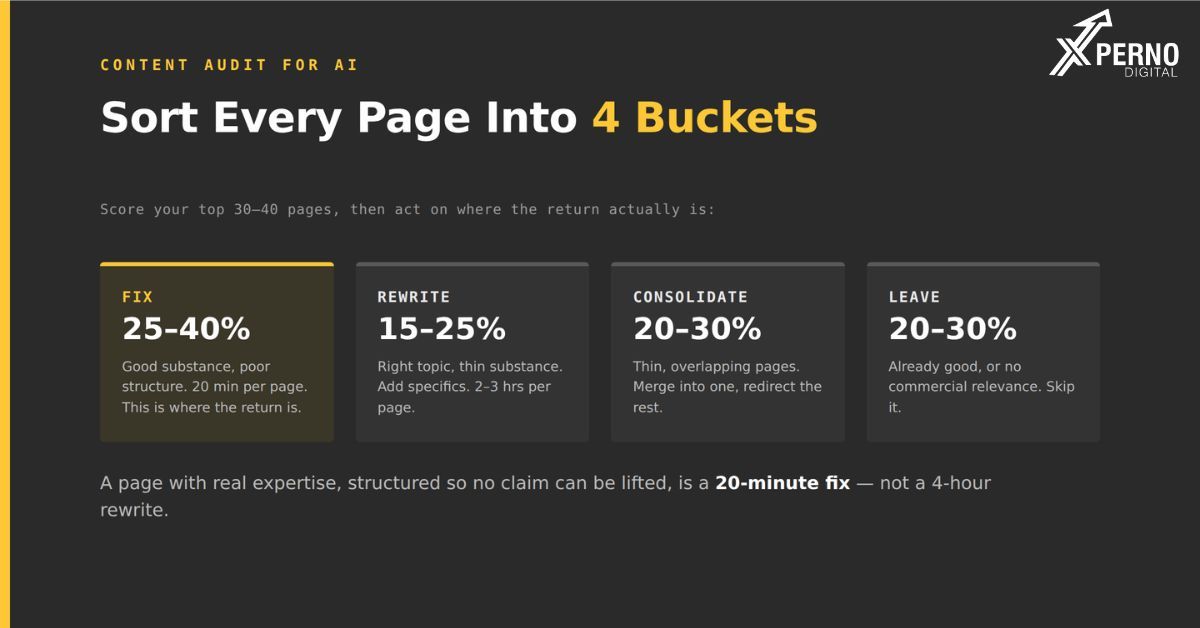
Sort every page into one of four actions: fix, rewrite, consolidate, or leave:
FIX: Highest priority: Good substance, poor structure. Contains real expertise and extractable facts but buries them.
The work: Rewrite headings as questions, rewrite the first sentence under each, break up dense paragraphs. Twenty minutes per page.
Typical share:25–40% of audited pages. This is where the return is.
REWRITE: Right topic, thin substance: The page addresses something buyers ask but contains no checkable facts.
The work: Add specifics. Numbers, conditions, boundaries, comparisons. Two to three hours per page.
Typical share:15–25%.
CONSOLIDATE: Multiple thin pages covering overlapping ground, nonauthoritative.
The work: Merge into one substantial page, redirect the others. This is usually where a large blog archive belongs.
Typical share: 20–30%.
LEAVE: Either already good, or not worth the effort old news posts, event announcements, pages with no commercial relevance.
Typical share: 20–30%.
One category worth calling out separately: DELETE. Pages containing factually wrong information about your product old pricing, discontinued features are actively harmful, because they are a source these systems may draw on. Fix or remove them before anything else.
What does the fix actually look like?
For most pages the fix is restructuring, not rewriting, and it takes about twenty minutes.
Before:
Our Onboarding Process:
We understand that getting started with new software can feel daunting. That’s why we’ve invested heavily in building an onboarding experience that meets you where you are. Our team has worked with hundreds of organisations across a wide range of sectors, and we bring that experience to every implementation
After:
How long does onboarding take?
Onboarding takes four to six weeks for teams under 50 users and eight to twelve weeks for larger deployments with custom integrations. A dedicated onboarding manager runs the process, and most customers are live on core functionality within the first two weeks.
Same page, same claim, restructured. Three extractable facts where there were none.
The mechanical steps:
1. Rewrite each heading as a buyer question
2. Write a new first sentence under each that answers it completely
3. Move the existing context below that sentence
4. Add at least one specific fact per section a number, a boundary, a condition
5. Break paragraphs so each carry one claim
6. Delete anything that is purely connective tissue
What if a page has nothing to say?
If you cannot state a specific fact in the first sentence of a section, the section probably should not exist.
This is the genuinely useful and slightly uncomfortable finding this audit produces. Applying the answer-first test to existing content makes it obvious which sections were written to fill space.
Three options when a section fails:
Add a fact: Often the fact exists internally and was never written down. What does it actually cost? How long does it actually take? How many customers actually do this? Ask someone who knows.
Cut the section: A shorter page with higher claim density outperforms a longer one with padding.
Consolidate the page: If the whole page fails, it may belong merged into a stronger one.
How long does the audit take?
About a day for the audit, then two to four weeks of fixes depending on how many pages fall into each bucket.
- Phase: Time
- Build the page list: 1 hr
- Score 30–40 pages: 6–8 hrs
- Sort into actions: 1 hr
- Execute FIX pages: (10–15 pages × 20 min) 4–5 hrs
- Execute REWRITE pages: (5–8 pages × 2–3 hrs) 12–20 hrs
- Consolidations and redirects: 3–5 hrs
Do the FIX pages first. They are the cheapest and produce the largest aggregate improvement. A company that only completes this step has captured most of the available return.
What should you expect afterwards?
Movement in eight to fourteen weeks, concentrated on the queries your fixed pages actually address.
Restructured pages need to be recrawled and reincorporated. Nothing happens immediately.
1. What to measure: Re-run your prompt set and check whether the specific pages you fixed now appear in citations, particularly in Perplexity where sources are visible.
2. A realistic outcome: An audit of 35 pages producing 12 fixes and 6 rewrites typically moves appearance rate by a few prompts out of twenty, concentrated on the specific and comparative queries. It rarely moves broad category queries, because structure was not the reason you were absent from those.
3. What the audit will not fix: Absence caused by having no third-party corroboration. If nothing outside your domain describes you, restructuring your own pages does not resolve that. The audit is one of three components content structure, content type, and off-site presence and it is the one you fully control.
Frequently Asked Questions:
Should I audit every page on my site?
No. Top 20 by traffic plus commercially important pages. The returns concentrate in a small number of pages and a full-archive audit rarely gets finished.
Is it better to fix old content or write new?
Fix first. Existing pages are already indexed and often already have authority. Restructuring is twenty minutes per page; new content is hours.
How do I know if a page is worth fixing?
Does it address a question buyers actually ask, and does it contain any real substance? If both are yes, fix it. If the topic is right but the substance is thin, rewrite. If neither, consolidate or leave.
Will deleting old content hurt my rankings?
Consolidating thin pages into stronger ones with proper redirects generally helps. Deleting pages that rank and drive traffic without redirecting them does not.
How often should I re-audit?
Annually for a full pass, quarterly for pages containing facts that change pricing, features, comparisons.
Can I automate this?
Partially. Crawlers can flag technical issues and thin pages. The judgement calls whether a heading matches a buyer question, whether a claim is extractable need a human, and that is where the value is.