
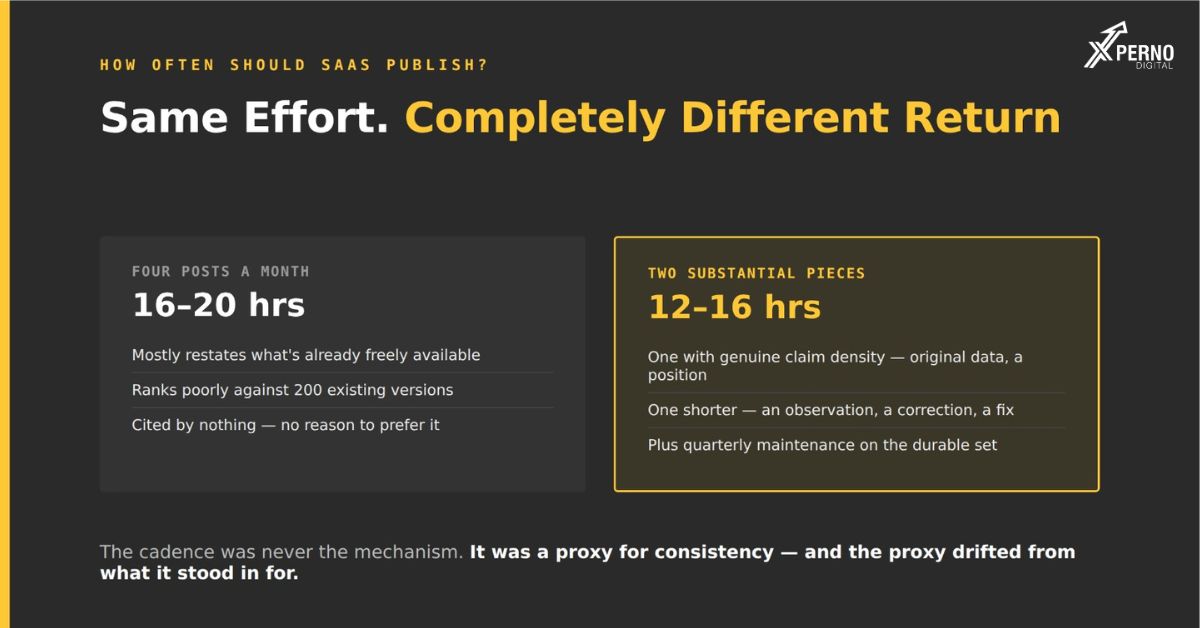
Two substantial pieces a month is a sustainable rate that outperforms four to eight thin ones. Publishing frequency matters far less than it used to what matters is whether each piece contains something specific enough to be worth citing, and whether the durable assets are being maintained.
The advice that consistency is essential comes from an era when frequency drove traffic growth. That relationship weakened substantially, and the advice outlived it.
Why did publishing frequency stop mattering as much?
Because more pages no longer means more chances to rank against a less crowded field.
Three conditions changed at roughly the same time. Informational queries increasingly get answered on the results page by featured snippets and AI Overviews. Buyers increasingly form shortlists inside AI interfaces before searching. And the market for explainer content is saturated being the two hundred and first adequate guide to a concept gives no source a reason to prefer yours.
The cadence itself was never the mechanism. It was a proxy for consistency, and the proxy drifted from the thing it stood in for.
How do you tell if your cadence is a strategy or a habit?
Take your last twelve published pieces and ask, for each one: what was this supposed to produce?
Not “engagement” or “brand awareness” or “thought leadership.” Something specific a ranking for a named query, a citation in an AI answer, a page the sales team can send to a particular objection.
Most teams can answer for three or four. The rest existed because the calendar said so.
That is not a criticism of anyone’s judgement. It is what an output target reliably produces, and it would produce the same result with a different team.
Why do cadence targets produce the wrong content?
Because volume metrics reward whatever is fastest to produce, and the fastest thing to produce is a restatement of content that already exists.
A writer working from a keyword tool or a model generating a draft produces the consensus view of a topic, because the consensus is what is available to work from. That content ranks poorly against the two hundred existing versions and gets cited by nothing, because there is no reason for a system assembling an answer to prefer your version of a claim that fifteen sources already make.
Cadence targets also hide the asymmetry between content types:
| Content type | Time to produce | Useful life |
| Comparison page vs a named competitor | 4 hours | Years |
| Use-case page for a real segment | 3 hours | Years |
| Integration page | 1–2 hours | Years |
| Blog post explaining a concept | 4 hours | ~2 weeks |
| Trends roundup | 4 hours | ~1 month |
Under a “posts published” target, every row counts as one. Twelve blog posts a quarter looks more productive than three comparison pages. It rarely is.
What should consistency actually mean?
Four things, none of which is publishing frequency:
- Maintaining the durable set. Comparison and alternatives pages contain facts about competitors’ products that change. Quarterly review, without fail a stale comparison is worse than none, because being demonstrably wrong about a checkable fact undermines the whole page.
- Monthly measurement. A fixed prompt set, same wording, same conditions, logged. Without a consistent baseline you cannot tell whether anything is working, and not being able to tell is the most common reason teams abandon a channel that was working.
- Off-site outreach. This compounds and has a four-to-six-month lead time. Ten targeted approaches a month, sustained, produces something. Fifty in one quarter followed by nothing produces almost nothing.
- Review requests. Velocity matters more than volume, and velocity requires steadiness. Five a month for a year beats sixty in one campaign.
What does a sustainable publishing rhythm look like?
Two substantial pieces a month, plus quarterly maintenance on the durable assets.
One piece with genuine claim density original data, a specific comparison, a position you would defend. One shorter piece an observation, a practical fix, a correction of something commonly believed.
Roughly twelve to sixteen hours a month, which a founder or a single marketer can sustain indefinitely.
Compare that to four posts a month, which is sixteen to twenty hours producing content that mostly restates what is already freely available. Same effort, different return.
What should you do with the time you free up?
Reducing from four posts to two frees roughly eight hours a month. None of the work below appears on a content calendar, which is precisely why it does not happen under a cadence target.
| Activity | Hours/month | Why it matters |
| Off-site outreach | 2–3 | Identifying which roundups actually appear in AI citations, and approaching those authors specifically |
| Measurement | 1 | Running the fixed prompt set, logging results, calculating share of voice |
| Maintenance | 1 | Rotating through comparison and use-case pages, verifying facts against competitors’ live pages |
| The substantial piece | 3–4 | Original data takes an analyst afternoon. A customer interview takes 45 minutes plus an hour of processing. |
How do you make the case for publishing less?
Reframe the target around asset value, show the asymmetry with your own data, and change the reporting at the same time.
The resistance is rarely about the argument. It is about what the reduction looks like on a dashboard.
- Reframe the target. “One comparison page plus one substantial piece” is defensible monthly if you can state what each produces.
- Show the asymmetry with your own data. Pull the pages that have actually contributed to pipeline over the last year. In most B2B companies it is a small number, and they are rarely the informational posts.
- Propose it as a quarter-long test rather than a permanent change. Two months building the bottom-of-funnel set, one month measuring.
- Change the reporting at the same time. If the report still leads with posts published, the reduction reads as underperformance regardless of what it produces.
Do search engines reward publishing frequency?
For some query types, yes news, fast-moving topics, anything where recency is part of relevance. For most B2B evergreen content, no.
A comparison page updated quarterly is fresher, in the sense that matters, than a blog archive updated daily with content nobody reads.
The other common objection that your audience expects it is worth checking rather than assuming. Most B2B blogs have no returning readership waiting for the next post; traffic arrives from search, reads one page, and leaves. If yours genuinely has subscribers who notice when you skip a week, that is a real asset and this advice applies less to you.
When does publishing more make sense?
When your content is genuinely differentiated original research, proprietary data, a distinctive voice with a real readership.
In that case publishing more is straightforwardly good, and your constraint is capacity rather than strategy.
The problem was never frequency. It is frequency as a substitute for deciding what each piece is for.
Frequently Asked Question :
How often should a B2B SaaS company publish?
Two substantial pieces a month is sustainable and outperforms four to eight thin ones. Frequency matters far less than whether each piece contains something specific.
Will publishing less hurt our rankings?
Not if the pieces you do publish are stronger. Ranking depends on whether a page answers a query better than the alternatives, not on how many pages you produced that month.
What if leadership expects weekly content?
Reframe the target around asset value, propose it as a quarter-long test, and change the reporting at the same time. All three, or the reduction reads as underperformance.
How do I know if a piece is worth publishing?
Could a competitor publish it with their logo on it? If yes, it is consensus content it may rank, but it will not differentiate you.
What should I do with the time saved?
Off-site outreach, measurement, maintaining the durable assets, and producing one genuinely substantial piece.
Does this apply to LinkedIn posting too?
Less so. Feed content has a different mechanic recency matters more and a post’s useful life is days. Daily posting on LinkedIn is more defensible than daily blogging.