
Claude draws on trained knowledge and, when web search is enabled, live retrieval favouring sources that describe a product consistently and can be attributed clearly.
The mechanism is broadly similar to other assistants:
Trained knowledge: Reflects the state of the web at training time. It changes only when a new model version ships, which is outside anyone’s control and unpredictable in timing.
Live retrieval: Happens when a query needs current information and search is available. This responds to new content in weeks rather than waiting for a release.
What that means practically?: The same work that produces visibility elsewhere produces it here. There is no Claude-specific technique, and anyone selling one is overstating what is knowable about a system whose mechanics are not published.
Does Claude matter for B2B visibility?
Its consumer user base is smaller than ChatGPT’s, but enterprise and developer adoption is substantial which means its answers reach a narrower audience with a higher concentration of technical B2B buyers.
Three things worth knowing:
Heavy use inside companies: Claude is widely deployed through enterprise plans and API integrations, which puts it in front of people during work rather than during casual browsing.
Strong developer adoption: Coding tools and developer workflows use it heavily. If you sell developer tools, infrastructure or API-first products, your buyers are likely using it daily.
Longer, more analytical queries: The usage pattern skews toward extended reasoning rather than quick lookups, which tends to favour specific, detailed sources over broad ones.
The honest assessment: For most B2B categories, Claude is worth testing but is not where the volume is. For technical products it may matter more than its consumer share suggests. Check rather than assume.
How should you test it?
Add it to your monthly prompt set. The prompts are already written, so the marginal cost is small.
Testing conditions:
- Fresh conversation each time: Prior context in a conversation influences later answers.
- Same phrasing every month: Changing wording destroys the comparison.
- Note whether search was used: Answers drawing on live retrieval differ from those drawing on trained knowledge, and the distinction matters for interpreting movement.
- Three runs on your most important prompts : Output is variable across all these systems.
What to record?: Whether you appeared, position, competitors named, and every factual claim made about your product.
The accuracy check matters here .Extended analytical answers contain more claims about your product than a short listing does, which means more opportunities for something outdated to surface old pricing, a discontinued feature, a wrong category.
What does the divergence tell you?
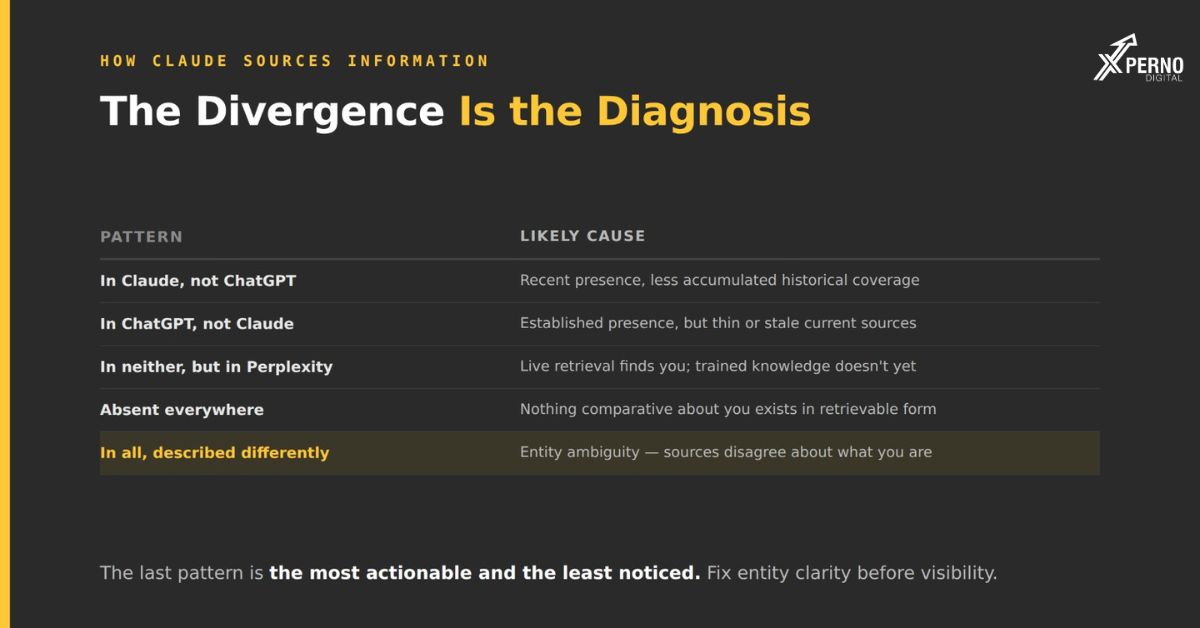
If you appear in Claude but not ChatGPT, or the reverse, that pattern points at which part of your visibility is weak.
- Pattern Likely cause
- In Claude, not ChatGPT: Recent presence, less accumulated historical coverage
- In ChatGPT, not Claude: Established presence, but thin or stale current sources
- In neither, but in Perplexity : Live retrieval finds you; trained knowledge does not yet
- Absent everywhere: Nothing comparative about you exists in retrievable form
- In all, described differently: Entity ambiguity sources disagree about what you are
The last pattern is the most actionable and the least noticed. If three engines describe your category differently, the sources describing you do not agree, and that is an entity problem to fix before working on visibility.
Is there anything Claude-specific to do?
No. The characteristics that produce citation are the same across engines: extractable claims, comparative framing, third-party corroboration, entity clarity, recency.
Worth stating plainly because a certain amount of content exists claiming otherwise.
What is not true:
- That there are Claude-specific formatting techniques
- That a particular content structure works uniquely well here
- That optimising separately for each engine is worth the segmentation
What is true: Engines weight the same signals differently. Perplexity favours recency because it retrieves live. Google AI Overviews favour ranking pages. ChatGPT leans more on accumulated presence. Claude sits closer to the ChatGPT pattern, with a usage profile that favours detailed sources.
The practical implication: Optimise once for the underlying characteristics, test across all of them, and read the divergence as a diagnostic rather than as a set of separate projects.
What about crawler access?
Check whether `Claude Bot` is blocked in your robots.txt it is frequently disallowed during security reviews without a decision being made.
The pattern is the same as with `GPT Bot` and `PerplexityBot`. A legal or security review in 2023 or 2024 recommended blocking AI crawlers as a precaution, someone implemented it, and nobody revisited it.
Two places to check:
- Your `robots.txt`, for `Claude Bot` and `anthropic-ai`
- Your CDN or WAF settings Cloudflare and others have offered one-click AI crawler blocking, frequently enabled by people not thinking about marketing implications
The trade-off is the same as for any AI crawler. If you monetise pageviews, blocking is defensible. If you depend on being recommended which describes almost all B2B software blocking removes you from the layer where shortlists form while leaving you described entirely by third-party sources you do not control.
What should you actually do?
Nothing Claude-specific. Add it to the test set and let the results tell you whether it matters in your category.
A reasonable approach:
1. Check crawler access. Two minutes, and it occasionally explains an entire absence.
2. Add it to your monthly prompt set. Same prompts, same conditions, three runs on the important ones.
3. Check accuracy carefully, since longer answers contain more claims about you.
4. Read the divergence against your other engines as a diagnostic.
5. Do the underlying work comparison content, extractable facts, third-party corroboration. That is what moves all of them.
If you sell to developers or technical buyers, weight this engine more heavily in your testing. The audience concentration is genuinely different.
For everyone else, test it monthly and spend your effort on the work that affects every engine rather than on any one of them.
Frequently asked questions:
Does Claude use live web search?
It can, depending on the interface and whether search is enabled. Some queries are answered from trained knowledge alone.
Should I block ClaudeBot?
Only if you monetise pageviews. For B2B software, blocking removes you from citations while leaving third-party descriptions of you intact.
Is Claude worth optimising for separately?
No. The characteristics that produce citation are the same across engines. Optimise once, test across all of them.
Why does Claude give different answers to ChatGPT?
Different training data, different retrieval behaviour, different weighting. The divergence is diagnostic rather than a problem to solve.
Does Claude matter for B2B?
Its enterprise and developer adoption is substantial, which concentrates its audience among technical B2B buyers. For developer tools it may matter more than consumer share suggests.
How often should I test it?
Monthly, alongside your other engines. The prompts already exist, so the additional cost is minimal.