
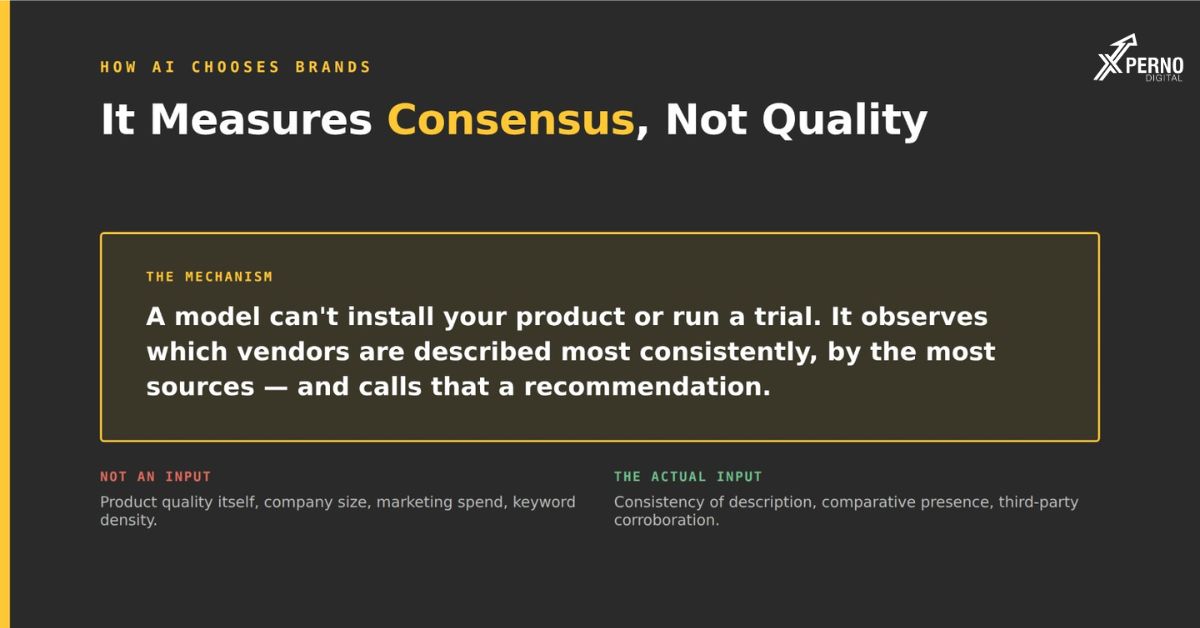
AI engines select brands by measuring which vendors are described most consistently across the sources they can access not by assessing product quality.
That distinction is the whole thing, and it explains most of what otherwise looks arbitrary.
A model asked “what’s the best tool for X” is not evaluating software. It cannot install anything, run a trial, or talk to a customer. What it can do is observe that across review platforms, category roundups, comparison pages and community threads, certain vendors are repeatedly described as suiting certain situations.
The output looks like a judgement about quality. The input is a measurement of consensus.
Which means a well-documented, widely-described average product outranks a better product that nobody has written about. That is uncomfortable and it is the operating reality.
What are the actual inputs?
Six signals, in roughly descending order of weight:
1. Consistency of description across independent sources:
The strongest signal. If eight sources describe you as field service software for HVAC contractors under 200 technicians, that description becomes what you are.
Where it breaks?: When sources disagree. You say “revenue intelligence platform”; G2 says sales analytics; three articles say CRM. The model reconciles the conflict, usually by following external consensus over your own framing.
2. Presence in comparative content:
Buyer queries are comparative. A source that positions you relative to alternatives is directly usable; a source describing you in isolation is not.
This is why comparison pages, alternatives pages and third-party roundups dominate citations they contain the comparative claims these queries require.
3. Volume and recency of third-party mentions:
More independent sources means more corroboration. Recent sources describe a product that currently exists.
Recency matters more than most people expect. A review profile that stopped in 2022 suggests a product that may have stopped too.
4. Extractability of your own facts:
A model needs specific, attributable statements. “Starts at $49 per user per month, minimum five seats” is usable. “Flexible pricing that scales with you” is not.
If nothing about your pricing, target customer or capabilities exists in extractable form, you cannot be described accurately even when the model wants to.
5. Specificity match to the query:
The narrower the query, the more a narrow source wins. “Best project management tool” favours the vendor mentioned everywhere. “Project management for architecture firms under 50 people” favours whoever has a page addressing exactly that.
This is the structural advantage available to smaller companies, and it is larger in AI search than in traditional search because prompts are more specific than search queries.
6. Entity clarity:
Whether the system holds a coherent representation of what your brand is category, function, customers, price point, competitors. Ambiguity here means you get considered for the wrong queries and excluded from the right ones.
What does not appear to matter?
Four things that companies assume are inputs and are not.:
Product quality itself: These systems cannot assess it directly. They observe what people say about it, which is a proxy that fails when nobody has said anything.
Company size and funding: Only insofar as larger companies tend to accumulate more third-party mentions. Size is correlated with the signal, not the signal itself. Well-documented small vendors are cited regularly; poorly documented large ones are absent.
Keyword density and traditional on-page SEO signals: These systems are not matching keyword frequency. Optimising density is optimising for a mechanism that is not operating.
Your marketing spend: There is currently no way to buy organic citation. Advertising formats are being tested, but the cited sources themselves are earned.
Why does this produce unfair outcomes?
Because presence and quality are different things, and only one of them is measurable from text.
Worth being direct about this?, particularly since the commercial incentive runs the other way.
What the mechanism rewards?: Companies that have been written about consistently, by multiple sources, recently, in comparative terms.
What it does not reward?: Having the better product, if nobody has documented that.
The systematic distortions this create:
- Incumbents accumulate presence, which produces more citation, which produces more presence
- Newer vendors are absent regardless of merit until third-party coverage accumulates
- Categories with active review cultures favour vendors who ask for reviews systematically
- Vendors who gate their pricing and documentation are invisible in comparisons that turn on those facts
This is not new. Analyst reports, review sites and trade coverage have always favoured the well-documented over the merely good. What is new is that the synthesis is now automatic, invisible to the buyer, and delivered as though it were an assessment.
What does this mean practically?
It means the work is documentation and distribution, not persuasion.
Three implications that follow directly from the mechanism:
Being described consistently matters more than being described well. Standardise how you describe yourself category, function, target customer and deploy that description verbatim everywhere. Variation creates ambiguity; ambiguity produces wrong categorisation.
Third-party sources do most of the work: Four of the six most-cited source types are not on your domain. You can publish excellent content indefinitely and remain invisible if nothing external corroborates it.
Specificity is the lever available to smaller companies: You will not win “best CRM software.” You can win “CRM for field service teams under 50” if you are the only vendor with a page addressing it.
How do you check where you stand?
Run five buyer-intent prompts and read what the answer says about you, not just whether you appear.
The prompts:
1. Best [category] tool for [your ideal customer’s specific situation]
2. Compare the top [category] platforms for [company size or industry]
3. [Your largest competitor] alternatives
4. What should I look for when choosing a [category] platform?
5. Is [your product] good for [your primary use case]?
Run in fresh sessions, across ChatGPT and Perplexity at minimum.
Three outcomes, three different diagnoses:
You appear consistently: The consensus about you is working. Recheck quarterly.
You are absent while competitors appear: Not a quality problem. Nothing comparative about you exists in retrievable form, or nothing external corroborates it.
You appear but described wrongly: Wrong category, old pricing, discontinued features. Address this before working on visibility increasing the reach of a wrong description makes it worse.
The fifth prompt is the one people skip and the most revealing: It frequently returns nothing at all, which tells you the system has no coherent representation of your product to draw on.
Frequently Asked Questions:
Do AI engines assess product quality?
No. They observe how products are described across sources. Quality is inferred from consensus rather than evaluated directly.
Can I pay to be recommended?
Not currently. Some platforms are testing advertising formats, but organic citation is earned through presence rather than purchased.
Why does a worse product get recommended over mine?
Because it is documented more consistently across more independent sources. The mechanism measures presence, not merit.
Does company size determine who gets recommended?
Only indirectly. Larger companies tend to accumulate more third-party mentions. Well-documented small vendors are cited regularly.
How long does it take to change how I’m described?
Live retrieval reflects changes in four to eight weeks. Trained knowledge updates only on model releases, which is outside anyone’s control.
What is the single biggest lever?
Comparison content your own and third-party. It is the content type these queries need and the one most companies have not built.