
AI engines answer comparison queries by assembling claims from multiple sources that position products against each other — primarily third-party roundups, review platforms and vendor comparison pages, including your competitors’ pages about you.
This is mechanically different from how they answer a general question. A query like “what is a CRM” can be satisfied from trained knowledge. A query like “compare Salesforce and HubSpot for a 40-person sales team” requires specific, current, comparative claims which means retrieval, and which means sources.
The practical consequence: Comparison queries are more winnable than general category queries, because they depend on retrievable content rather than accumulated brand association. A smaller vendor with strong comparison content can appear in comparison answers while remaining absent from “best CRM software.”
That asymmetry is the most useful thing in this post.
Why do these queries matter more than category queries?
Comparison and alternatives queries carry substantially higher commercial intent, and they are less dominated by incumbents.
Three query types, three very different buyer states:
- Query Buyer state Distance from purchase
- “What is field service software” Learning Months, or never.
- “Best field service software” Building a longlist Weeks.
- “Service Titan alternatives for small contractors” Actively switching Days to weeks.
The third has a budget, a timeline and a specific dissatisfaction. They have already decided to leave someone.
And the competitive picture is different. The generic category query is dominated by whoever has the most accumulated mentions across the web usually the largest vendors, and often not winnable at any realistic investment. The alternatives query depends on whether comparison content exists, and frequently it barely does.
What sources do these answers come from?
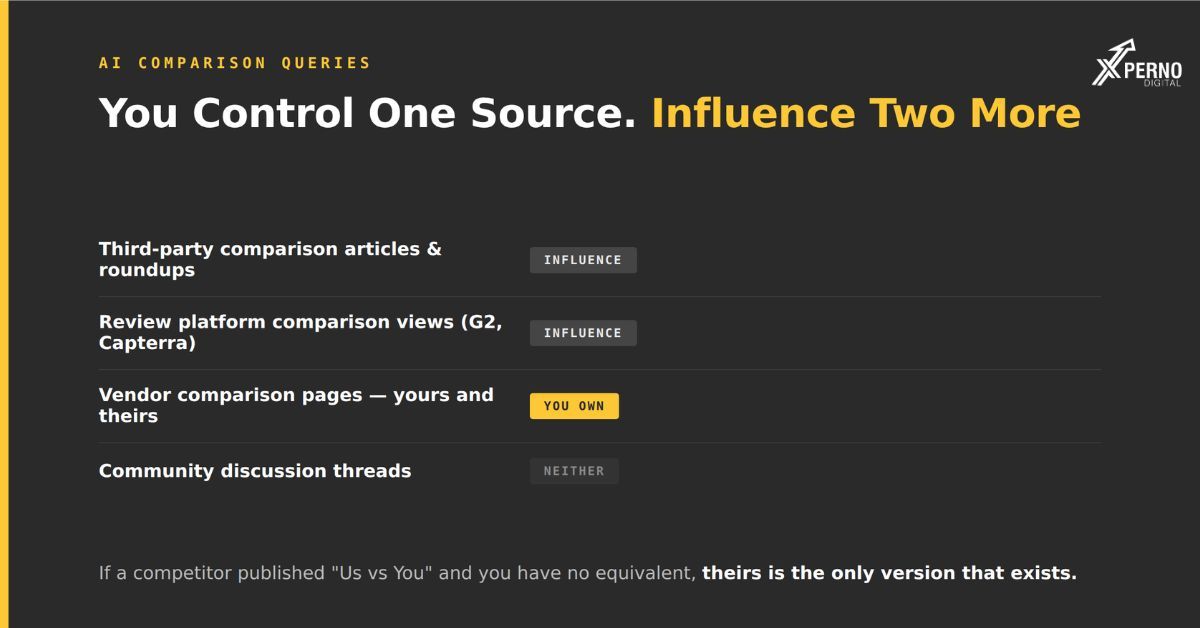
Four source types dominate comparison answers, and three of them are not on your domain:
1. Third-party comparison articles and roundups: Independent “X vs Y” pieces and “best tools for Z” articles. The most frequently cited source type, because they are external and structurally comparative.
2. Review platform comparison views: G2 and Capterra both offer direct product-versus-product comparison pages, which are ideal input structured, attributed, comparative.
3. Vendor comparison pages yours and your competitors: This is the one worth dwelling on. If a competitor has published “Us vs You,” that page is a source these systems read when someone asks about you. Your competition is describing you in retrievable content.
If you have no equivalent page, theirs is the only version of that comparison in existence.
4. Community discussion: Threads where practitioners debate which tool suits which situation. Particularly influential in technical categories.
The pattern to notice: You control one of these four directly and influence two more. Absence from all four is why a well-funded company with a large content team can be entirely missing from comparison answers.
Why do models sometimes get comparisons wrong?
Comparison answers go wrong when the underlying sources are outdated, one-sided or thin and pricing is the most common failure.
Four recurring errors:
- Outdated pricing: Comparison content ages badly. An article from 2023 stating your competitor’s pricing, or yours, gets synthesised into a current-sounding answer. Pricing changes more often than the content describing it.
- Discontinued features: A comparison referencing a capability one vendor has since removed, or one you have since added.
- One-sided synthesis: If the only comparison content about you was written by a competitor, the model has a single, self-interested source. The resulting characterisation will reflect that.
- Wrong competitive set: You are compared against companies you do not consider competitors, because that is how third-party sources have grouped you. This is an entity problem rather than a comparison problem, and it needs fixing upstream.
- How to check: ask an AI engine to compare you against your main competitor, then verify every factual claim about both products. Errors about your competitor matter too a buyer who spots one discounts the whole answer, including the parts favourable to you.
How do you get into comparison answers?
Build the comparison content yourself, get into third-party comparison sources, and keep both current:
1. Build comparison pages for your real competitors:
One page per competitor that actually appears in your deals. Not by market size pull your last fifty won and lost deals and count which names come up.
What makes one usable by a model:
- Checkable facts: pricing, user limits, integrations, deployment options
- A clear statement of who each product suits
- Explicit acknowledgement of where the competitor is genuinely better
- Structured comparison, ideally a table with consistent labels
That third point is the one most companies omit and the one that decides whether the page is trusted. A comparison where every row favours you is a weak source when cross-referenced against three others
2. Build one alternatives page for your largest competitor:
Different structure, different query. An alternatives page lists five to seven options for someone leaving a specific vendor, with you as one of them presented in the same format as everyone else.
Listing only yourself does not answer a query asking for alternatives, and it will not be cited when third-party roundups list eigh
3. Get into third-party comparison content:
Find the “X vs Y” articles and roundups that Perplexity cites in your category. Approach the authors with something useful a correction if you are described inaccurately, a data point, or a specific case for inclusion.
Ten targeted approaches to publications that are already being cited beats fifty generic ones.
4. Maintain review platform comparison views:
G2 and Capterra generate product-versus-product pages automatically for products in the same category. Your presence there depends on having enough recent reviews to be included.
5. Keep everything current:
You are publishing facts about other companies’ products. Quarterly verification against their live pricing and feature pages. A visible last-updated date.
An outdated comparison is worse than none : Being demonstrably wrong about a checkable fact undermines every other claim on the page and it is exactly the kind of error a buyer notices and a competitor points out.
What about being compared unfavourably?
Being compared unfavourably in a specific dimension is normal and is not the problem. Being absent from the comparison entirely is.
If a model says your competitor has better reporting and you have simpler onboarding, that is a functioning comparison. Some buyers want the first, some want the second, and you are in the consideration set for the second group.
What is genuinely worth fixing?:
Factually wrong claims: Trace the source, correct your own pages, update third-party listings, contact publishers.
Being characterised only through a competitor’s framing: The fix is publishing your own version so a second source exists.
Consistently losing on a dimension you actually win on: Usually means the fact is not stated anywhere extractable. If you have an integration your competitor lacks and no page says so plainly, no model can know it.
What is not worth fighting?: A fair assessment of a genuine limitation. Trying to suppress that produces content that reads as evasive, and buyers discover the limitation anyway during evaluation.
How do you track this?
Run comparison and alternatives prompts monthly, and record both whether you appear and what is said about you:
The prompts to include in your fixed set:
- [Your product] vs [main competitor]
- [Main competitor] alternatives
- Compare the top [category] tools for [your customer profile]
- Is [your product] or [competitor] better for [specific use case]
- What are the main differences between [you] and [competitor]
- What to record: Whether you appear, your position, every factual claim made about you, every factual claim made about the competitor, and from Perplexity which sources were cited.
The source list is the actionable part. If the same third-party article appears in five of your comparison answers, getting into or correcting that article is worth more than a quarter of general content work.
Frequently Asked Questions:
Why does ChatGPT recommend my competitor over me?
Usually because comparison content positioning them exists and equivalent content positioning you does not not because of a judgement about product quality.
Can I stop AI engines comparing me to a specific company?
No. The comparison reflects how third-party sources group products. You can influence it by publishing accurate comparisons against your actual competitors, which shifts the association over time.
Should I create comparison pages for competitors much larger than me?
Yes those are often the highest-value pages, because buyers searching “[large incumbent] alternatives” are actively looking for smaller options.
What if a model states something false about my competitor?
Correct it if it appears on your pages. Beyond that it is their problem, but a buyer who spots the error discounts the entire answer including the parts favouring you, so accuracy serves you either way.
How often do comparison answers change?
They respond faster than general category answers, because they depend more on retrieval than on trained knowledge. New comparison content can show up within weeks.
Do I need a page for every competitor?
No. Three or four that actually appear in your deals, plus one alternatives page. These are maintenance-heavy and stale pages are worse than absent ones.