
Google AI Overviews are AI-generated summaries that appear above traditional search results, synthesising an answer from multiple web pages with links to the sources cited.
They matter more than any other AI surface for one reason: reach. ChatGPT and Perplexity require a user to choose to go there. AI Overviews appear to people doing ordinary Google searches, which is still where most B2B research begins.
They also behave differently from other AI engines, which is what makes them worth a separate strategy.
How does Google select sources for AI Overviews?
AI Overviews draw predominantly from pages already ranking well for the query, then select among them based on which contain a clear, extractable answer to the specific question asked.
This is the key structural difference from Chat GPT and Perplexity. Those engines retrieve more broadly and weight third-party corroboration heavily. AI Overviews correlate much more closely with existing search rankings.
The practical consequence: Traditional SEO is the entry ticket here in a way it is not elsewhere. A page that ranks nowhere will not be cited in an AI Overview. A page that ranks in the top ten and answers the question directly frequently will be.
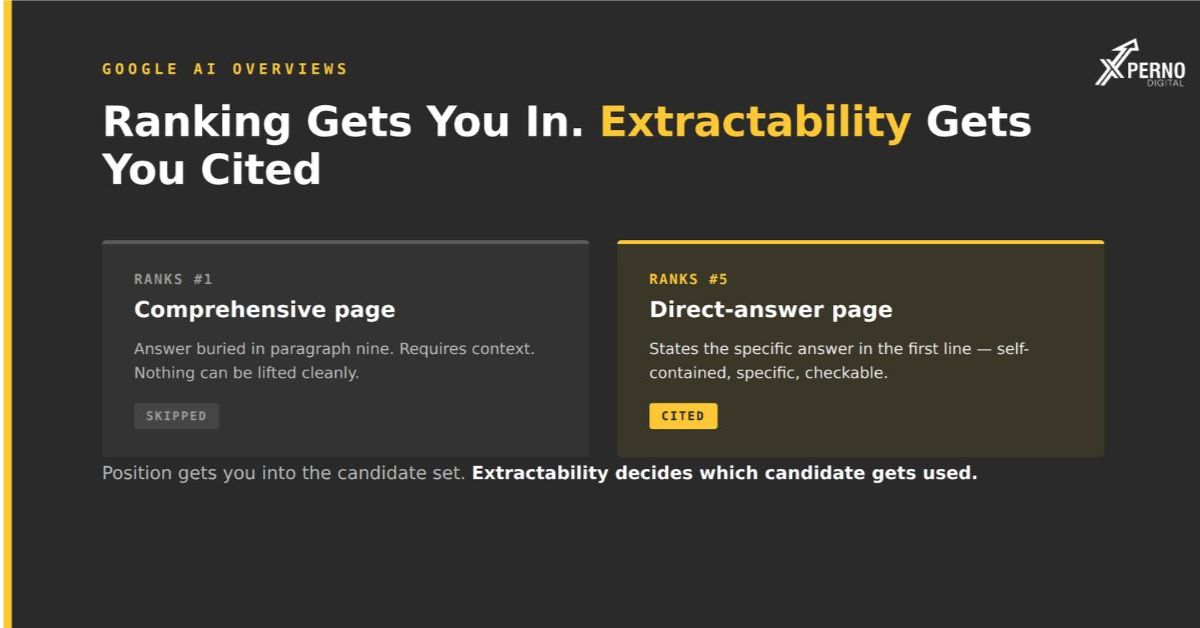
But ranking alone is not sufficient: Pages ranking first are routinely passed over in favour of pages ranking fifth that state the answer more clearly. Position gets you into the candidate set; extractability decides which candidate gets used.
Why does a #1 ranking page get skipped?
A top-ranking page gets passed over when a lower-ranking page states the specific answer more directly and more extractably.
Four Common Reasons:
- The answer is buried: Your page ranks first because it is comprehensive. The specific question asked is answered in paragraph nine. A competitor’s thinner page answers it in the first line, and that page gets cited.
- The page answers the topic, not the question: Ranking is topical; citation is specific. A page about “project management software” ranks for the category. A page about “how much project management software costs for a 50-person team” gets cited for that query.
- No self-contained claim: The answer exists but is distributed across three paragraphs and requires context to make sense. Nothing can be lifted cleanly.
- The claim is hedged into uselessness: “Costs vary considerably depending on your requirements” is technically accurate and contains nothing extractable. “Most tools in this category run $15–$60 per user per month, with the variation driven by seat count and feature tier” can be used.
How do you optimise for AI Overviews?
Rank first, then make the specific answer extractable in that order:
1. Maintain baseline search rankings:
Because AI Overviews draw from ranking pages, everything that produces rankings still applies. Technical health, useful content, internal linking, some authority.
This is the one AI surface where classic SEO remains a prerequisite rather than a supporting factor. There is no route to AI Overview citation that bypasses ranking.
2. Target question queries specifically:
AI Overviews appear far more often on question-shaped queries than on navigational or transactional ones.
- Triggers an Overview frequently Rarely triggers one
- “How much does X cost” “X login”
- “What is the best X for Y” “X pricing page”
- “How long does X take” brand navigational searches
- “X vs Y” “buy X”
- “is X worth it”
Build pages that target the question forms. Your existing pages likely target the topic forms.
3. Answer in the first sentence:
The single highest-leverage change. Every H2 phrased as a question a buyer would ask, answered completely in the first sentence beneath, with no dependency on preceding context.
Test it by copying that sentence out of the page and reading it alone. If it still states a complete fact, it can be cited.
4. Use specific, checkable claim:
Numbers, ranges, conditions, boundaries. Not adjectives.
Hedged content is the most common failure among well-ranking B2B pages, because hedging feels safer. A range with stated variables “$15–$60 per user per month, driven by seat count and tier” is both more honest and more usable than “it depends.
5. Structure for scanning:
Short paragraphs, one claim each. Clear headings. Tables for comparative data. Lists where the content is genuinely a list.
These are the same signals that have long supported featured snippets, which is not coincidental AI Overviews evolved from the same underlying capability.
Do AI Overviews reduce your traffic?
AI Overviews reduce clicks on informational queries and have a smaller effect on commercial ones, but the mechanism matters more than the aggregate number.
Two things happen simultaneously and they are frequently conflated:
Clicks fall on queries the Overview fully answers: “What is a CRM” gets answered on the page. Nobody clicks. If your traffic depended on that query, it declines.
Being cited becomes more valuable than ranking: For commercial queries, the Overview names vendors. A buyer reading “the main options for teams under 50 are A, B and C” now has a shortlist, and the vendors named benefit substantially often more than a #3 organic ranking would have delivered.
The strategic implication: Informational content that exists to capture top-of-funnel traffic is losing value. Content that gets you named in a commercial answer is gaining it.
That is the same reprioritisation that applies across AI search generally, arriving via a different route.
Can you opt out of AI Overviews?
You cannot opt out of AI Overviews while remaining in Google Search, because they use standard Googlebot access.
This is a common point of confusion, so worth stating plainly:
- Control What it does? Effect on Search.
- Google-Extended Controls use in Gemini and AI training No effect on Search or AI Overviews.
- no snippet Prevents snippet display Removes you from AI Overviews and from featured snippets and normal snippets.
- max snippet:0. Same effect .Same trade-off.
- Blocking Googlebot Removes you from Search entirely Total.
There is no setting that removes you from AI Overviews while preserving normal search visibility. `no snippet` technically achieves it but at the cost of your search snippet, which is generally a worse outcome.
For B2B software this is not a difficult call. Being cited in an Overview puts you in front of a buyer at the moment they are forming a shortlist. That is worth more than the clicks you might protect.
How do you track AI Overview appearances?
There is no dedicated report, so track it manually alongside your other AI visibility testing.
What Search Console does not tell you.: AI Overview impressions and clicks are folded into your normal Search performance data. There is no separate dimension for them, so you cannot isolate the effect from the report.
A workable manual method:
1. Take fifteen to twenty question-shaped queries relevant to your buyers
2. Search each in an incognito window, monthly
3. Record whether an Overview appeared, whether you were cited, and which sources were
4. Screenshot with the date visible
What to watch for beyond your own presence: Overview appearance is itself volatile. Google adjusts which queries trigger them, so a query producing an Overview this month may not next month. Record whether one appeared at all, not just whether you were in it otherwise a query that stopped triggering Overviews looks like a loss of visibility.
Third-party tools increasingly report AI Overview presence for tracked keywords. Treat the figures as directional; methodologies vary and results diverge from what individual users see.
How does this differ from optimising for ChatGPT?
Google AI Overviews reward ranking and extractability; ChatGPT and Perplexity reward corroboration across independent sources.
- AI Overviews ChatGPT / Perplexity
- Entry requirement Ranking well Being retrievable and corroborated
- Primary lever Answer clarity on ranking pages Third-party presence and comparative content
- Response to new content Weeks Weeks (retrieval) / model release (trained)
- Where the work happens Mostly on your domain Substantially off your domain
What this means practically?: If you appear in AI Overviews but not in ChatGPT or Perplexity, your on-site SEO is working, and your off-site presence is thin. That is a common and diagnosable pattern, and it points squarely at review platforms, roundups and comparative content.
If the reverse, your content is being retrieved and corroborated but is not ranking well enough to enter the AI Overview candidate set. That points at traditional SEO fundamentals.
Testing all three engines is what makes the diagnosis possible.
Frequently Asked Questions:
Do AI Overviews use the same ranking algorithm as Google Search?
They draw predominantly from pages that rank well, but selection among those pages depends on which contain a clear, extractable answer to the specific query. Ranking is the entry ticket, not the decider.
Can I pay to appear in AI Overviews?
No. Google has tested ad placements adjacent to Overviews, but the cited sources themselves are organic.
Why did my traffic drop when AI Overviews launched for my queries?
Overviews reduce clicks most on informational queries they fully answer. Commercial queries where the Overview names vendors show a smaller effect, and being named can outweigh the click loss.
Does schema markup help with AI Overviews?
Indirectly. It disambiguates your facts, which supports accurate citation, but it is not a selection factHow often do AI Overviews change?
How often do AI Overviews change?
Frequently. Which queries trigger them, and which sources are cited, both shift. Monthly tracking is enough to see the trend without chasing noise.
Should I write shorter content because of AI Overviews?
Not shorter denser. Claim density matters more than length. A long page with the answer stated clearly at the top of each section works well.