
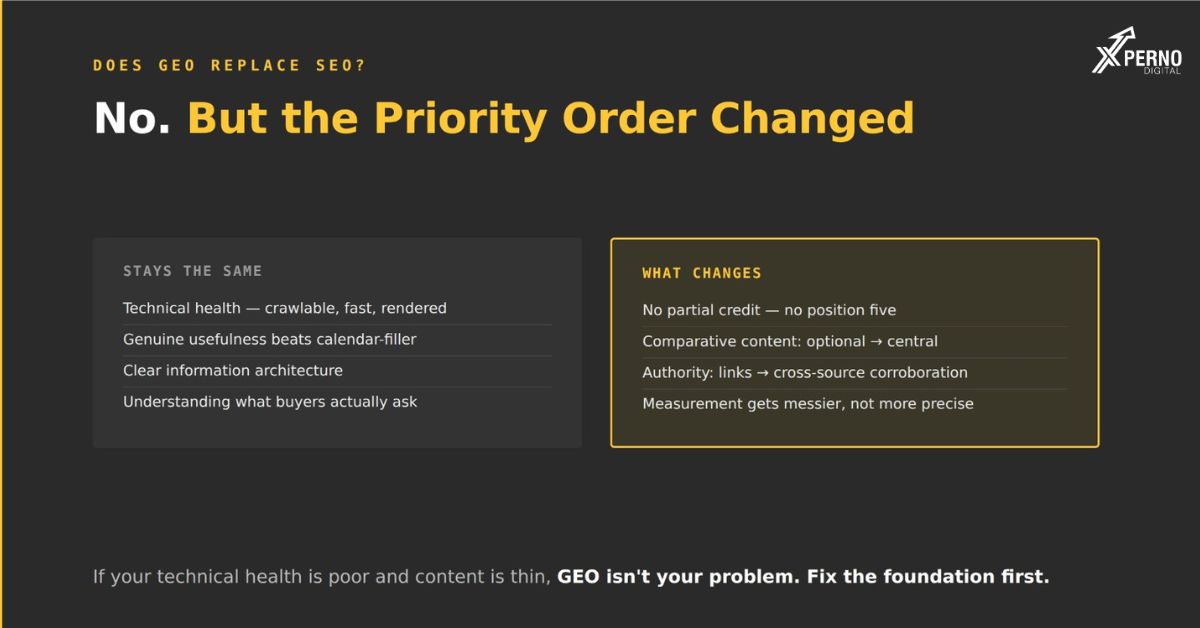
No. GEO and SEO share their technical and content foundations, and a company with broken SEO will fail at both. What changes is which parts of the work pay off.
That is the short answer. The longer one is more useful, because “no” alone leaves you doing exactly what you were doing before, which is also wrong.
What is genuinely true?
- The foundations are shared and largely unchanged
- The priority order within those foundations has shifted meaningfully
- Some activities that worked well have stopped working well
- Some that were marginal have become central.
Who has an incentive to overstate it?: Agencies selling GEO as a new service line, tool vendors launching AI visibility products, and anyone whose commercial story depends on your existing work being obsolete.
Who has an incentive to understate it?: Experienced SEOs who have correctly watched five previous “end of SEO” moments turn out to be adjustments and have over-corrected into dismissing this one.
We sell this work, so weigh the below accordingly? The specific claims are checkable.
What stays the same?
Four foundations, and they account for most of the work:
Technical health: If crawlers cannot access your site, if content renders only in JavaScript, if pages are broken or unreachable — you fail at both. Nothing about AI search reduces the importance of a functioning site.
Genuine usefulness: Content that answers a real question, written by someone who understands the subject, still outperforms content produced to fill a calendar.
Clear information architecture: Logical structure, sensible internal linking, discoverable pages. Both systems need to find and understand your content.
Understanding your buyer: Knowing what people actually ask, in their own words, is the input to both. What changed is the interface where they ask it, not the questions.
The practical implication: If your technical health is poor and your content is thin, GEO is not your problem. Fix the foundation first. Anyone selling you AI visibility work on a broken site is selling you something that will not work
What actually changes?
Four shifts, each with a concrete consequence:
1. No partial credit:
Ranking eighth produced some visibility. In an answer naming four vendors there is no position five.
Consequence: Incremental improvement matters less, crossing the threshold matters more. Moving from position 15 to 9 gains something in search and nothing in AI answers.
2. Comparative content moves from optional to central
Buyer queries in AI interfaces are comparative best tool for X, compare A and B, alternatives to C. A page describing only your product cannot answer them.
Consequence: The typical B2B content portfolio, heavy on explainers and light on comparison, is structurally wrong for this. Comparison and alternatives pages become the highest-value content you can build.
3. Authority shifts from links toward corroboration:
SEO authority could be built substantially on your own property. Retrieval favours sources that multiple independent parties corroborate.
Consequence: Four of the most-cited source types are not on your domain. You can publish excellent content indefinitely and remain invisible if nothing external describes you consistently.
4. Measurement gets worse before it gets better:
SEO has mature tooling. AI visibility has manual prompt testing and imprecise results.
Consequence: You cannot manage this the way you manage SEO. Feedback is slower, noisier and directional. Anyone presenting AI visibility figures with rank-tracker precision is overstating the method.
What should you stop doing?
Three activities that have lost most of their value:
Volume publishing against keyword lists: Explainer content is the least-cited type for vendor recommendation queries and the most affected by zero-click answers. If twelve months of it did not produce visibility, more will not either.
Chasing category head terms: “Best CRM software” is dominated by whoever has accumulated the most mentions over years. In most categories it is not winnable at any realistic budget, and it converts worse than the narrower queries anyway.
Link building as the primary off-site activity: Links still contribute to ranking. But being described accurately in a source these systems read matters more than being linked from a directory nobody reads.
What should you start doing
Four things, in order of return:
Comparison and alternatives pages: Six to ten pages, finite build, targeting the highest-intent queries in your category and the most-cited content type in AI answers.
Extractable facts: State plainly what your product does, who it is for, what it costs, what it integrates with. Marketing prose contains nothing a model can lift.
Third-party presence: Review platforms with recent velocity, inclusion in the roundups that actually appear in citations for your category, genuine community participation.
Monthly measurement: Fifteen to twenty fixed prompts, fresh sessions, logged. Without a baseline you cannot tell whether anything works, and that uncertainty is what causes teams to abandon the effort in month three.
Is this different from previous “SEO is dead” moments?
Somewhat larger, and worth being sceptical about anyway including about this post.
Search has been declared dead repeatedly: Mobile-first indexing, voice search, featured snippets, every substantial core update. Most were adjustments. The teams that panicked wasted a quarter; the teams that ignored them lost a little ground and caught up.
What is genuinely different this time?: The interface changed rather than the ranking. A synthesised answer naming four vendors is a different output from a page of ten links, and the absence of partial credit is a real structural change.
What is the same as every previous time?: The underlying work. Be genuinely useful, be clearly structured, be credibly cited. That has been the answer to every previous shift and it is the answer to this one.
The honest position?: This is a meaningful shift in which parts of the work pay off, not a reset. Be sceptical of anyone claiming otherwise and be sceptical of anyone claiming nothing changed, because they are usually people who have not run the check
How do you know if it applies to you?
Run five buyer-intent prompts and look at the answers. Fifteen minutes, no tools.
Open ChatGPT and Perplexity in fresh sessions. Ask for the best tool for your ideal customer’s specific situation. Ask for alternatives to your largest competitor. Note which brands appear.
If you appear consistently, this is not your most urgent problem. Recheck quarterly and spend your attention on whatever your actual constraint is. That is a legitimate outcome and it is more common than the marketing around this suggests.
If competitors appear and you do not, you have confirmed exposure in a channel your reporting does not cover and the reprioritisation above is worth making.
If you appear but are described inaccurately, fix that before anything else. Increasing the reach of a wrong description makes things worse.
Frequently Asked QFseouestions:
Should I stop doing SEO?
No. Reprioritise within it. Less volume publishing and head-term chasing; more comparison content, extractable facts and third-party presence.
Is SEO dead?
No. Search volume remains substantial, and several AI engines draw predominantly from pages that already rank. What changed is which SEO activities pay off.
Do I need a separate GEO budget?
Generally no. Treating it as a parallel workstream produces duplicated effort. Same team, same budget, different priority order.
Will my existing SEO work still count?
Technical health, useful content and clear architecture all still count. Volume content targeting informational queries counts for less than it did.
How long before the reprioritisation shows results?
Specific and comparative queries typically move in eight to fourteen weeks. Broad category queries take six to twelve months, and in entrenched categories may not be winnable.
Who should I not trust on this question?
Anyone whose answer is a confident extreme in either direction, and anyone presenting precise figures without stating how they measured.