
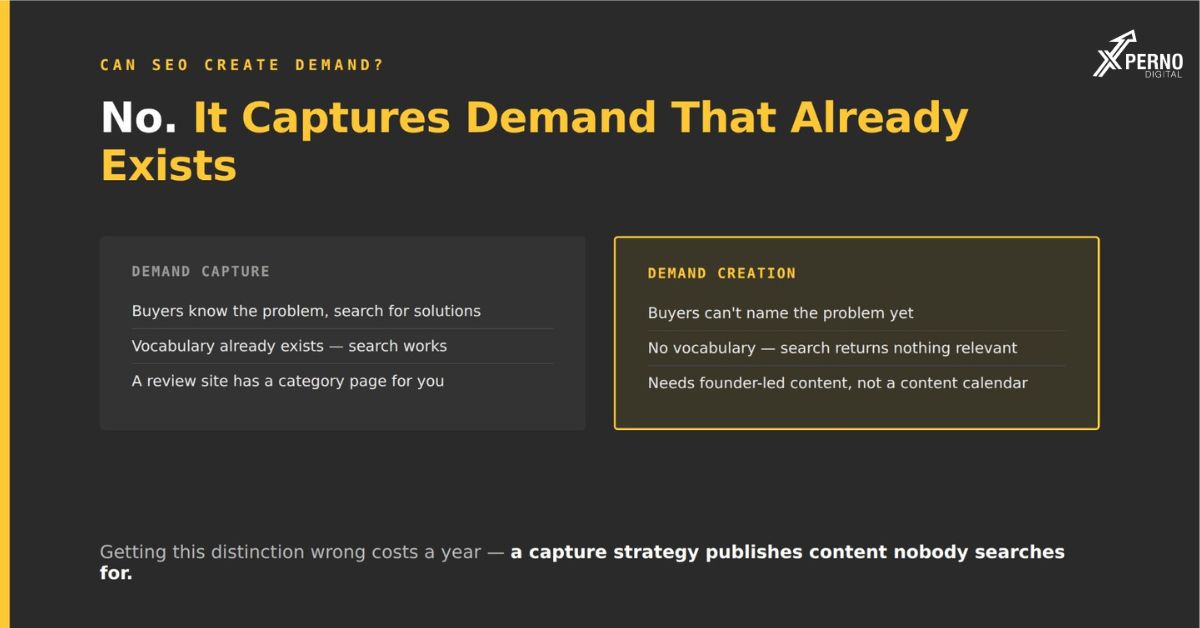
No. Search captures demand that already exists it cannot create demand for something buyers cannot name. If your category has no established vocabulary, buyers do not know to search for it and cannot describe it to an AI assistant, which makes search the wrong primary channel until the vocabulary exists.
This is an uncomfortable position for an agency to publish, and it is the accurate one. Getting the distinction wrong costs a year.
What is the difference between demand capture and demand creation?
Demand capture means buyers know they have the problem and are actively looking for a solution. Demand creation means you are defining something new and buyers lack the vocabulary to describe the problem until someone gives it to them.
The distinction determines which channels can work for you, and it is checkable in ten minutes.
| Check | Demand capture | Demand creation |
| G2 or Capterra has a category page | Yes | No |
| Competitors run ads on the category term | Yes | No |
| Comparison articles already exist | Yes | No |
| Search returns relevant competing results | Yes | No |
| Prospects use the term unprompted on calls | Yes | No |
Three or four noes means you are creating a category, and a capture strategy will publish content nobody searches for.
What happens if you run the wrong strategy?
You spend a year producing content against search volume that does not exist, then conclude the channel does not work.
The sequence is predictable. A demand-creation company hires for content or an agency, targets terms a keyword tool suggested, publishes consistently, and sees nothing because nobody is searching those terms in the first place. The diagnosis usually lands on execution rather than on the channel being structurally unavailable.
The same applies in AI search, and more sharply. A buyer cannot ask an assistant about a category they cannot name. When they describe their problem in whatever vocabulary they have, the model answers with the nearest established category and you are not in it.
Why does founder-led content work for category creation?
Because a person can hold a position that a company cannot easily hold, and vocabulary forms through repetition by identifiable people.
Three mechanisms, none of which an agency can substitute for.
A person can hold a position:
Category creation requires arguing that the existing way of doing something is wrong. That is a claim, and claims attach to people.
Companies hedge through legal review, through brand guidelines, through committee. Hedged arguments do not teach anyone a new word, because the thing that makes a new category memorable is the sharpness of the distinction being drawn.
Consistency over years builds vocabulary:
A category becomes searchable when enough independent sources use the term. That starts with a small number of people using it repeatedly, in public, until practitioners pick it up.
The sequence runs roughly: a few companies use the term, practitioners repeat it in communities, trade publications adopt it, a review platform creates a category page, search volume becomes measurable.
That is a multi-year commitment from a specific person, and it cannot be delegated because the credibility attaches to whoever keeps saying it.
People follow people:
In markets without established categories, awareness runs through individuals podcasts, conference talks, LinkedIn, community participation. A company page publishing the same content reaches a fraction of the audience, because nobody follows a company page for a point of view.
What does founder-led content actually involve?
Two to four hours a week, sustained for years. That is the honest number, and it is why most category creation attempts fail.
- A defensible position, repeated. Not a different topic every week the same argument approached from different angles, for two years. That repetition is what teaches a market a word.
- Long-form conversation. Podcasts, recorded interviews, conference talks. These carry the explanation a new category requires and cannot be summarised away the way a blog post can. Ask whether the podcast publishes transcripts that determines whether it is also a searchable asset.
- Community participation. Where practitioners discuss the problem before it has a name. This is where category vocabulary actually forms, and it requires someone who genuinely understands the problem rather than a marketer monitoring mentions.
- Original research. Naming and quantifying a problem is how a category acquires legitimacy, and it is the most reliable route to earned coverage because journalists need statistics.
What can an agency genuinely help with here?
The mechanics, not the view:
| An agency can | An agency cannot |
| Structure, distribution and measurement | Supply the position |
| Turn a founder’s 20-minute conversation into publishable material | Sustain the consistency — that has to be the founder |
| Capture adjacent demand meanwhile with comparison content | Create search volume that does not exist |
| Prepare for the transition once vocabulary emerges | Accelerate how fast a market adopts a word |
The most useful thing an agency does during category creation is capture the adjacent demand. Buyers with your problem are currently searching for the nearest established category, and comparison content against those tools reaches them using vocabulary they already have while the category story gets built in parallel.
When is an agency the better answer?
When the category exists and you are invisible in it, which is the more common situation.
Established comparison queries, review platforms with a category page, third-party roundups being published and a company with no comparison content, nothing corroborating them externally, facts locked behind forms, possibly a blocked crawler nobody has checked.
That is a mechanical problem with a mechanical fix, and it does not require anyone to become a public figure.
Most B2B software companies are in this situation rather than in category creation, which is worth establishing before committing to a multi-year founder-visibility programme.
Are you creating a category or badly positioned?
If buyers have the problem and search for solutions using older vocabulary, you are in capture with a positioning problem which is much cheaper to solve.
This distinction is worth checking carefully, because the two look similar from inside a company. Creating a category name while operating in an established space is common, and it is not the same as creating a category.
The test: does anyone search for the problem you solve, using any vocabulary? If yes, the demand exists and your naming is the issue. If nobody searches for the problem at all, in any words, the category genuinely does not exist yet.
When should you revisit search?
When your category term returns relevant results and a review platform has created a page for it.
That is the practical threshold. A review-site category page means shared vocabulary, a browsable set of alternatives and structured comparative data exactly what search engines and AI systems need.
Run the ten-minute check quarterly. When it flips, the standard approach applies fully, and you will have years of consistent description behind you while competitors are starting from nothing.
Frequently Asked Question:
Can SEO create demand for a new category?
No. Search captures demand that exists. Category creation requires teaching a market a new word, which happens through people rather than through search.
How do I know if I am creating a category or just badly positioned?
If buyers have the problem and search for solutions using older vocabulary, you are in capture with a positioning problem — much cheaper to solve.
Should I use my category name or the established one?
Both. Established vocabulary in comparison and capture content; your own in founder content, research and community.
How long does category creation take?
Typically years. Categories that appear to have emerged quickly usually had a long period of practitioner usage first.
What if the founder will not be visible?
Then category creation is unlikely to work. The honest options are capturing adjacent demand or accepting a slower path through community and partnerships.
Does it help if competitors adopt my category name?
Yes. A category with one vendor is a product name. Several players using the same term is what makes it a category.