
A consensus signal is agreement across independent sources about what your product is and who it suits. AI engines weight it heavily because it is difficult to fabricate and it is the only quality proxy available from text.
A model cannot install your software or talk to your customers. What it can observe is that eight different sources a review platform, three roundups, a competitor’s comparison page, two community threads, your documentation describe you in broadly the same terms.
That agreement is the evidence. Where it exists, you get recommended. Where sources disagree, the model reconciles the conflict and usually follows the external majority over your own framing.
The uncomfortable implication: Consensus measures how consistently you have been described, not how good your product is. A well-documented average product outranks a better one nobody has written about.
How does consensus form?
Through accumulation across independent sources over months which is why it cannot be bought or rushed.
The mechanism is straightforward and slow:
1. A source describes you
2. Another source, written independently, describes you similarly
3. A third repeats it, often having read the first two
4. The description stabilises into what you are
Two properties worth understanding:
It is self-reinforcing: Once three sources agree, the fourth writer researching your category encounters that description and repeats it. Consensus accelerates once established, which is why incumbents compound and newcomers struggle.
It is slow to change: If the consensus about you is wrong old pricing, outdated category, a discontinued feature correcting it means changing the underlying sources one at a time and waiting. There is no faster path.
Why does disagreement hurt more than absence?
Absence means you are not considered. Disagreement means the model has to pick a version, and it usually picks the one you did not choose.
Three specific ways disagreement shows up:
Category conflict: You describe yourself as a “revenue intelligence platform.” Your G2 listing says sales analytics. Three articles say CRM. The model reconciles this, follows the external majority, and you get considered for CRM queries where you compare badly.
Attribute conflict: Your pricing page says $49. A roundup from 2023 says $89. A review mentions a free tier you discontinued. The answer contains whichever the model weighted most, and you cannot predict which.
Positioning conflict: You position for enterprise; every third-party source describes you as an SMB tool. External consensus wins, and enterprise buyers never see you.
The fix in all three cases is the same: Make the sources agree. Which is unglamorous, slow, and mostly a matter of persistence rather than skill.
What sources actually build consensus?
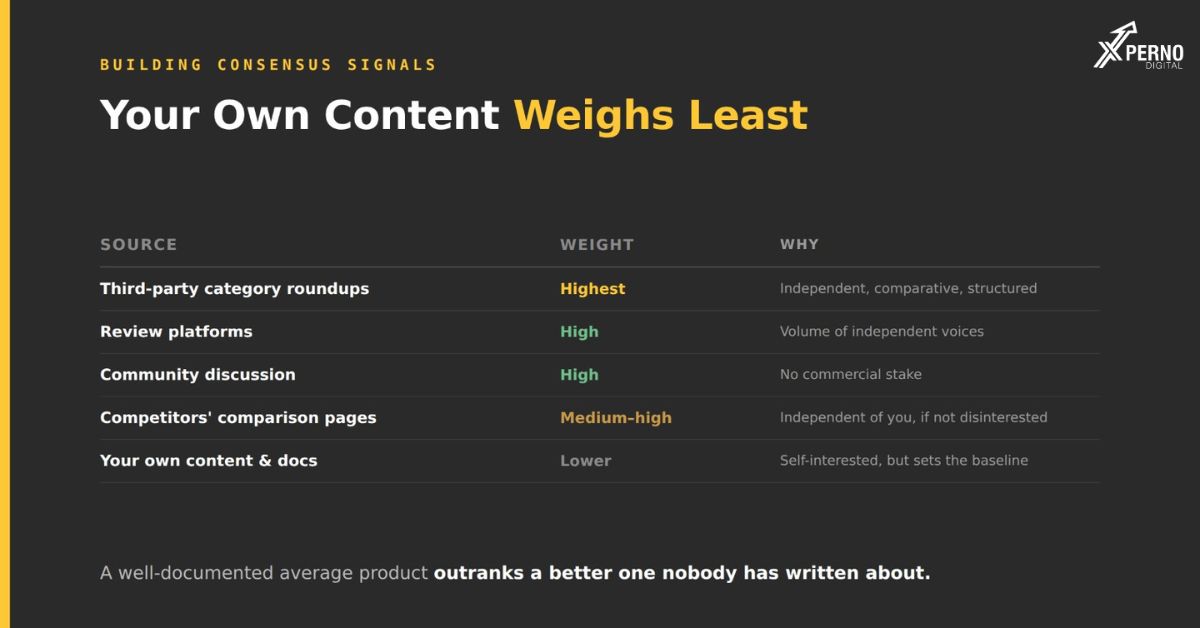
Independent sources carry the most weight, and four of the six that matter are not on your domain.
- Source Weight Why ?
- Third-party category roundups Highest Independent, comparative, structured
- Review platforms High Volume of independent voices, structured data
- Community discussion High Practitioners with no commercial stake
- Competitors’ comparison pages Medium-high Independent of you, though not disinterested
- Structured listings and databases Medium Machine-readable, widely mirrored
- Your own content and documentation Lower Self-interested, but establishes the baseline
Your own content matters least for consensus and most for accuracy. It is the reference point everything else should agree with, but it is one self-interested voice among many.
Competitors’ pages about you are a genuine source. They describe you, they are read by these systems, and if you have no equivalent page, their characterisation is the only version that exists.
How do you build it deliberately?
Five steps, in sequence. The first two are fast; the rest take months:
Step 1: Write one canonical description:
One or two sentences containing category, function and target customer.
“[Product] is field service scheduling software for HVAC and plumbing contractors with 10–200 field technicians.”
This becomes the reference point. Every subsequent step is about getting sources to agree with it.
Step 2: Deploy it everywhere you control:
Website meta description, About page, Organization schema, LinkedIn, G2, Capterra, Crunchbase, documentation, app marketplace listings, press boilerplate.
Verbatim, not paraphrased. Variation is what creates the ambiguity you are trying to remove.
Most companies find eight to fifteen places where the description differs. Fixing them is a day of work and it is the highest-return step here.
Step 3: Connect your presences:
Organization schema with a complete `sameAs` array listing every profile you control. This declares explicitly that these all refer to one entity rather than leaving it to inference.
Step 4: Build independent sources:
The slow part:
- Review platforms: Systematic requests at points of high satisfaction. Recency matters more than volume.
- Category roundups: Identify which ones appear in AI citations for your category, then approach the authors with something useful a correction, a data point, a specific case for inclusion.
- Community: Genuine participation, affiliation disclosed, over months.
- Earned coverage: Original data is the most reliable route.
Step 5: Correct disagreement as you find it:
Monthly, check what the engines say about you and verify every factual claim. Where a source is wrong, trace it Perplexity’s citations help and correct it at source.
How long does it take?
Four to six months before consensus shifts meaningfully, and twelve before it compounds
- Timeline: What happens?
- Weeks 1–2: Canonical description deployed everywhere you control
- Weeks 3–8: Own sources corrected and crawled. Nothing visible changes
- Months 2–4: Review velocity accumulates. Outreach begins landing
- Months 4–6: Third-party sources start agreeing. Answers begin shifting
- Months 6–12: Consensus stabilises. Self-reinforcement begins working for you
Why there is no faster path? You cannot manufacture independent agreement quickly. Attempts to mass review generation, astroturfing, paid placements presented as independent are detectable, and when they surface the reputational cost exceeds the invisibility you started with.
Which is also why it remains a source of advantage? Slow, unglamorous work that cannot be shortcut is work most competitors will not do.
What if the consensus about you is wrong?
Correct the sources, not the symptom, and expect it to take longer than building consensus from scratch.
Changing an established description is harder than establishing one, because the self-reinforcing property works against you — writers researching your category encounter the wrong description and repeat it
The sequence:
1. Document it: Screenshots, dated, across engines. You need a baseline.
2. Trace the source: . Perplexity shows citations. Read the cited pages and identify which ones carry the wrong claim.
3. Fix your own pages first, with a plain, dated, extractable correction.
4. Update every listing you control.
5. Contact publishers: where third-party articles are wrong. Success rates are moderate and the effort is small.
6. Publish content asserting the correct version a comparison page, a positioning piece so a correct source exists to be found.
7. Recheck monthly: Partial correction is normal: an engine may state your correct category while still quoting old pricing.
Frequently Asked Questions:
Can I build consensus faster by paying for coverage?
Paid placements are usually disclosed, which reduces their weight as independent sources. The independence is what you were buying.
How many sources do I need before consensus forms?
There is no threshold. Agreement among five or six independent sources is more valuable than volume from many that all repeat one original.
What if my competitors describe me inaccurately?
Publish your own comparison page so a second version exists. You cannot compel them to change theirs.
Does consensus matter more than my own content?
For citation, yes. Your content establishes the baseline that everything else should agree with, but it is one self-interested voice.
How do I check the current consensus about my brand?
Ask ChatGPT, Perplexity and Gemini to describe your product, and check every factual claim. Where they disagree with each other, the consensus has not settled.
Is this the same as brand awareness?
Related but distinct. Awareness is whether people know you exist. Consensus is whether the sources describing you agree on what you are.