
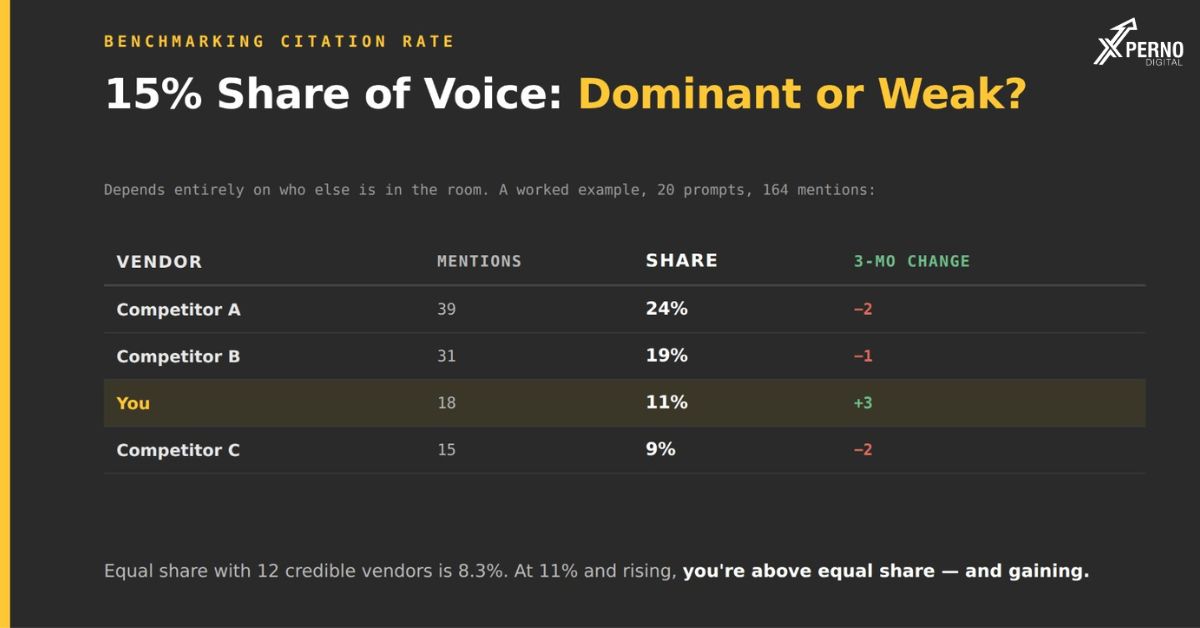
An absolute citation rate is uninterpretable on its own 15% share of voice is dominant in a four-vendor category and weak in a forty-vendor one.
Without a comparison you cannot answer the only question that matters commercially: are we gaining or losing ground relative to the companies we compete against for the same deals?
Two specific failures that benchmarking prevents:
Reading category growth as your success: Your appearance rate rises because the whole category gained coverage. Without competitor data you conclude your work succeeded.
Missing a competitor’s move: They publish comparison content or land a roundup inclusion, their share climbs, yours falls proportionally. Your own numbers barely move, so nothing flags it.
What is equal share?
Equal share is 100 divided by the number of credible vendors in your category the figure you would hold if every vendor were cited equally.
- Vendors in category / Equal share
- 4 / 25%
- 8 / 12.5%
- 20 / 5%
- 40 / 2.5%
Why this is the right reference point? It converts an uninterpretable percentage into a ratio anyone can read.
- Your share ÷ equal share Read
- Below 0.3× Effectively invisible
- 0.3–0.7× Present but not prominent
- 0.7–1.3× Competitive, in the consideration set
- Above 1.3× Category leader position
How to count credible vendors? Not everyone in the market the vendors that actually appear in AI answers for your category. Run ten prompts, record every brand named, and count the distinct names that appear more than once. That is your real competitive set, and it is usually smaller than your internal list.
How do you build the benchmark?
Record every vendor named across your prompt set, not just whether you appeared.
This is the step that makes benchmarking possible, and it is the one most tracking sheets omit.
The columns you need:
- Column Purpose
- Date Month
- Prompt ID Fixed reference
- Engine ChatGPT / Perplexity / AI Overviews
- Run 1, 2, 3
- All vendors named, in order This is the benchmark data
- Your position, if named Prominence
- Sources cited From Perplexity where the citations come from
The Calculation:
Vendor share of voice = that vendor’s mentions ÷ total vendor mentions across all prompt.
Do it for yourself and your top three to five competitors. Group everyone else as “all others.”
A worked example from 20 prompts producing 164 total vendor mentions:
- Vendor Mentions Share 3-mo change
- Competitor A: 39 / 24% / +2
- Competitor B: 31 / 19% / −1
- You: 18 /11% / +3
- Competitor C: 15 / 9% / −2
- All others: 61 /. 37%
Equal share with 12 credible vendors would be 8.3%. At 11% you are slightly above equal share and gaining, while sitting third. That is a specific, defensible statement about competitive position.
Which competitors should you track?
Track the vendors that actually appear alongside you in AI answers not your internal competitor list.
These are frequently different, and the difference is itself informative.
Three groups worth distinguishing:
- Vendors you compete with in deals. From your CRM who you win against and lose to.
- Vendors AI names alongside you. From your prompt data.
- The overlap. These are your real benchmark set.
When the two lists diverge significantly, you have found something. A vendor appearing constantly in AI answers who never shows up in your deals means the model has grouped you with a company in an adjacent segment that is an entity problem, and it means you are being considered for the wrong queries.
Conversely, a competitor you lose deals to who never appears in AI answers is currently invisible in this channel. That is an opportunity, and it will not last.
What does the gap tell you?
The pattern of where you trail by prompt type points at which part of your visibility is weak.
Break the comparison down by query type rather than reading a single aggregate number.
- Where you trail? Likely cause Fix
- Alternatives queries: No alternatives page exists Build one for your largest competitor
- Comparison queries: No comparison content, or theirs is the only version Build comparison pages
- Broad category queries: Accumulated presence gap Usually not winnable quickly deprioritise
- Specific use-case queries: No page addresses that situation Build use-case pages
- Everywhere, consistently: Thin third-party corroboration Reviews, roundups, community
The most actionable finding is trailing on alternatives and comparison queries while holding your own elsewhere. That gap is closable in a quarter and it sits on the highest-intent queries in your category.
The least actionable is trailing only on the broad head term. That is usually an accumulation gap that a year of work will not close, and recognising it early saves the budget for queries you can win.
How often should you benchmark?
Full competitive benchmark quarterly: Your own share of voice monthly.
Monthly: Run your prompt set, calculate your own share of voice, record every vendor named. Twenty to thirty minutes.
Quarterly: Do the full competitive calculation, update the equal-share figure if the vendor set has changed, and read the gap by query type. An additional hour.
Why not monthly for the full analysis?: Competitor positions move slowly, and month-to-month variation in this data is mostly noise from output variability. Quarterly is where the signal is.
What are the limits?
Four, and they should be stated rather than hidden:
Your prompt set is a sample: Real buyers phrase things you have not tested. A competitor might dominate queries you never ran.
Output is variable: Movement of a few percentage points is within the margin. Three runs per prompt reduces noise without eliminating it.
Mentions are not weighted by prominence: Being named first and being named fifth count equally in a raw share calculation. Recording position lets you weight it if you want to, at the cost of complexity.
Attribution to your own work is imperfect: If your share rises, you cannot cleanly separate your content work from a competitor’s decline or a third-party article that happened to include you.
None of this makes it worthless. It makes it directional which is considerably better than the alternative, which is no view at all of your position in a channel affecting your pipeline. Report it as direction rather than precision, and round to whole numbers rather than implying an accuracy the method does not have.
Frequently Asked Questions:
How many competitors should I benchmark?
Three to five individually, with everyone else grouped. More than five becomes unreadable in a report.
What if my competitors change?
Review the set quarterly. New vendors appearing consistently in your prompt data should be added; ones that vanish can be grouped into “all others.”
Should I weight mentions by position?
You can, and it produces a more meaningful number. Start unweighted for simplicity and add weighting once the basic tracking is a habit.
How do I count vendors in my category?
Run ten prompts and count distinct brands appearing more than once. That is the real competitive set, and it is usually smaller than your internal list.
What if a competitor’s share drops suddenly?
Check whether a source that was citing them changed. Sometimes one roundup article accounts for a large share of a vendor’s citations, and its removal or update moves the numbers.
Can I benchmark without competitor data?
Not meaningfully. An absolute share of voice is uninterpretable without knowing how many vendors are competing for the same answers.