
AI-generated content is not penalised for being AI-generated. The problem is mechanical rather than punitive: a model generating content about your category produces the consensus view of that category, which gives no source a reason to cite you specifically.
This distinction matters because the debate is usually framed around detection and penalties, and that framing leads to the wrong conclusions.
Google’s stated position is that it rewards helpful content regardless of how it was produced. That is a reasonable policy and it is broadly what the evidence shows. Plenty of AI-assisted content ranks perfectly well.
But ranking and citation are different outcomes, and AI-generated content fails at the second for a reason that has nothing to do with policy.
Why is AI-generated content structurally uncitable?
A model generates the average of what already exists on a topic, and the average contains nothing worth citing.
Consider what happens when you ask an AI to write about your category. It draws on everything published on that subject and produces a well-organised synthesis of the consensus.
The output is competent. It is also, by construction, a restatement of what fifteen other sources already say.
Now consider a model deciding which source to cite when answering a buyer’s question. It needs a source that adds something a specific number, a comparison nobody else made, a position, a boundary condition. Faced with your page and fourteen others saying the same thing, there is no basis for preferring yours.
The mechanism in one sentence: AI content is generated from the consensus, so it cannot differentiate you from the consensus, so it cannot be the reason you get cited.
This applies regardless of how good the writing is. A beautifully written restatement of the consensus is still a restatement.
Where does AI genuinely help?
AI helps most with structure, transformation and volume tasks where the substance already exists.
Restructuring existing content: You have a page with real expertise buried in bad structure. Feeding it to a model with instructions to make every heading a buyer question and answer it in the first sentence is a legitimate and fast use.
Turning expert input into readable prose: A subject-matter expert talks for twenty minutes. The transcript is messy and full of genuine insight. A model turns it into a draft. The substance is human; the assembly is automated. This is the strongest use case in B2B and it is underused.
Documentation and reference content: Where the facts are known and the job is clear organisation rather than original thinking.
Meta descriptions, summaries, alt text: Mechanical, high-volume, low-judgement.
First drafts of structural scaffolding: Outlines, section frameworks, FAQ question lists. The shape, not the substance.
Research assistance: Finding sources, summarising material you then verify, generating angles to consider.
Translation and localisation drafts, with human review.
None of these are marginal. Together they represent a real productivity gain, and dismissing AI writing tools entirely means giving that up for no benefit.
Where does it cost you?
AI hurts where your differentiation is supposed to come from original analysis, comparative judgement and defensible positions.
Comparison content: A model does not know where your competitor is genuinely better for a specific segment. It does not know what your sales team hears on calls. It will produce a generic feature comparison that reads as marketing collateral, which is precisely the version that fails.
Original data and analysis: Self-evidently. The value is that nobody else has it.
Opinion and positions: A model will produce the balanced, consensus-safe version of any argument. The whole value of a position is that some people disagree with it.
Anything requiring proprietary knowledge: What you learned from 40 client engagements. What broke in the last migration. Which integrations actually cause problems.
Thought leadership: The name is unfortunate but the category is real. Content whose purpose is to demonstrate that a specific person thinks well about something cannot be produced by a system that thinks like everyone.
How do you tell if content is too generic to cite?
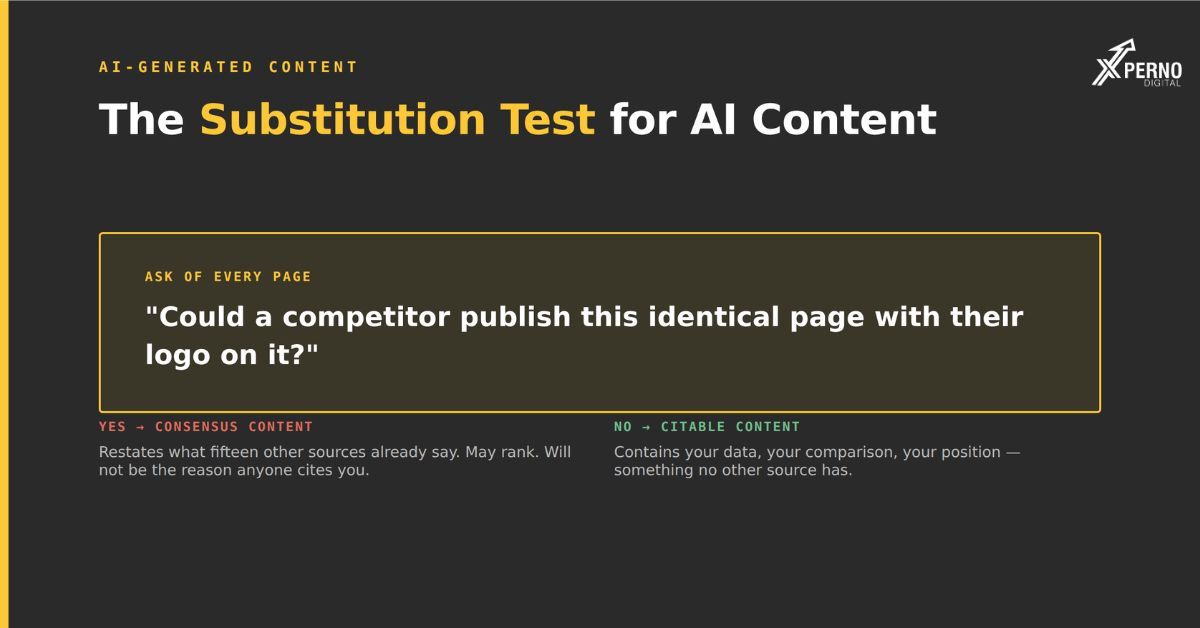
Apply the substitution test: could a competitor publish this identical page with their logo on it?
If yes, it is consensus content. It may rank, it may be useful to a reader, and it will not be the reason anyone cites you.
Three sharper checks:
Claim density: Count sentences stating something specific and checkable a number, a boundary, a condition, a comparison. Divide by total sentences. Under one in ten and the page is mostly connective tissue.
The extraction test: Pick any sentence. Could it be lifted and attributed as a fact? Or is it a general statement that requires the surrounding argument?
The disagreement test: Is there anything on this page a competent person in your field might dispute? Content nobody could disagree with is content nobody needs to cite, because every other source says it too.
What’s the right way to use AI in content production?
Use it for assembly, not for substance and be explicit internally about which parts are which.
A workable process:
1. A human decides what the piece argues and what specific facts it will contain. This is the part that cannot be delegated.
2. A human supplies the substance the data, the comparison, the position, the client observation. Twenty minutes of talking is enough.
3. AI assembles a draft from that input.
4. A human adds the specifics back in. Drafts smooth over precise numbers and hedge specific claims; this step puts them back.
5. A human applies the substitution test. If a competitor could publish it, it goes back to step 2.
The rule of thumb: AI can write the connective tissue. It cannot write the claims. If your process has a model producing the claims, you are automating the part that was supposed to differentiate you.
Does it matter that AI content is detectable?
Detection matters less than the mechanical problem, but it carries a reputational cost in specific contexts.
On detection tools: They are unreliable in both directions. They flag human writing as AI and miss AI writing routinely. Making decisions based on their output is unwise.
On human detection: Readers in some fields have become good at spotting the register over-structured, evenly hedged, certain recurring vocabulary, a particular rhythm. In B2B marketing and technical fields specifically, this is now widely noticed.
Where the reputational cost is real? If you are selling expertise, publishing content that reads as machine-generated undermines the thing you are selling. The content need not be detected by a tool; it only needs to read as generic to someone deciding whether you know what you are talking about.
Where it is largely irrelevant? documentation, reference content, and anything where the reader wants a fact rather than a perspective.
What should you actually do?
Use AI for assembly, produce fewer pieces, and put the saved time into the substance only you have.
The productivity gain is real. The mistake is spending it on volume.
The wrong version: AI lets you publish twelve posts a month instead of four. You now have twelve pieces of consensus content instead of four.
The right version: AI removes four hours of assembly time per piece. You publish three pieces a month instead of four, and spend the recovered hours pulling usage data, interviewing a customer, running a systematic test, or building a comparison page with facts nobody else has.
Same total effort. One produces content that could have any logo on it; the other produces content only you could have written.
Frequently Asked Questions:
Does Google penalise AI-generated content?
No. Google’s stated position is that it evaluates helpfulness rather than production method. The problem with AI content is that it tends to be generic, not that it is machine-produced.
Will AI-written content rank?
Often, yes particularly for informational queries. Ranking and citation are different outcomes, and it performs much worse at the second.
Should I disclose that content is AI-assisted?
There is no general requirement. Some publications and industries have their own norms. If your content is substantively human with AI assembly, disclosure is not usually expected.
Can AI write comparison pages?
It can write the structure. It cannot supply the comparative judgements where a competitor genuinely wins, what the real trade-offs are which are the parts that make the page worth citing.
Are AI de tection tools reliable?
No. They produce false positives and false negatives frequently. Do not make editorial or hiring decisions based on them.
What’s the single best use of AI in content?
Turning a subject-matter expert’s twenty-minute conversation into a readable draft. The substance is human, the assembly is automated, and it removes the main bottleneck in expert-led content.