
When is SEO the wrong investment?
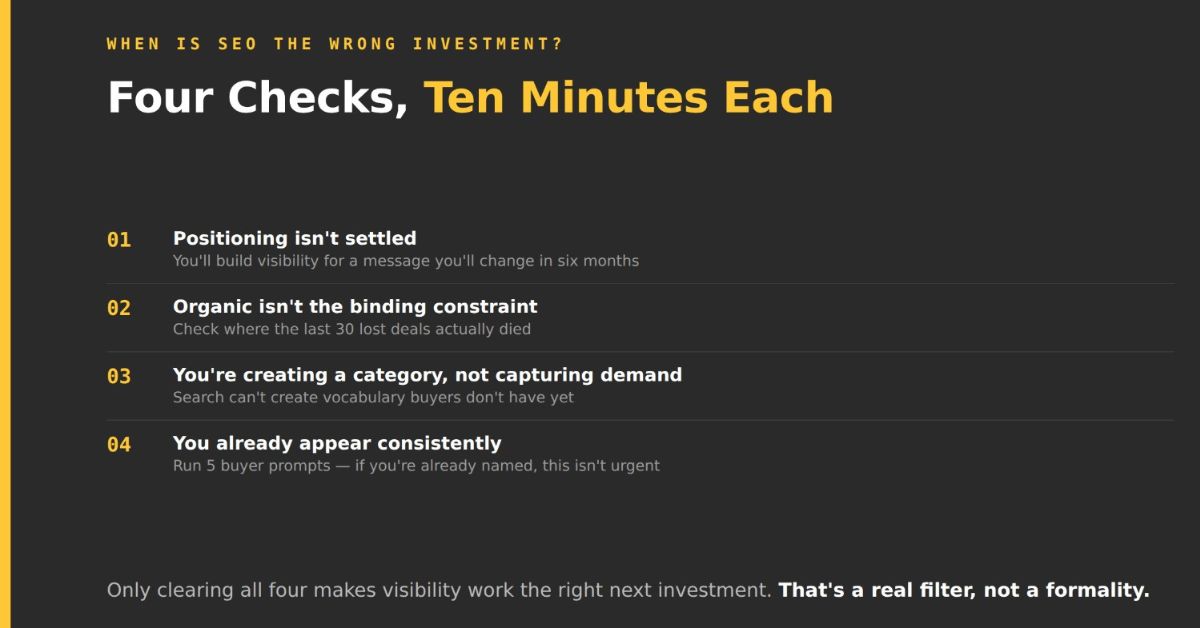
SEO is the wrong investment in four situations: when positioning is not settled, when organic is not the binding constraint, when you are creating a category rather than capturing demand, and when you already appear consistently in the places buyers look. Each is checkable in ten minutes.
We sell this work, which makes this an odd post to publish. The reasoning is at the end.
Situation 1: Your positioning is not settled:
Comparison pages require knowing which competitors you beat and for whom. Use-case pages require knowing which segments produce revenue. Both require settled positioning.
If you proceed anyway, you build visibility for a message you will change. Six months later the content describes a product you have repositioned, and the consensus forming about you across third-party sources is one you no longer want. Correcting an established description is harder than establishing one.
How to check: can you name who your product is genuinely wrong for, specifically? Can you name the three segments producing most of your revenue? If either answer is hedged, the positioning is not settled.
What to do instead: talk to more customers, narrow the segment. The content work is cheaper and faster once you know what you are building it around, and it will not need redoing.
Situation 2: Organic is not the binding constraint:
If deals stall at proposal, if your close rate dropped, if your sales cycle doubled the bottleneck is downstream of visibility.
Proceeding anyway sends more people into a funnel that is leaking further down. Cost per acquisition rises. The visibility work looks like it failed, when it worked and the problem was elsewhere.
How to check: pull the last thirty lost deals and find the stage where they died. If they are dying at proposal, at security review, or at procurement, that is the constraint and it is not a marketing problem.
What to do instead: fix the binding constraint. It is usually cheaper than a content programme, and the visibility work will be worth more afterwards because the funnel will hold what it catches.
Situation 3: You are creating a category, not capturing demand:
If buyers cannot name your category, they cannot search for it and they cannot describe it to an AI assistant. Search captures demand that exists; it does not create it.
The ten-minute check: does a review site have a category page for what you do? Do competitors run ads on the term? Does searching it return relevant competing results? Do prospects use the term unprompted on calls? Three or four noes means you are creating a category.
What to do instead: founder-led content, community participation, podcasts, partnerships, direct outbound. Revisit search once the category has vocabulary usually signalled by a review platform creating a category page.
One nuance worth checking: you may be creating a category name while operating in an established space. If buyers have the problem and search using older vocabulary, that is a positioning problem rather than category creation and it is much cheaper to solve.
Situation 4: You already appear consistently:
Run five buyer-intent prompts in ChatGPT and Perplexity, in fresh sessions, three runs on the important ones.
If competitors are named and you are not, there is an exposure worth addressing. If you are named consistently, this is not your most urgent problem recheck quarterly and spend the attention on whatever is.
This outcome is more common than the marketing in this field suggests. Some companies are already well positioned, usually because they built comparison content years ago for other reasons, or because their category is fragmented enough that everyone gets named.
How do you run this qualification yourself?
Forty minutes, four checks, no tools and no agency required:
| Check | Time | What to do | Fail condition |
| Positioning | 10 min | Write down who your product is wrong for, specifically | You cannot, or the answer hedges |
| Constraint | 10 min | Pull the last 30 lost deals and find the stage they died at | They died downstream of first contact |
| Category | 10 min | Review site category page? Competitors bidding? Comparison articles? | Three or four noes |
| Visibility | 10 min | Five buyer prompts across two engines | You already appear consistently |
Only if you clear all four is a visibility engagement the right next investment. That is a real filter, and it turns away more companies than most agencies would like.
Why would an agency publish this?
Two reasons, and the second is the honest one.
An engagement that should not have been sold ends badly. It consumes the team, produces a difficult conversation in month six, and the client tells people. The revenue is real and the total cost is larger.
And qualification is a credibility signal. In a field where the mechanics are opaque and claims are hard to verify, the willingness to say “not yet” is one of the few things a buyer can read as evidence of judgement. A prospect who has been pitched twice this month by agencies claiming universal fit notices immediately.
That is a commercial argument, not a moral one. It is better stated plainly than dressed up as principle.
What should you ask any agency you are considering?
“What would make you tell us not to hire you?”
An inability to name any condition suggests either no judgement or no willingness to exercise it. Someone who has genuinely done this work has a list, because they have had the conversation and remember it.
Ask it of us too. If the answer is vague, that is information.
What if you fail one check but not the others?
Fix the failing one first in most cases it is cheaper than the content programme:
| If this fails | Do this instead |
| Positioning | Customer interviews and segment narrowing. Then revisit. |
| Constraint | Fix whatever is killing deals downstream. Visibility work will be worth more afterwards. |
| Category | Founder-led content, community, partnerships. Recheck the category test quarterly. |
| Visibility (you already appear) | Nothing. Recheck quarterly and monitor whether competitors are gaining. |
One exception: technical hygiene is worth doing at any stage. Crawler access, server-side rendering and basic schema do not depend on positioning and will not need redoing later.
Frequently Asked Questions:
How do I know if organic is my real constraint?
Pull the last thirty lost deals and find the stage where they died. If it is downstream of first contact, more visibility will not help.
What if we are pre-product-market-fit but want to start early?
Do the technical hygiene — crawler access, rendering, basic schema. That work does not depend on positioning and will not need redoing. Leave the content until the positioning settles.
Is it ever too late to start?
No. Most companies in most categories have done nothing here, which is why the advantage is currently available. It narrows as the practice becomes routine.
We already appear in AI answers. Should we do nothing?
Recheck quarterly and monitor whether competitors are gaining. Position can erode without anything on your side changing.
How much does this qualification cost?
Nothing. Forty minutes, four checks, no tools required.
Why would an agency publish this?
Engagements that should not have been sold end badly and cost more than they earn — and saying so is one of the few credibility signals available in a field where most claims cannot be verified.