
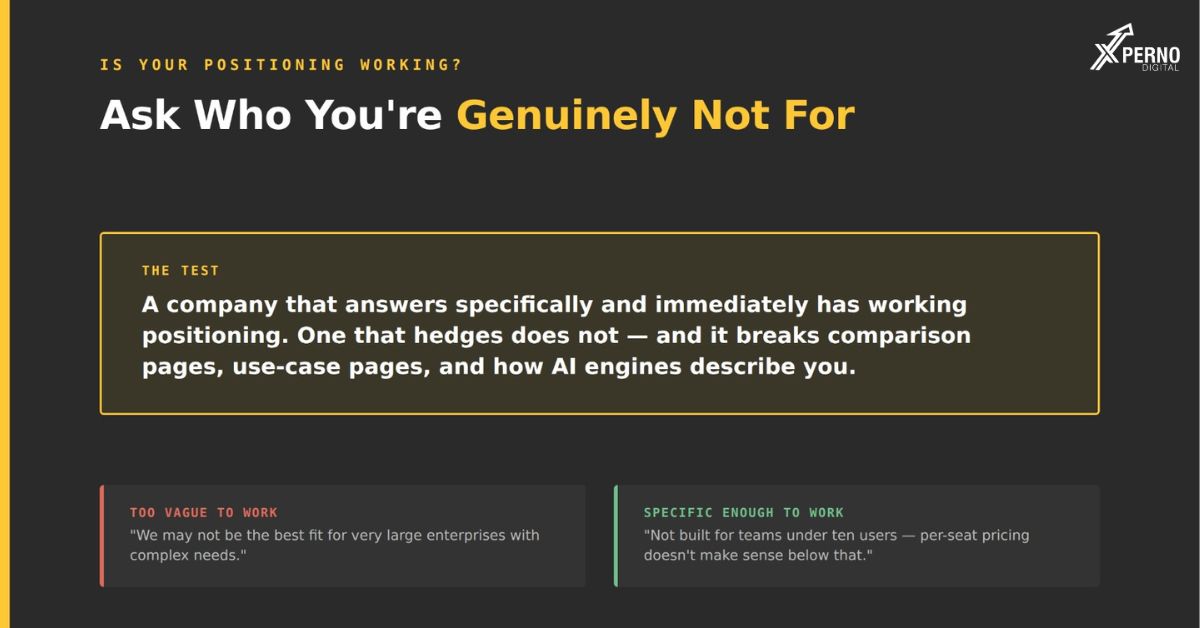
Ask who your product is genuinely not for. A company that can answer specifically and immediately has working positioning. A company that hedges or cannot answer does not and the consequences show up in comparison content, use-case pages, sales qualification and how AI engines describe you.
This is usually framed as a strategy question. It is more useful as a practical one, because the inability to answer breaks specific things you can identify.
What do the three possible answers tell you?
Companies fall into three groups, and the group determines what can be built.
| Answer type | Example | What it means |
| Specific and immediate | “Wrong for teams under ten, and wrong for anyone needing offline access” | Working positioning. Everything downstream can be built from it. |
| Hedged | “We can work for most businesses, though we are strongest in…” | Names a preference rather than a boundary. Excludes nobody. |
| Absent | Genuine inability to answer | Frequently pre-product-market-fit, or growth by taking whatever came. |
The middle group is the largest and the most misleading, because a hedged answer sounds like an answer.
Why does the absence of an answer break comparison pages?
Because a comparison page that works requires naming at least one segment where the competitor is genuinely better and that requires knowing who you are not for.
Without a boundary you already drew, every concession feels like a loss rather than a statement of scope. So the page gets written with every row favouring you.
Those pages are discounted by human readers, who have seen a dozen of them, and they provide weak signal to any system cross-referencing multiple sources. A page where every judgement favours the publisher contains no information that could not have been predicted from knowing who wrote it.
Why does it break use-case pages?
Because specificity requires exclusion.
If your product serves everyone equally, a page for architecture firms and a page for law firms differ only in the industry name. That is a template rather than a page, and neither will be cited for either query.
A use-case page needs a section describing what is genuinely different about serving that segment regulatory requirements, workflow differences, integrations they specifically need, terminology. If you cannot fill that section, the segment did not warrant a dedicated page.
How does positioning affect how AI engines describe you?
AI engines describe you based on how sources describe you, and sources describe you specifically only when you describe yourself specifically.
A company with a clear boundary generates consistent descriptions “field service scheduling for HVAC contractors with 10–200 technicians.” That description propagates. Review listings use it. Roundups repeat it. Third-party articles adopt it. The consensus forms around something precise.
A company without one generates vague descriptions, because there is nothing specific to repeat. Sources default to the category name. And when a buyer asks which tool suits their particular situation, a vendor described only as “a CRM” cannot be matched to a situation.
The practical consequence: vagueness in your positioning becomes vagueness in how you are described, which becomes absence from situational queries exactly the queries a smaller company can win.
How do you find out who you are not for?
Three routes, in order of reliability:
| Source | What to look for |
| Churn data | Which customers left within twelve months, and what did they have in common? Size, industry, use case, what they were trying to do. |
| Worst-fit current customers | The ones consuming disproportionate support, complaining about missing features, whose renewal is always uncertain. |
| Sales team | Which deals would they rather not have won? They will answer quickly and accurately, and it is rarely written down. |
A useful exercise: get three people from sales, support and product in a room and ask each to write down who the product is wrong for, independently. If the three lists do not overlap, that is the finding.
How do you write the exclusion?
Specifically enough that a prospect could read it and reasonably decide not to buy.
Too vague to be useful:
We may not be the best fit for very large enterprises with complex needs.
Excludes nobody, flatters you by implication, and no reader believes it.
Specific enough to work:
We are not built for teams under ten users the per-seat pricing does not
make sense below that, and the workflow assumes multiple people.
And we do not handle multi-currency invoicing. If you operate across more
than two currencies, you will need a separate finance tool alongside us.
Two clear boundaries, both checkable, both genuinely disqualifying.
Where should the exclusion appear?
Five places, present but not prominent:
- The product page: a short section stating what you do not do and who should look elsewhere.
- Comparison pages: the segment where each competitor is the better choice.
- Use-case pages: what the product does not handle for that specific segment.
- Pricing: the minimum viable customer, stated as a fact.
- Sales conversations: early, not late. A rep who says “we are probably wrong for you, and here is why” in minute five builds more trust than one who discovers it in month three.
Does stating exclusions reduce pipeline?
It reduces poor-fit pipeline, which is generally a good trade.
The customers you lose are the ones who would have churned, complained or asked for refunds. Whether that counts as a cost depends on whether you measure revenue or retained revenue.
The more relevant question is what it buys: comparison content that is credible, use-case pages that are specific, sales conversations that qualify faster, a description of your product precise enough for a system to match against a buyer’s situation, and a support team not absorbing the cost of poor-fit customers.
Companies that do this typically report fewer demos and higher close rates.
Frequently Asked Question:
What if our product genuinely works for everyone?
Check that against your customer data. Most products claiming universal fit have three segments producing most of the revenue and a long tail that churns.
Where does “who we are not for” go on the site?
Product page, comparison pages, use-case pages and pricing. Present but not prominent you are not leading with it, you are not hiding it.
Will stating exclusions reduce our pipeline?
It reduces poor-fit pipeline. Companies that do this typically report fewer demos and higher close rates.
How do I find who we are not for?
Churn data, worst-fit current customers, and asking sales which deals they would rather not have won. All three, then look for the overlap.
Does positioning affect how AI engines describe us?
Yes. Sources describe you specifically only when you describe yourself specifically. Vague positioning produces vague descriptions, which produces absence from situational queries.
Is this the same as an ideal customer profile?
Related but not identical. An ICP describes who you want. This describes who you will actively turn away, which is a stronger and more useful commitment.