
For most B2B software companies, competitors have published comparison pages describing their product its pricing, its limitations, its ideal customer to buyers who are actively evaluating. If you have no equivalent page, that version is the only one that exists, and it is what AI engines draw on when answering comparison questions.
Run the search before reading further. Try “[your product]” vs and “[your product]” alternatives. If the results are dominated by pages you did not write, you have found the situation.
Why does this matter more than it used to?
Two things changed the weight of competitor comparison pages.
They are a heavily cited source type. When an AI engine answers a comparison question, it needs comparative claims, and vendor comparison pages contain the densest concentration of them available including your competitors’ pages about you. The self-interest is discounted but not disqualifying, particularly when multiple vendors’ pages can be cross-referenced.
And absence is now total. In a ranked list, being outranked by a competitor’s page about you still left you on the page. In a synthesised answer built from three sources, if none of them is yours, your framing simply does not exist. There is no position five.
What does a competitor’s page about you actually say?
Not lies. Most comparison pages are factually defensible, which is precisely what makes them effective.
| What they do | Effect |
| Emphasise dimensions where they win | Selected honestly, framed advantageously |
| Omit segments where you are better | No obligation to include it, no commercial reason to |
| Cite pricing that may be outdated | Comparison pages age and rarely get updated the stale version is what gets read and cited |
| Characterise your ideal customer | Frequently narrower than reality, or positioned as the segment they do not want |
The cumulative effect is a description of your product that is accurate in its parts and misleading in its shape. Nobody lied; you were simply not in the room.
How do you audit what is out there?
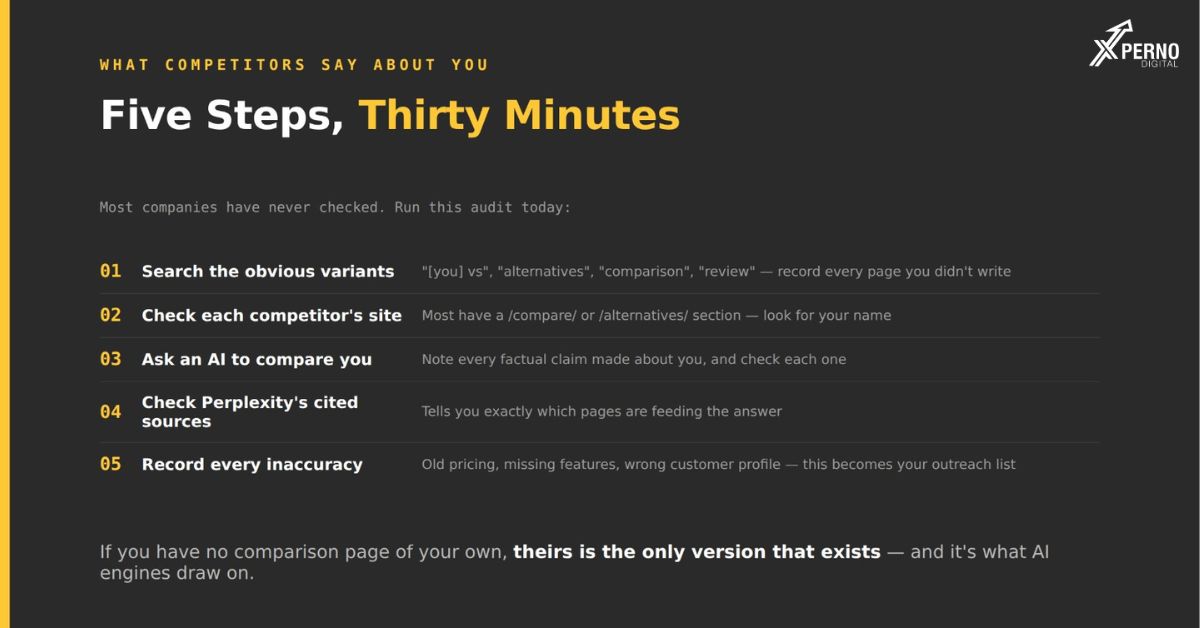
Five steps, about thirty minutes, and most companies have never done it:
1. Search the obvious variants:
“[your product]” vs
“[your product]” alternatives
“[your product]” comparison
“[your product]” review
Record every page written by someone else.
2. Check each competitor’s site directly:
Most have a /compare/ or /alternatives/ section. Look for your name.
3. Ask an AI to compare you:
How does [your product] compare to [competitor]?
Note every factual claim made about you, and check each one.
4. Check Perplexity’s cited sources:
Run the same query in Perplexity and read the cited URLs. That tells you which specific pages are feeding the answer more useful than knowing they exist.
5. Record every inaccuracy:
Old pricing, missing features, wrong customer profile. This list becomes your outreach list.
Does publishing your own comparison page give competitors attention?
No the buyer searching “[you] vs [competitor]” already has both names.
This is the standard objection and it does not survive examination for three reasons.
- You are not introducing anything. Someone running that search knows both companies.
- The comparison happens without you. Buyers ask for it, analysts publish it, review platforms structure their entire product around it, and models synthesise it from whatever is available.
- The traffic argument is backwards. A comparison page targets people already evaluating both products the highest-intent visitors you will get. The alternative is not them declining to compare; it is them comparing using your competitor’s page.
The choice is not between comparison and no comparison. It is between being represented and being described entirely by others.
Which competitors should you build pages for?
The three or four that actually appear in your deals from your CRM, not from market share.
Pull the last fifty won and lost deals and count the names. If sales does not record this, ask them; they will answer accurately in five minutes.
The market leader may never appear if you sell to a segment they do not serve. Building against a competitor you never face is effort spent on a query your buyers do not run.
What should each page contain?
Roughly four hours per page. A finite project, not a content programme:
- A direct answer in the first 150 words stating who each product suits. Most likely section to be extracted.
- Checkable facts rather than adjectives pricing, user limits, integrations, deployment options, support tiers.
- At least one segment where the competitor is genuinely better. The part most companies will not do, and what makes everything else believable.
- A clear decision: choose them if X, choose us if Y.
- Quarterly review, because you are publishing facts about another company’s product.
What should you do about inaccurate claims?
Email the publisher with the correction. Success rates are moderate and the effort is one email.
Hi [name] your comparison page lists our pricing at $89/user.
We moved to $49/user with a five-seat minimum in March.
Pricing page here if useful: [link].
Thanks for including us either way.
Most companies will correct a factual error about a competitor when it is pointed out — partly from professionalism, partly because publishing something demonstrably wrong is a credibility risk for them too.
The page you correct may be feeding AI answers about you for years, which makes one email a reasonable investment.
Frequently Asked Question :
How do I find comparison pages written about my product?
Search “[your product]” vs and “[your product]” alternatives, check each competitor’s /compare/ section directly, and run the comparison query in Perplexity to see which pages are actually cited.
Should I ask a competitor to remove their page about us?
No it will not work and it is not reasonable. Ask them to correct factual errors, which frequently does work.
Which competitors should I build comparison pages for?
The ones that appear most often in your actual deals, from your CRM. Usually three or four, and not necessarily the biggest names in the category.
Will a comparison page send traffic to my competitor?
Some. The visitor was already comparing you both, and the alternative is them comparing using your competitor’s page instead of yours.
How often do comparison pages need updating?
Quarterly. You are publishing facts about another company’s product, and being demonstrably wrong undermines the entire page.
What if a competitor’s page is unfair but not factually wrong?
Publish your own version. You cannot compel a change to an opinion, but you can ensure a second source exists.