
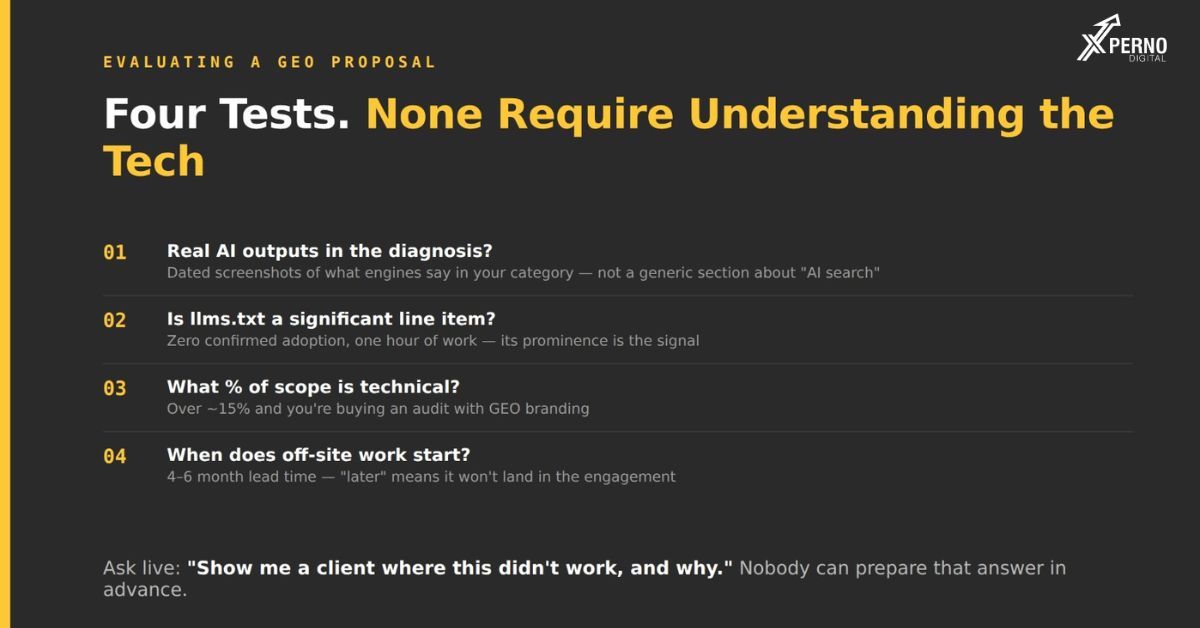
Check whether the deliverables changed or only the vocabulary did. Four tests do this reliably: does the diagnosis contain actual AI outputs for your category, is llms.txt a significant line item, what proportion of the scope is technical, and when does off-site work start. None of them requires you to understand the technology.
The term is new enough that almost every agency added it to their services page in the last eighteen months. Some did the work behind it. Some found and replaced.
We sell this service, so the tests below apply to our proposals too. That is the reason to publish them they are cheap for a buyer to apply and expensive for an agency to fail.
Test 1: Does the diagnosis contain actual AI outputs?
An AI visibility audit should contain dated screenshots of what the engines actually say about your product, in your category.
If the audit contains a crawl report, a keyword gap analysis, and a section about AI search that could have been written without looking at your site nobody ran the check. They wrote about the concept.
What a real diagnosis looks like?
You are absent from all four comparison prompts. Competitors A and B
appear in every run across both engines. The sources feeding those
answers are three trade roundups and G2 you are missing from all four.
Your docs subdomain returns nothing for site: queries, which removes the
content most likely to be cited for technical questions.
What a templated one looks like?
AI search is transforming how buyers discover software. We will optimise
your content for generative engines and improve your visibility across
AI platforms.
The second could be sent to any company in any category with the name changed. That is the test.
Test 2: Is llms.txt a significant line item?
llms.txt is a proposed file giving AI systems a structured guide to your content. It is a community proposal with no confirmed adoption by any major provider, and it takes about an hour to write.
Implementing it is fine it costs nothing and does no harm. Its prominence in a proposal is the signal.
A twenty-line markdown file appearing as a meaningful deliverable tells you something about how the rest was scoped. It usually appears alongside other speculative items “AI-optimised meta tags,” “LLM-friendly formatting,” “prompt optimisation,” “AI content scoring.”
That cluster indicates a proposal built on plausible-sounding activity rather than on evidence, because activity is easier to specify than outcomes and speculative activity is easiest of all.
Test 3: What proportion of the scope is technical?
Technical work removes blockers. It does not create citation. If technical is more than roughly 15% of the effort, you are buying an audit with GEO branding.
Crawler access, server-side rendering, schema and structured data all matter and once they are fixed, additional technical effort has sharply diminishing returns.
Ask for the effort split. Anyone who has planned the work can give it to you immediately.
| Component | Reasonable share | What it means if it is off |
| Diagnosis and measurement | 10% | Under 5% — nobody ran the check properly |
| Content architecture | 30–40% | Under 20% — the highest-value work is missing |
| Technical | 5–10% | Over 15% — this is a technical audit relabelled |
| Off-site distribution | 30–40% | Under 20% — the engagement will plateau |
| Reporting and iteration | 10% | Absent — you cannot tell whether it worked |
Test 4: When does off-site work start?
Four of the six most-cited source types in AI recommendations are not on your domain, and that work has a four-to-six-month lead time.
Third-party roundups, review platforms, community discussion and competitors’ comparison pages. Outreach conducted in week seven produces coverage in month five.
If off-site work is scheduled for “later” or described vaguely, it will not land within the engagement. It is also the hardest and slowest component, which is exactly why it is the one most commonly under-scoped difficult to promise, difficult to show progress on.
Ask specifically: what activity, starting in which week, measured how.
What questions work better asked live?
Two, because they cannot be prepared for in the way a written proposal can.
“Show me a client where this did not work, and tell me why.”
Everyone has failures. An agency claiming a perfect record is either new or not being straight. The explanation reveals how they diagnose problems — and whether they diagnose them at all.
“What do you think is overhyped right now in this field?”
Someone who genuinely works in this has opinions about what is being oversold. Enthusiasm for everything means either they are not paying attention or they sell whatever is currently easiest.
What is genuinely different about GEO, and what is not?
The foundations are shared. Four things genuinely changed:
| Shared with SEO | Genuinely different |
| Technical health and crawlability | No partial credit ranking eighth was visible, absent from a four-vendor answer is not |
| Genuinely useful content | Comparative content moves from optional to central |
| Clear information architecture | Authority shifts from links toward corroboration across independent sources |
| Understanding what buyers ask | Measurement is manual and imprecise — no rank-tracker equivalent exists |
A site that fails at the left-hand column fails at both disciplines, and no amount of AI-specific work compensates.
The honest summary: a meaningful shift in which parts of the work pay off, not a reset. Anyone selling it as either a total reinvention or as nothing new is overstating in one direction and both overstatements are usually commercially motivated.
Should you pay separately for SEO and GEO?
No. They share foundations and should be one engagement with a reprioritised allocation.
Separate line items for both, or a premium charged for the GEO label, is worth questioning. The underlying work is largely the same disciplines weighted differently less volume publishing and head-term chasing, more comparison content, extractable facts and third-party presence.
Frequently Asked Question :
Is GEO a real discipline or repackaged SEO?
The underlying shift is real and verifiable in fifteen minutes. A meaningful share of the advice around it is repackaged, which is why the four tests are worth applying.
Should I pay separately for GEO and SEO?
No. They share foundations and should be one engagement with a reprioritised allocation. Separate line items for both is a signal worth questioning.
Is llms.txt worth implementing?
It costs an hour and does no harm. There is no confirmed evidence major systems read it, so do not treat it as a lever or pay meaningfully for it.
How much technical work should a GEO engagement include?
Roughly 5–15%. Technical work removes blockers; it does not create citation. Above that, you are buying an audit with different branding.
What should a real AI visibility audit contain?
Dated screenshots of actual AI outputs for your category, the prompts tested, which competitors appeared and how often, which sources the engines cited, and a diagnosis specific enough that it could not apply to another company.
How do I compare quotes fairly?
Ask every agency to price the same defined scope. Vague scopes produce incomparable quotes, which is how overpaying happens.