
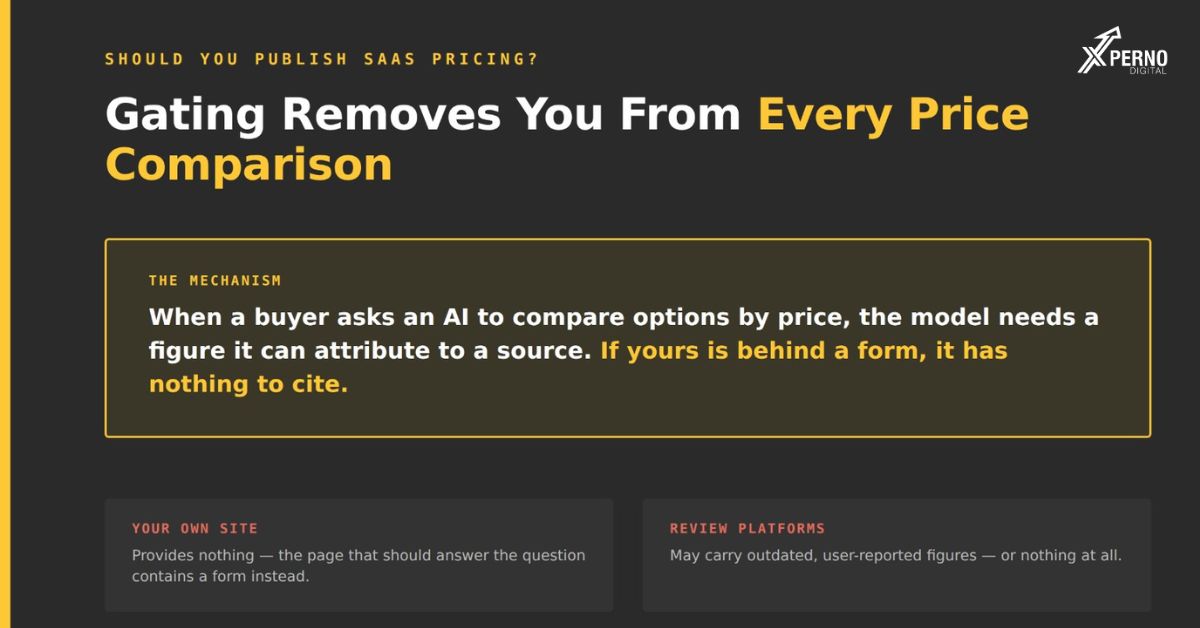
Publishing at least a starting figure is now the stronger default for most B2B software companies, because gating pricing removes you from every query that compares options on cost in search and in AI answers. Gating remains a legitimate commercial decision, but the cost has risen and most companies have not revisited the calculation since they made it.
This is not an argument for full transparency. It is an argument for one extractable fact.
What does gating your pricing actually cost?
It removes you from price comparison queries entirely, because no extractable pricing fact about your product exists anywhere.
When a buyer asks an AI to compare options in your category by price, the model needs a figure it can attribute to a source. If your pricing exists only behind a form:
- Your own site provides nothing the page that should answer the question contains a form
- Review platforms may have outdated user-reported figures, or nothing
- Third-party roundups list “contact for pricing,” which is not a comparison point
- Competitors’ comparison pages about you may state a number, and it may be wrong
The outcome is not that you rank lower in a price comparison. It is that you cannot be included in one.
The same applies in ordinary search. “How much does [category] software cost” is a high-intent query, and a page that answers it with a form does not answer it.
What are the legitimate reasons to gate pricing?
Four, and they deserve stating properly rather than dismissing:
| Reason | When it genuinely applies |
| Negotiated enterprise contracts | Every deal is bespoke and a published number would anchor negotiations badly |
| Competitive sensitivity | Few players, heavy price competition, and undercutting is a real risk |
| Configuration complexity | Price genuinely depends on seat count, modules, volume and deployment |
| Lead capture | The form produces contacts — though quality is frequently worse than assumed |
The fourth is the argument most often made and least often verified. Check the conversion rate and the lead quality rather than assuming. A meaningful share of pricing form fills across B2B are competitors, students and researchers.
What is the middle option between gating and full transparency?
Publish the structure and a starting point. One extractable fact is enough to be included in a comparison.
Option 1: Starting point with conditions
Pricing starts at $49 per user per month with a five-seat minimum.
Teams above 200 users and deployments requiring custom integration
are priced individually.
Extractable facts a figure, a minimum, a boundary condition while preserving the negotiation on enterprise deals.
Option 2 : A range with the variables stated
Most customers pay between $2,000 and $8,000 per month. The variables
are seat count, number of integrations, and whether you need the
compliance module.
Gives a buyer enough to self-qualify and gives a model something to work with, without committing to a specific figure.
Option 3: Tier structure plus an entry price
Three tiers: Starter, Growth and Enterprise. Starter begins at $49
per user per month. Growth and Enterprise pricing depends on seat
count and module selection.
The weakest of the three, and still considerably better than a form alone.
How do you measure what gating is costing you?
Three checks, about twenty minutes, and they measure the exposure directly rather than in principle.
1. Ask an AI what your product costs:
Open ChatGPT and Perplexity in fresh sessions and ask directly. Three possible outcomes: it cannot say, it gives an outdated figure from a third-party source, or it gives a competitor’s figure by mistake. All three are informative.
2. Ask it to compare your category on price:
Compare [category] tools for a 50-person company by cost.
See whether you appear at all. This is the query that gating removes you from.
3. Check your form’s actual conversion and lead quality:
What proportion of pricing-page visitors fill the form? Of those, how many are qualified? If the qualified share is low, the lead capture argument is weaker than it appears.
Does publishing pricing reduce leads?
Frequently yes, and it typically raises close rates fewer conversations, better ones.
A prospect who discovers your price on a discovery call after forty minutes has wasted their time and yours. A prospect who sees a starting figure and books anyway has pre-qualified themselves.
Companies moving from gated to published pricing commonly report a drop in demo volume alongside an increase in close rate. Whether that is a good trade depends on where your constraint sits if sales capacity is the bottleneck, it is a clear win.
Model the trade before assuming the form is producing value.
How should you decide?
Three questions.
- Is your pricing genuinely non-standard, or is it standard and you would rather not say? Most SaaS pricing is more predictable than the gating implies. If you could state a starting figure accurately, the complexity argument does not apply.
- What does the form actually produce? Check the conversion rate and lead quality. Do not assume.
- What is the cost of absence? Run the three checks above. If an AI cannot state your price, or states one from two years ago, you have measured it directly.
Frequently Asked Question
Should I publish full pricing?
Not necessarily. Publishing a structure and a starting figure captures most of the benefit while preserving negotiation on enterprise deals.
What if my pricing is genuinely custom?
State a range with the variables that drive it, or a starting point with the conditions attached. The goal is one extractable fact, not full transparency.
Will competitors use my published pricing against me?
They can already estimate it from review sites, former customers and your sales team’s proposals. The information asymmetry is smaller than it feels.
Does gating pricing affect Google rankings?
Indirectly. A page that does not answer the query it targets performs worse, and “how much does X cost” is a high-intent query.
How do I know if gating is costing me?
Ask an AI what your product costs, then ask it to compare your category on price. If you are absent or misquoted, that is the cost.
Do companies that publish pricing get fewer leads?
Frequently yes, with higher close rates. Fewer conversations, better ones. Model that trade before assuming the form is producing value.