
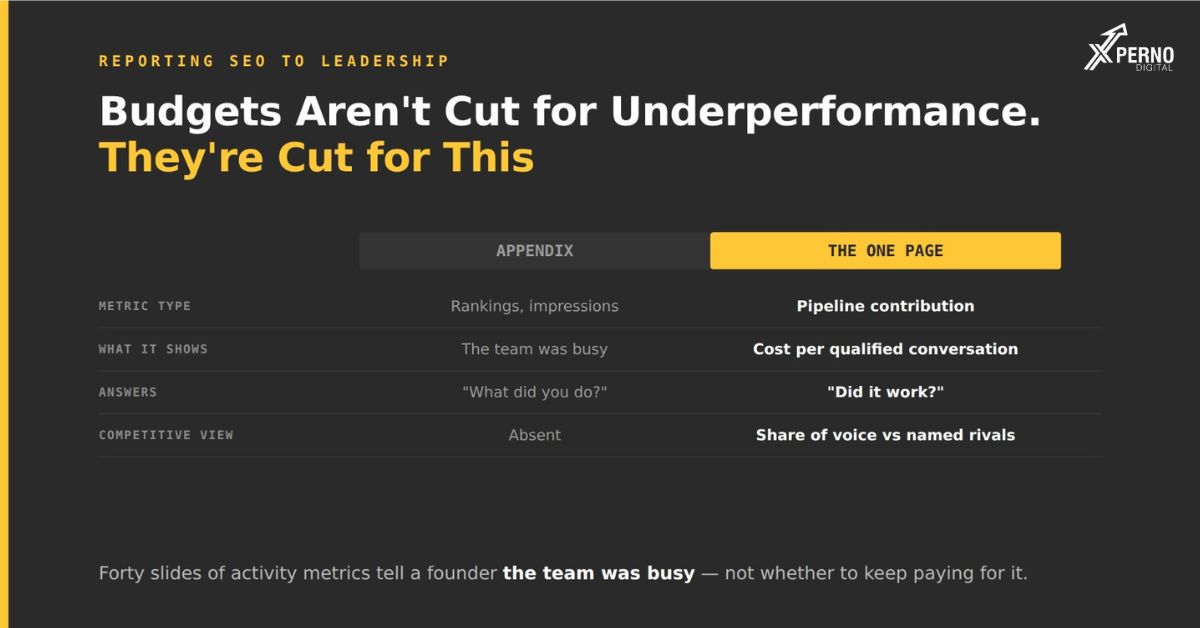
Report pipeline contribution, cost per qualified conversation, and share of voice against competitors on one page. Rankings, impressions and keyword counts belong in an appendix, because they are inputs rather than outcomes and they train the conversation toward the wrong question.
This matters because most SEO budgets are not cut for underperformance. They are cut because the reporting made it impossible for anyone to tell whether the work was producing anything.
Why do SEO budgets get cut?
Budgets are cut when a report answers “what did you do” rather than “did it work.”
The typical monthly report contains impressions, average position, keyword counts and a list of pages published. Every number in it is real. None of them answers the question the person reading it actually has, which is whether to keep paying.
A founder reading forty slides of activity metrics learns that the team was busy. That is not the same as learning that the channel is working, and in a budget review the difference is decisive.
Why are rankings no longer a good proxy?
Rankings were always a proxy for being in front of a buyer at the moment of decision, and two changes weakened that connection.
Zero-click answers mean a high ranking produces fewer visits than it used to. The position is unchanged; what it delivers is not. Featured snippets and AI Overviews increasingly answer the query on the results page.
Upstream shortlisting means a growing share of buyers form their vendor list before running a search at all. The ranked list they eventually see is one they arrived at already decided, having been given three names by an AI assistant.
The proxy did not stop existing. It drifted from the thing it stood in for and reporting it as though nothing changed is what makes a working channel look unaccountable.
What should a monthly SEO report contain?
Five sections on one page, in this order:
1. Pipeline contribution, in currency:
State the method and its limits. First-touch, last-touch or self-reported whichever you use, name it.
An imperfect number with a stated method survives scrutiny. A precise number for a metric nobody cares about does not.
Organic contributed 6 qualified conversations this month, up from 4.
Cost per qualified conversation: $340, against $890 for paid.
Method: first-touch attribution, with 30% of organic conversations
self-reporting “found via AI tool or search” on the demo form.
2. Cost per qualified conversation, versus paid:
This is the comparison a CFO is making regardless. Making it for them is more persuasive than avoiding it even when the number is unflattering, because a channel that admits it costs more per conversation and explains why is more credible than one that dodges the comparison.
3. Trajectory and payback period:
Organic is a compounding investment with a slow start. If month one did not establish that, month four looks like failure to anyone reading the numbers cold. Show the curve you expect and mark where you are on it.
4. Share of voice against competitors:
Where you sit relative to the companies you actually lose deals to. This is what leadership wants to know and almost no report includes it.
| Vendor | Share of voice | 3-month change |
| Competitor A | 24% | +2 |
| Competitor B | 19% | −1 |
| Us | 11% | +3 |
| Competitor C | 9% | −2 |
Three numbers per row answers where you stand, who is ahead, and whether the gap is closing.
5. Leading indicators last, and briefly:
Rankings, citations, impressions. Present but not leading.
Why should a report include what did not work?
Because a report with no misses reads as curated, which makes the successes less believable.
Every leadership team knows not everything succeeds. More practically: in a channel where the client cannot independently verify most of what you tell them, voluntarily reporting a failure is one of the few credibility signals available.
It is also how you set expectations before they are violated rather than after.
The four broad category prompts did not move. Expected at this stage
but worth noting that the incumbents here have a decade of accumulated
presence and the head query may not be winnable at all.
We will reassess at month six and reallocate if so.
That paragraph does three things: states the miss, explains it, and pre-commits to a decision point.
How long should an SEO report be?
One page. Anything longer belongs in an appendix nobody is obliged to read.
A forty-slide deck is not thoroughness. It is a document designed to be hard to argue with, and it gets treated accordingly skimmed for the summary slide, the rest unread. The tell is that nobody ever asks a question about slide 27.
One page can be interrogated. That is uncomfortable, and it is the point. A report that invites questions is a report someone read.
How do you transition from ranking-led reporting?
Run both formats for a quarter, explain the change in writing before the numbers shift, and prepare for the first bad month.
If you have reported rankings for two years, switching abruptly looks evasive particularly if the rankings were good and the new metrics are not yet.
- Run both for one quarter. Lead with pipeline and share of voice; keep rankings in an appendix.
- Explain the change once, in writing, before the numbers change. Why rankings drifted as a proxy, what replaces them, what you expect to see.
- Expect the new metrics to show problems the old ones concealed. That is the intended outcome and it is worth saying so in advance.
What should be left out of the report?
Five things that appear in most reports and belong in an appendix at most.
| Metric | Why it should not lead |
| Rankings | A leading indicator at best; invites a conversation about positions rather than pipeline |
| Total traffic | Dominated by branded and returning visits, which mask what is actually changing |
| Impressions | Does not predict revenue |
| Keyword counts | Measures coverage, not outcome |
| Hours worked | Effort is not an outcome, and reporting it invites a conversation about rates |
Anything requiring a glossary also belongs in the appendix. If leadership needs to understand retrieval mechanics to read the report, it will not get read.
What if leadership asks for the detail anyway?
Keep it, in an appendix. What matters is what you lead with, because that trains the conversation.
Lead with rankings and you will spend every meeting discussing positions. Lead with pipeline and you will discuss whether the channel is working. Only one of those conversations helps you keep the budget.
Frequently Asked Question :
How long should a monthly SEO report be?
One page. Anything longer belongs in an appendix that nobody is obliged to read.
What if I cannot attribute pipeline cleanly?
State the method and its limits. Attribution in organic is genuinely imperfect, and saying so is more credible than presenting a precise number you cannot defend.
Should I stop tracking rankings entirely?
No, track them as a leading indicator. Just do not lead with them, because that trains the conversation toward positions rather than outcomes.
What is share of voice and how is it calculated?
Your brand’s mentions as a proportion of all vendor mentions across a fixed set of buyer-intent prompts, run monthly in identical wording.
How do I report a month where nothing moved?
State the flat numbers, list what was delivered, and say when you expect movement. Months two and three are typically flat by design if that was set out in advance, it is not a surprise.
Will leadership accept fewer metrics?
Generally yes, if the ones you keep answer their actual question. Resistance usually comes from removing metrics without replacing them with something more useful.