
They dominate broad category queries, where accumulated mentions decide the answer. They frequently lose specific situational queries, where the answer depends on whether anyone addressed that situation.
The split is consistent and it follows from the mechanism:
Broad query: “best CRM software.” The model needs to identify the leading options in a category. It draws on which vendors are described most often across the most sources. That is a function of years of accumulated coverage, and large companies have it.
Specific query: “CRM for field service teams under 50 with QuickBooks integration.” The model needs a source addressing that situation. Accumulated brand mentions do not answer it. Whoever wrote about that specific case does.
The consequence: The advantage large companies hold is not general. It is concentrated in exactly the queries that convert least.
Why do incumbents win the broad queries?
Because consensus is self-reinforcing, and they have had longer to accumulate it.
The mechanism compounds:
1. A company is described in enough sources that a description stabilises
2. A writer researching the category encounters that description and repeats it
3. The next writer encounters it in more places and repeats it more confidently
4. The description becomes what the category is
Once three or four sources agree, the fifth writer is not making an independent judgement. They are documenting an apparent consensus.
This is not a criticism of the incumbents. They earned the early coverage. But it means the broad query is decided by accumulated history rather than by current merit, and a year of excellent work does not displace a decade of accumulation.
The practical implication: In a category with two entrenched brands, the head query may not be winnable at any realistic budget. Establishing that in month one is more valuable than discovering it in month nine.
Where do smaller companies actually win?
Four query types where accumulated presence does not decide the answer:
Specific situational queries:
“Project management for architecture firms under 50 people.” Incumbents write for everyone, which means they address nobody’s specific situation. Frequently nobody has a dedicated page for it.
Why this matters more in AI search than in traditional search?: Prompts are longer and more situational than search queries. People type fragments into Google and describe their circumstances to an AI, which favours narrow sources.
Alternatives queries:
“[Incumbent] alternatives.” The buyer has explicitly asked for options other than the market leader. The incumbent’s accumulated presence works against them here.
This is the highest-intent query in B2B software and it is structurally available to smaller companies.
Integration and stack-fit queries:
“[Category] that works with QuickBooks and Shopify.” Answered by whoever documented their integrations plainly. Company size is irrelevant; documentation quality decides it.
Comparison queries:
“[You] vs [Incumbent].” Requires comparative content. If you have built the page and they have not and larger companies frequently do not build comparison pages against smaller competitors you are the only source.
What advantages does a small company genuinely have?
Three, and they are real rather than consoling:
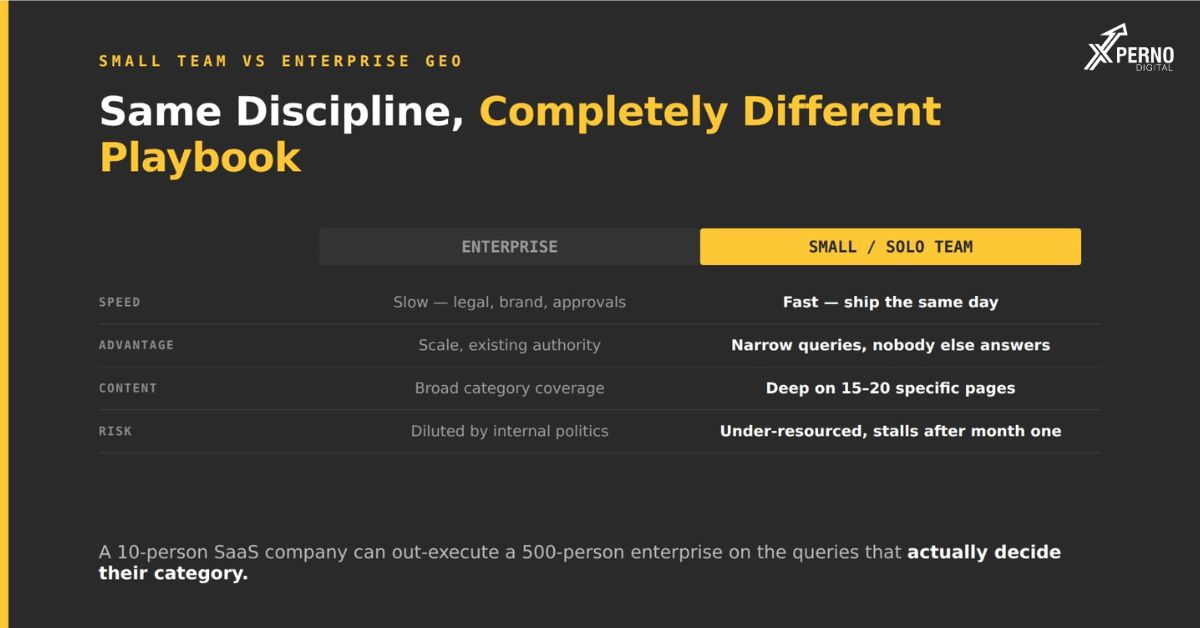
Speed of change: You can publish six comparison pages in a month. A large company routes the same work through legal, brand and three approval layers, and frequently decides not to name a smaller competitor at all.
Willingness to be specific: Naming where a competitor is better is a decision a founder can make in a meeting. At scale it becomes a policy question, and the answer is usually no.
Narrow focus: If you serve one segment well, you can address it specifically. A company serving twelve segments has to hedge.
And one thing that is not an advantage: Being “more innovative” or “more agile” in general. Those are claims rather than mechanisms. The three above are mechanisms they describe why the work actually gets done differently.
What disadvantages are real?
Three, and it is worth being honest about them:
No accumulated coverage: You cannot manufacture ten years of mentions. This is the binding constraint on broad queries and there is no shortcut.
Fewer reviews: Review volume and recency matter, and a company with a hundred customers cannot generate what one with ten thousand can. Recency helps twenty recent reviews beat two hundred old ones but the gap is real.
Less third-party coverage: Journalists and analysts write about the companies their readers know. Getting into roundups is harder when you are not already in the conversation.
What follows from these?: Compete where accumulation does not decide the answer. That is not a workaround, it is the correct strategic response to a real constraint.
Does size correlate with visibility at all?
Loosely, and less than people assume. Documentation quality and comparative content predict citation better than headcount
What you observe when running category checks?
Well-funded companies with large content teams are routinely absent from AI answers, because their content is explanatory rather than comparative and their documentation is gated.
Smaller companies with strong comparison pages and public documentation appear consistently, particularly on specific queries.
The variable that actually predicts citation is whether extractable, comparative, corroborated content about you exists not how many people work there.
One honest caveat: Size correlates with the ability to produce that content, and with the third-party coverage that corroborates it. So the correlation exists; it is just weaker and more addressable than it appears.
What should a small company actually do?
Concede the broad query, contest everything else, and check which situation you are in before committing budget.
Step : Establish whether the head query is winnable: Run it three times in fresh sessions across three engines. Same two names every time means consensus has hardened. Varying names means there is room.
Step 2: If it has hardened, stop targeting it: This is not defeat. The specific queries convert better anyway, and the budget saved is real.
Step 3: Build the queries that are available: Comparison pages against your real competitors, an alternatives page for the largest, use-case pages for your actual segments, integration pages.
Step 4: Build review recency. You cannot match volume. You can match velocity, and recency carries more weight than total count.
Step 5: Get into the roundups that actually get cited. Run your prompts in Perplexity, see which articles feed answers in your category, and approach those specifically.
The strategic summary: You are not competing for the same queries as the incumbent. You are competing for the ones they cannot be bothered to address, which happen to be the ones with the highest intent.
Frequently Asked Questions:
Can a small SaaS company compete with an incumbent in AI search?
On specific, situational, alternatives and comparison queries, yes. On the broad category query in a settled market, usually not.
Do AI engines favour big brands?
They favour brands described consistently across many sources, which correlates with size. It is accumulated coverage rather than size itself.
How do I know if the head query is winnable in my category?
Run it three times in fresh sessions across three engines. The same two names every time means consensus has settled.
Is review volume or recency more important?
Recency. Twenty reviews from the last six months does more than two hundred from four years ago, which is the part a smaller company can actually contest.
What is the single best query type for a small company?
“[Largest competitor] alternatives.” Highest intent, structurally available, and one page of work.
Will this change as more companies do GEO?
Yes. The specific queries currently unaddressed will get addressed, and the advantage narrows. That is an argument for acting now rather than a reason to dismiss it.