
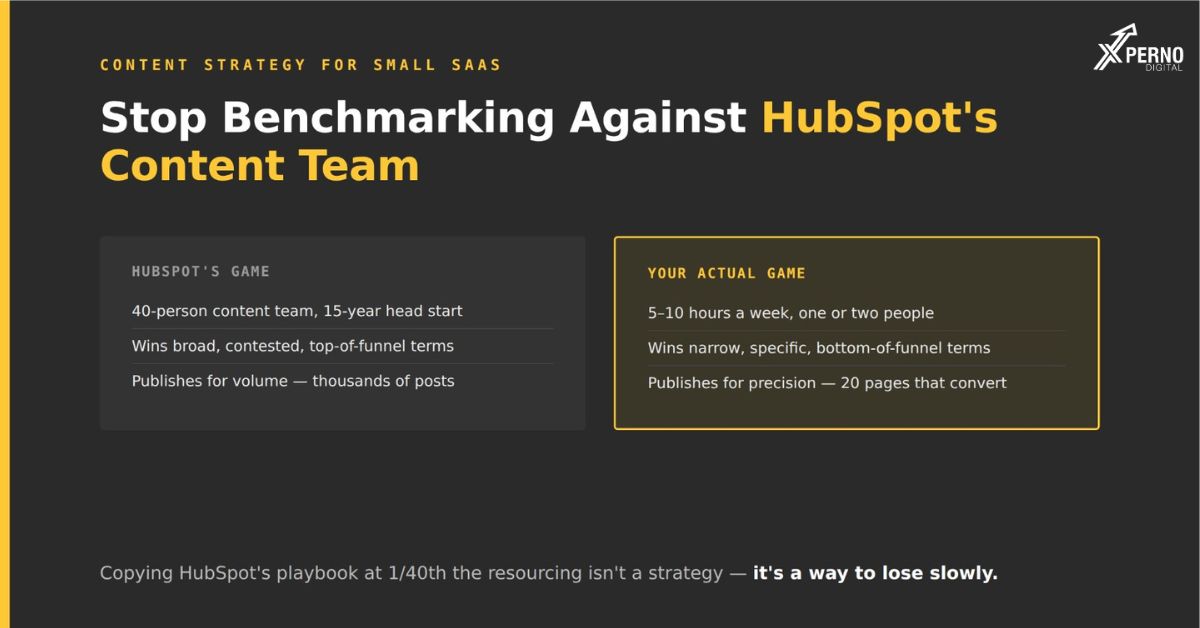
Because it required conditions that a small company does not have and a market that no longer exists: a decade of runway, a large content team, and cheap abundant organic traffic.
The playbook is well known. Publish comprehensive content on every topic adjacent to your category, rank for informational queries, capture emails, nurture downward. It worked, spectacularly, for the companies that ran it early.
Four things made it work then:
Time: The traffic compounded over years, not quarters. The companies that succeeded were publishing consistently for five or six years before the results were obvious.
Scale: Dozens of writers and editors producing at a volume a small team cannot match.
A less crowded market: In 2012 there were not two hundred adequate explanations of every B2B concept. Now there are.
Cheap organic traffic: Informational queries produced clicks. Increasingly they produce an answer on the results page and no click at all.
None of those four conditions holds for a fifty-person company today. Copying the playbook means running a strategy whose preconditions are absent.
What actually happens when a small team tries it?
A predictable eighteen-month sequence, ending with the channel being written off.
Months 1–6: Four posts a month. Some rank for low-volume informational terms. Traffic grows slowly from a small base. Everyone is encouraged.
Months 6–12: Traffic plateaus. The posts that ranked are informational, so they convert poorly. The team publishes more, because that is what the playbook says.
Months 12–18: Pipeline from content is minimal. Budget gets questioned. The conclusion drawn is either “SEO does not work for us” or “we need to publish more.”
Both conclusions are wrong: The problem was never volume or channel fit. It was that a small team ran a strategy designed for a large one, targeting the queries that convert least.
What makes this worse now?: Informational content is the least-cited type when AI engines answer vendor questions. So the same content that underperforms in search also produces nothing in the channel where shortlists increasingly form.
What should a fifty-person company do instead?
Build a finite set of bottom-of-funnel assets, then sustain a low publishing rate rather than committing to a cadence from day one.
The inversion: The enterprise playbook builds awareness first and works downward. A small team should build the bottom first and work upward, because the bottom is finite, converts better, and faces less competition.
The finite set six to ten pages, about 25 hours:
- Asset: Count / Why
- Comparison pages vs real competitors: 3–4 / Highest-intent queries, most-cited content type
- Alternatives page for your largest competitor: 1 / Buyers who have already decided to switch
- Use-case pages for your actual segments: 4–6 / Where a small company beats incumbents?
- Indexable pricing: 1 / Answers a core evaluation question
Then two substantial pieces a month. Not eight thin ones. Original data where possible, deep use-case content otherwise.
Why this works at small scale?: It is a project with an end rather than a treadmill, it targets queries with far less competition, and the assets keep working for years with quarterly maintenance.
Where do smaller companies actually win?
Specificity. Incumbents write for everyone, which leaves every specific situation unaddressed.
The structural advantage: A large company’s category page has to serve a twelve-person startup and a two-thousand-person enterprise. It serves neither well. A page addressing exactly one of those situations beats it for that buyer.
- Incumbent owns: Available to you
- “Best CRM software: “CRM for field service teams under 50” |
- “Project management software : “Project management for architecture firms” |
- “Help desk platform”: “Help desk with Slack and Jira integration
Why this matters more in AI search than in traditional search?: Prompts are longer and more situational than search queries. People type fragments into Google and describe their circumstances to an AI. A narrow page answers a situational prompt directly; a broad category page cannot.
Where to find your specific queries?: Twenty recorded sales calls. The way prospects describe their situation is the query, in their language rather than yours.
What can you take from the enterprise playbook?
Three things that transfer, and it is worth being fair about them:
Consistency compounds: The underlying principle was correct content assets accumulate value over years. What does not transfer is the volume.
Topical clusters work: Covering a subject coherently, with linked pillar and supporting pages, is sound structure at any scale. Build two clusters properly rather than ten thinly.
Owning a category vocabulary is powerful: The companies that succeeded largely defined the language of their category. That remains available, and it is more achievable in a narrow niche than in a broad one.
What does not transfer?: The publishing cadence, the breadth of topics, and the assumption that informational traffic converts
Is this an argument against content marketing?
No. It is an argument against a specific strategy at a specific scale.
Worth being precise, because “content marketing does not work” is a common overcorrection and it is wrong.
Content marketing at small scale works when: The pieces are few, substantial, and targeted at buyers rather than at learners. One piece of original data a quarter outperforms twelve explainer posts.
It fails when: It is a publishing schedule with a volume target, producing consensus content that any competitor could have published.
The test: Could a competitor publish this exact page with their logo on it? If yes, it will not differentiate you in search or in AI answers, however well written it is.
What does the honest timeline look like?
Bottom-of-funnel assets convert within weeks of publishing. Broader visibility takes six to twelve months.
- Timeline: What happens?
- Weeks 1–4: Build comparison and alternatives pages.
- Weeks 4–12: These begin converting the traffic that reaches them.
- Months 3–: Movement in AI citation on specific and alternatives queries.
- Months 4–: Broader search rankings on comparative terms.
- Months 6–12 : Compounding, if you sustained the low publishing rate.
Compare that to the enterprise playbook, where meaningful results at small scale arrive somewhere between month eighteen and never.
The critical difference: The bottom-of-funnel assets serve buyers already searching, so they do not require a traffic base to work. A comparison page with 60 monthly visitors converting at 8% produces more than a blog post with 2,000 visitors converting at 0.2%.
Frequently Asked Questions:
Should small SaaS companies do content marketing at all?
Yes, fewer, more substantial pieces aimed at buyers rather than learners. Two a month with genuine specifics beats eight thin ones
How long before a small team sees results?
Bottom-of-funnel pages convert within weeks of publishing. Broader visibility takes six to twelve months.
Isn’t publishing consistency important?
Consistency in maintaining assets and measuring results matters. Publishing frequency matters much less than it used to, and it has become a justification for filler.
What if my competitors publish four times a week?
Check whether it is working for them. Volume that produces no citations and no pipeline is activity, not advantage.
How many pages do I actually need?
Six to ten bottom-of-funnel assets covers most small SaaS companies. That is roughly 25 hours of work.
Where do I find the specific queries to target?
Twenty recorded sales calls. How prospects describe their situation is the query, in their words rather than yours.