
There is no evidence that Core Web Vitals affect whether an AI engine cites your content. They matter for user experience and modestly for Google ranking, which matters indirectly for engines that draw from ranking pages.
The reasoning is mechanical. A retrieval system reads your HTML and extracts claims from it. Whether the page paints its largest element in 1.8 seconds or 3.4 seconds is not visible to that process the crawler fetched the HTML, and the rendering experience a human would have had is not part of the input.
Where the indirect effect lives?: Core Web Vitals are a modest Google ranking signal. Google AI Overviews and Gemini draw predominantly from ranking pages. So catastrophically poor performance could, in principle, keep a page out of the candidate set.
The scale of that effect: Small. Core Web Vitals were never a strong ranking factor, and the indirect path from performance to citation runs through two weak links.
What are Core Web Vitals?
Three metrics measuring loading, interactivity and visual stability:
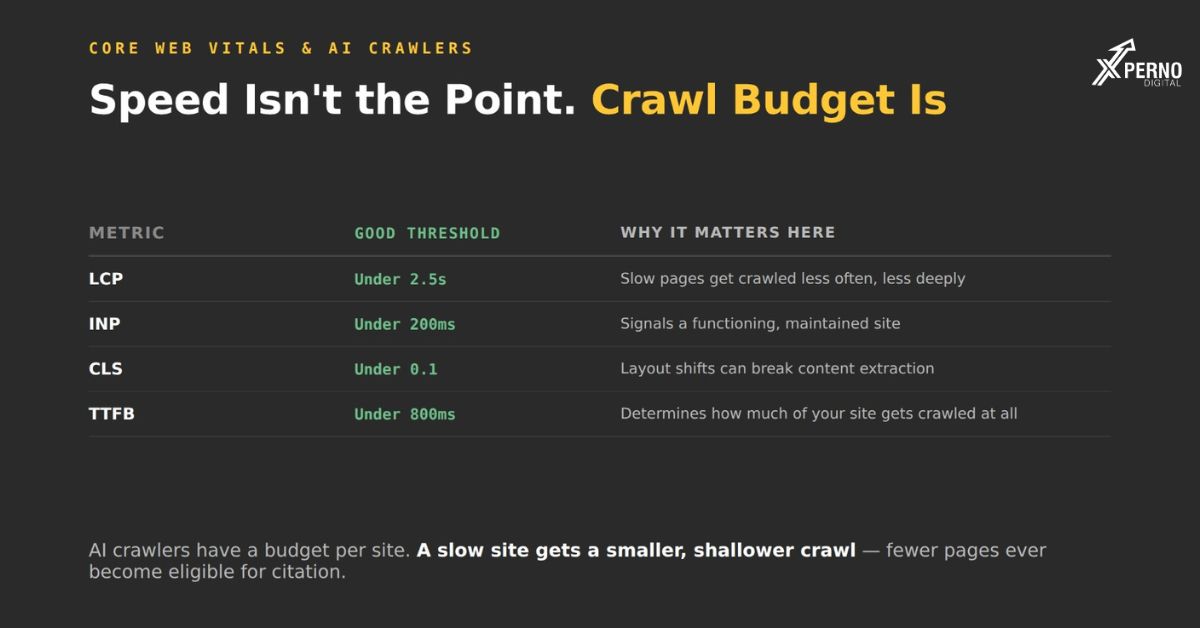
Metric: Measures /Good
- LCP: Largest Contentful Paint /How long until the main content appears /Under 2.5s
- INP: Interaction to Next Paint /Responsiveness to user input /Under 200ms
- CLS: Cumulative Layout Shift /Visual stability while loading /Under 0.1
INP replaced FID (First Input Delay) in March 2024. If you are working from older documentation or a dashboard that has not been updated, this is worth checking.
Why do they get so much attention?
Because they are measurable, dashboarded and easy to report which makes them attractive to optimise regardless of return.
This is worth naming directly, because it explains a pattern that costs companies real time.
Core Web Vitals have three properties that attract effort:
- They produce a number: A score that can go up is inherently satisfying to work on.
- They are visible in free tools: PageSpeed Insights and Search Console both surface them without any setup.
- Improvement is technically tractable: It is a defined engineering problem with known solutions.
Compare that to what actually drives AI citation: Building comparison content requires deciding which competitors to name and admitting where they win. Third-party presence requires months of outreach with uncertain returns. Neither produces a dashboard number and both require organisational buy-in.
Given the choice between a tractable problem with a score and an intractable one without, teams reliably choose the first. That is a rational individual response and a poor allocation of effort.
Where do they genuinely matter?
Three places, none of which is AI citation:
User experience and conversion: A slow site loses visitors. This is the strongest reason to care and it has nothing to do with search. If your pricing page takes six seconds to become usable, fix it because it costs you demos.
Google ranking, modestly: A real but small signal. It has never been decisive against content quality and relevance.
Crawl efficiency on large sites: Very slow response times reduce how much gets crawled. Relevant above a few thousand URLs; largely irrelevant on a twenty-page marketing site.
Where they do not matter?: Citation by ChatGPT, Perplexity, Claude or Copilot. None of those systems experiences your page the way a human browser does.
When should you work on them?
When performance is bad enough to affect users, and not as an AI visibility activity.
Worth fixing:
- LCP above four seconds on pages that matter pricing, product, comparison
- Layout shift severe enough that people misclick
- Mobile performance that makes the site genuinely unpleasant
Not worth a project:
- Moving LCP from 2.6s to 2.3s to turn an amber score green
- Optimising blog archive pages nobody converts on
- Chasing a perfect Lighthouse score
The test: Would a real visitor notice and be affected? If yes, fix it. If the only thing that changes is a dashboard colour, leave it.
What does the honest priority order look like?
Technical performance sits well below content and off-site work for AI visibility:
- Activity: Effect on AI citation / Effort.
- Comparison and alternatives content: Strong /High.
- Third-party corroboration: Strong / High, slow.
- Extractable facts: Strong Medium.
- AI crawler access: Total, where blocked / Very low.
- Server-side rendering: Total, where broken Varies.
- Entity consistency: Good / Low.
- Schema markup: Moderate /removes ambiguity / Low.
- Core Web Vitals: None demonstrated /Medium to high.
Two technical items above Core Web Vitals are worth noting, because they are frequently confused with performance work:
Crawler access: If `GPTBot` is disallowed, nothing else matters. Two-minute check.
Server-side rendering: If your content only appears after JavaScript runs, some crawlers see an empty page. Two-minute check, and it is genuinely about whether content exists in the HTML rather than about how fast it renders.
Both are binary and both are occasionally the entire explanation for an absence. Neither is a Core Web Vitals problem.
What should you do?
Run one check, fix anything genuinely broken, then move on:
The check (10 minutes):
1. Page Speed Insights on your five most important pages product, pricing, comparison, docs, homepage
2. Note anything with LCP above four seconds or CLS above 0.25
3. Check mobile as well as desktop
Fix what is genuinely bad: Usually one or two things account for most of it: uncompressed images, render-blocking scripts, or a font loading strategy causing layout shift.
Then stop: Once your key pages load acceptably, further performance work has almost no return for AI visibility and modest return for ranking.
Where the recovered time should go?: Comparison pages, extractable facts, review presence, roundup outreach. All slower, all less satisfying, all demonstrably effective.
Frequently Asked Questions:
Do AI engines consider page speed?
There is no evidence they do. A retrieval system reads your HTML; the rendering experience a human would have is not part of the input.
Is Core Web Vitals still a Google ranking factor?
Yes, modestly. It has never been decisive against content quality and relevance.
What replaced First Input Delay?
INP (Interaction to Next Paint) replaced FID in March 2024. Check whether your documentation and dashboards reflect this.
Should I aim for a perfect Lighthouse score?
No. Diminishing returns set in quickly. Fix what a real visitor would notice and stop.
Does slow loading stop AI crawlers?
Extremely slow response times can reduce crawl frequency on large sites. On a normal marketing site this is not a practical concer.
What technical work matters most for AI visibility?
Crawler access and server-side rendering. Both are binary, both take two minutes to check, and either can be the entire explanation for an absence.