
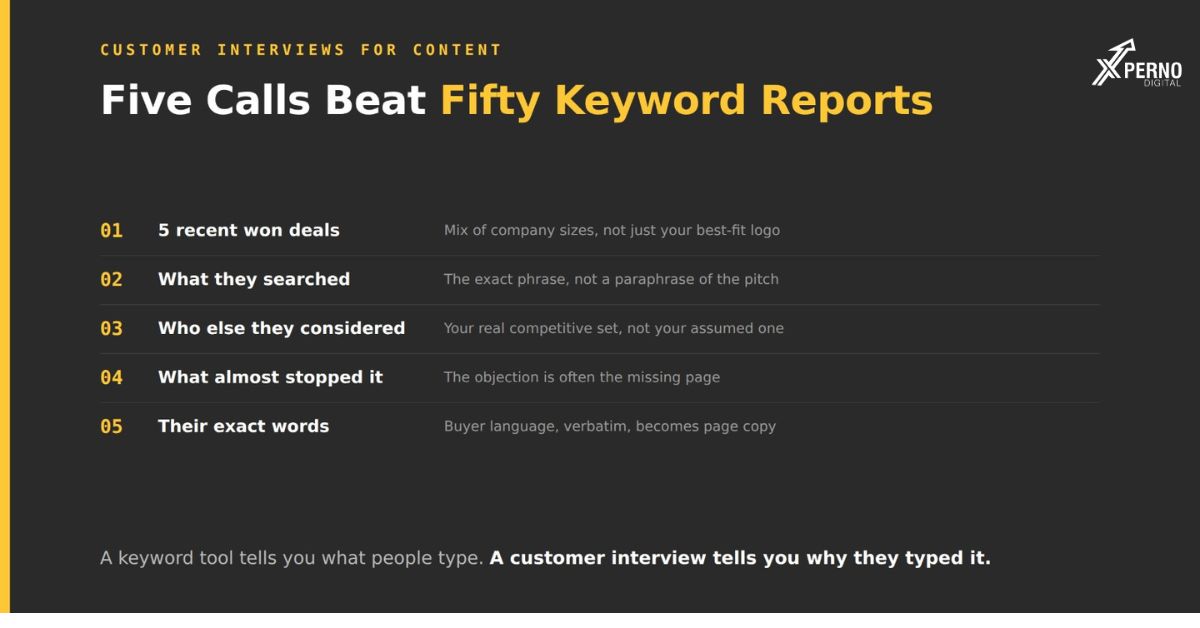
Because they contain specific, checkable facts about real situations which is exactly what most B2B content lacks and what retrieval systems need.
The content problem for most B2B companies is not writing ability. It is that nobody in marketing knows enough specifics. What breaks in month three of implementation, what the buyer was using before, what almost stopped the deal, what the actual timeline was that information exists with customers and rarely reaches a content brief.
A 45-minute conversation with one customer typically yields:
- Three to five specific numbers
- The exact language they use for the problem
- Two or three objections that nearly killed the deal
- A comparison against whatever they were using before
- One thing that did not work as expected
Every one of those is extractable. “We were losing about six hours a week to manual scheduling” is a claim. “Improves operational efficiency” is not.
How do you run the interview?
Forty-five minutes, recorded, with questions aimed at specifics rather than at satisfaction.
Get permission upfront to record and to use anonymised details. Most customers agree. Being clear about what you will publish makes the conversation easier for both sides.
Questions that produce usable material:
“What were you doing before, and what specifically broke?”
Produces the before-state and the trigger. The trigger is the most useful part it is what other buyers will recognise in themselves.
“How long did that take you before? How long now?”
Produces numbers. Push for specifics: “a lot faster” is not usable, “about six hours a week down to under one” is.
“What else did you look at?”
Produces the competitive set and the reasons. This feeds comparison content directly.
“What nearly stopped you buying?”
The most valuable question and the one people avoid. Every objection here is one your sales team hears repeatedly and your content does not address.
“What took longer than you expected?”
Produces honest limitations. Publishing these is what makes everything else believable.
“What would you tell someone in your position who is considering this?”
Produces their framing of the value, in their words which is almost always better than yours.
“What do you still use something else for?”
Produces the boundaries of what you do, which is the honest content most competitors avoid.
One technique worth using: When they say something general, ask “how much?” or “how long?” or “which one?” The follow-up is where the specifics come from.
What can you build from one transcript?
Five assets, each serving a different query type:
1. A use-case page:
What it uses?: The before-state, the trigger, the specific situation, the outcome.
Why it works?: The customer’s situation is a real one that other buyers share, described in their language rather than yours. That specificity is what makes a use-case page beat a generic category page for situational queries.
What to pull?: Their industry, company size, the job they were doing, the constraint they hit.
2. Comparison content:
What it uses?: What else they evaluated and why they chose differently.
Why it works?: You now have a real reason a real buyer chose you over a named competitor and, more usefully, the segment where that competitor was genuinely the better option.
What to pull?: The alternatives considered, the decision criteria, where the competitor was stronger.
3. An objection-handling page
What it uses?: What nearly stopped them, and what resolved it?
Why it works?: These are the questions every prospect has and almost nobody publishes answers to. “Is it worth it for a team our size?” answered with a real example is more convincing than any claim.
What to pull?: The objections, the resolution, whether the concern turned out to be justified.
4. Original data, once you have several:
What it uses?: The numbers, aggregated across interviews.
Why it works?: One customer saying they saved six hours a week is an anecdote. Twelve customers averaging four to seven hours is data and data is the most durable citation advantage available.
What to pull?: Any quantity. Time, cost, volume, headcount, timeline. Record them consistently so they aggregate.
5. Honest limitations content:
What it uses?: What took longer than expected, what they still use something else for.
Why it works?: This is the content that makes everything else credible. A page stating who your product is not for filters poor-fit prospects before they consume sales time, and it is the single largest credibility lever available.
What to pull?: The gaps, the workarounds, the things they wish they had known.
How many interviews do you need?
One produces four assets. Five or six produce data. Twelve makes the data defensible.
A workable cadence: One interview a month, forty-five minutes plus an hour of processing. That is roughly two hours a month producing more usable material than a week of writing from a keyword tool.
After six months you have six transcripts, which is enough to aggregate patterns and publish something no competitor can replicate.
Who to interview?: A mix. Recent customers remember the buying process. Long-standing customers know the limitations. Churned customers if any will talk produce the most useful material of all, and almost nobody asks them. How do you process a transcript?
Extract claims first, then decide what to build?
Step 1: Pull every specific fact: Numbers, timeframes, named tools, company details. Anything checkable. A 45-minute transcript typically yields eight to fifteen.
Step 2: Pull their language: How they described the problem before they knew your category existed. This is your keyword list and your headline copy.
Step 3: Pull the objections and the limitations: These become their own assets and they are the most differentiated content you will produce.
Step 4: Decide what to build: Not every interview yields all five assets. One might produce a strong use-case page and nothing else. That is fine.
On AI assistance: A model is genuinely useful for turning a messy transcript into a readable draft. It is not useful for deciding what matters in the transcript, because it does not know your market. Human decides what to use; model assembles the draft.
What about anonymity?
Anonymised works, as long as everything else stays specific.
Most customers will not consent to being named, particularly in competitive markets. That is normal and it does not undermine the content.
Keep: Industry, headcount, revenue band, the specific situation, real numbers, real timelines.
Remove: Company name, product name, anything visually identifying, quotes attributable to a named person.
The rule: A reader should be able to picture the company precisely without being able to identify it. “A 40-person HVAC contractor running three crews across two depots” is anonymous and specific. “A leading service business” is neither.
One caution: Anonymised content only works if the underlying interviews happened. The specificity that makes it credible is also what makes it checkable in a discovery call, where a prospect will ask follow-up questions the material should support.
Frequently Asked Questions:
How long should a customer interview be?
Forty-five minutes. Long enough to get past the rehearsed answers, short enough that customers agree to it.
Will customers agree to be interviewed?
Most will, particularly if you are clear about the time commitment and what you will publish. Offering to share the finished piece before publication helps.
Can I use a survey instead?
Surveys produce aggregate numbers; interviews produce language, objections and specifics. Both are useful and they are not substitutes.
Should I interview churned customers?
Yes, if any will talk. They produce the most useful material and almost nobody asks them.
How do I get numbers out of people who do not have t
Ask for estimates and label them as such. “Roughly six hours a week, by their estimate” is honest and usable.
Can I use AI to process the transcript?
For turning it into a readable draft, yes. For deciding what matters in it, no that requires knowing your market.