
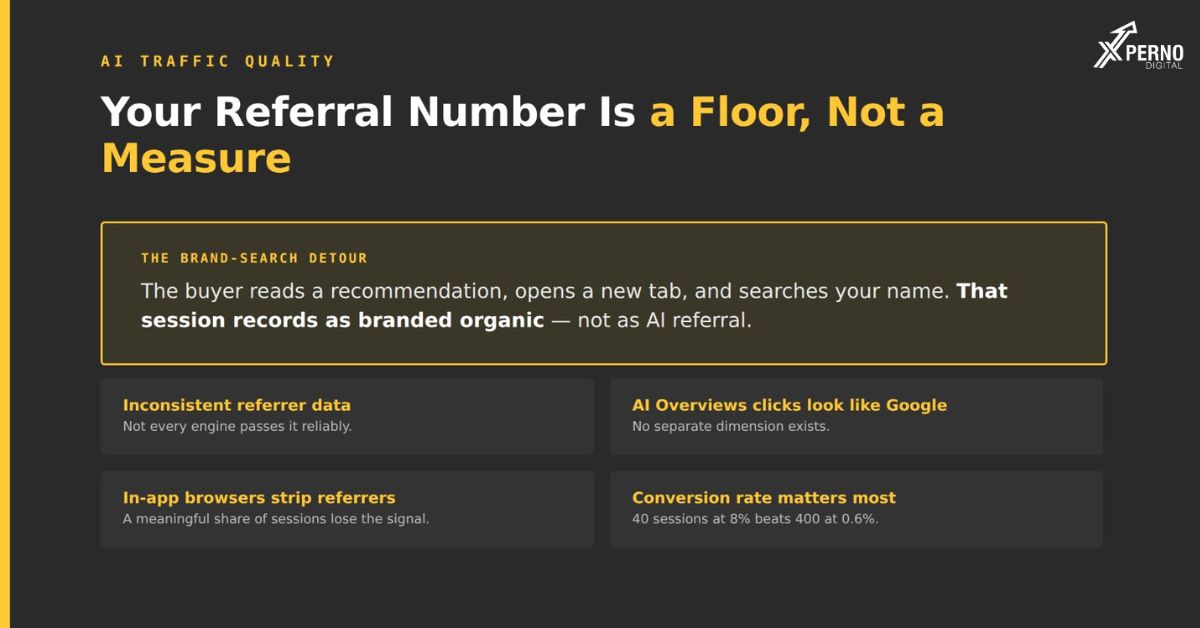
There is no reliable general answer, because it depends on your category and audience but the more important point is that referral volume from any of them badly understates their influence.
Most AI-influenced sessions never arrive as AI referrals. The buyer reads a recommendation, opens a new tab, and searches your brand name. That session records as branded organic.
So two things are true at once:
AI referral traffic is small typically a low single-digit percentage of sessions for B2B.
AI influence is considerably larger than that, and mostly invisible.
Which means the useful question is not “which engine sends the most traffic.” It is “which engine sends the traffic that converts, and where should I test most carefully.” Both are answerable from your own data.
What can you actually measure?
Referral volume and conversion rate by source, in GA4. Twenty minutes to set up.
The sources to look for in Reports → Acquisition → Traffic acquisition:
- chatgpt.com
- perplexity.ai
- gemini.google.com
- copilot.microsoft.com
- claude.ai
Build a comparison so you can see them as one line and individually.
The metric that matters is conversion rate, not volume. A source sending 40 sessions a month that converts at 8% is worth more than one sending 400 at 0.6%.
What you will typically find?: AI referral sessions convert at a higher rate than most other channels, because the visitor arrived having been recommended rather than having browsed. That pattern is consistent enough to expect, though the magnitude varies.
Why does AI referral traffic convert well?
Because the visitor arrives having already been told you are a reasonable option, with reasoning attached.
Compare three visitors:
- Arrived via Prior context
- Broad organic search Learning about a category, may not be in market
- Paid ad | Saw a claim they discount as advertising
- AI recommendation Told you suit their specific situation, and why
The third has done more of the evaluation before arriving. They are not learning what your category is they are checking whether the recommendation was right.
Two practical implications:
Your landing pages are answering the wrong questions for these visitors. They already know roughly what you do. What they need is specifics pricing, fit for their situation, how you compare to the other names they were given.
A small volume converting at a high rate justifies more attention than the volume suggests. If AI referrals are 2% of sessions and 8% of demos, the channel is doing four times the work its traffic share implies.
Which engines should you test most carefully?
Weight your testing toward where your buyers actually are, which varies by category.
Rough audience profiles:
ChatGPT: largest consumer base by a wide margin. Broadest exposure across almost every category.
Perplexity: Research-heavy usage. Over-indexes on people doing deliberate evaluation, which skews toward B2B buyers in an active process.
Google AI Overviews: The widest passive reach. Buyers encounter them doing ordinary searches without choosing an AI tool at all.
Copilot : Concentrated among business users inside Microsoft 365. Strongest for enterprise and mid-market B2B.
Claude: Smaller consumer base, substantial enterprise and developer adoption. Matters more for technical products than its share suggests.
Gemini: Google Workspace distribution, similar business-user concentration to Copilot.
How to decide where to focus?: Test all of them monthly, then look at which ones actually name you and which send converting traffic. The general profiles above are a starting hypothesis, not an answer for your category.
Why is the volume number so misleading?
Four reasons, and together they mean referral data is a floor rather than a measurement.
The brand-search detour: The buyer reads a recommendation and then searches your name. Recorded as branded organic.
Inconsistent referrer data: Not every engine passes referrer information reliably, and some strip it depending on link rendering.
AI Overviews clicks look like Google organic: They originate on a Google results page and are recorded as such. No separate dimension exists.
In-app browsers and privacy settings: strip referrers in a meaningful share of sessions.
The practical conclusion: If your analytics shows 2% AI referral traffic, the actual influence is larger and you cannot say by how much. Treat the number as evidence the channel exists, not as a measure of its size.
What should you track instead?
Visibility rather than traffic share of voice across a fixed prompt set, per engine.
This is the reframing that resolves the measurement problem. Attribution asks where a session came from, and the AI touch frequently produces no session.
A workable set:
- Metric Source What it tells you
- Share of voice, per engine Manual prompt testing Competitive position
- Appearance rate, per engine Manual prompt testing Baseline visibility
- AI referral conversion rate GA4 Quality of the traffic you can see
- Branded vs non-branded organic Search Console | Whether discovery is happening elsewhere
- Self-reported attribution Form field The only signal that captures the detour
The form field is worth adding today. An open text “how did you first hear about us?” on your demo form surfaces answers like “ChatGPT recommended you” that no dropdown would have contained and no analytics can see.
Does traffic quality differ meaningfully between engines?
Probably, but not enough to change what you do and your own data will tell you better than any general claim.
What is plausible: Perplexity’s research-heavy usage suggests more considered evaluation. Copilot’s business-user concentration suggests more in-work buying research. ChatGPT’s breadth suggests more variance.
What is not established: any reliable general ranking of engines by traffic quality for B2B. Sample sizes in most published comparisons are small, methodologies vary, and category effects are large.
What to do about it: Check your own conversion rate by source in GA4. If one engine’s traffic converts materially better, that is a real finding about your category and it is better evidence than anything published, because it is your buyers.
What not to do: Shift your content strategy toward one engine. They reward the same underlying characteristics, and optimising for one at the expense of the others is segmenting effort for no gain.
Frequently Asked Questions:
How much AI referral traffic should I expect?
Typically a low single-digit percentage of sessions for B2B. Treat it as a floor — most AI influence arrives as branded search or direct.
Does AI traffic convert better than organic?
Usually yes, because the visitor arrived having been recommended. Check your own conversion rate by source rather than relying on a general claim.
Which engine matters most for B2B?
Depends on category. ChatGPT has the broadest reach, Perplexity skews research-heavy, Copilot concentrates among business users. Test all and read your own data.
Can I track AI Overviews traffic separately?
No. It originates on a Google results page and records as normal Google organic. No separate dimension exists in GA4 or Search Console.
Should I optimise differently per engine?
No. They reward the same characteristics. Test across all of them and read the divergence as a diagnostic.
What’s the best proxy for AI influence?
Branded search volume against non-branded in Search Console, plus an open-text “how did you hear about us” field on your forms.