
Backlinks matter indirectly. They help pages rank and be discovered, which affects whether those pages enter the retrieval candidate set but link volume does not directly determine whether you get cited.
Both extreme positions are wrong:
“Links are dead”: Is wrong because several AI engines draw predominantly from pages that already rank, and links remain a ranking input. A page nobody links to and nobody ranks is unlikely to be retrieved by anything.
“Links matter exactly as before”: Is wrong because the direct citation signal is corroboration across independent sources, and that is a different thing from link count. A page with two hundred backlinks and no extractable claims will not be cited.
The useful version sits between them, and it changes what you should optimise for.
What is the actual mechanism?
Links contribute to ranking; ranking determines candidate set membership; extractability and corroboration determine which candidates get used.
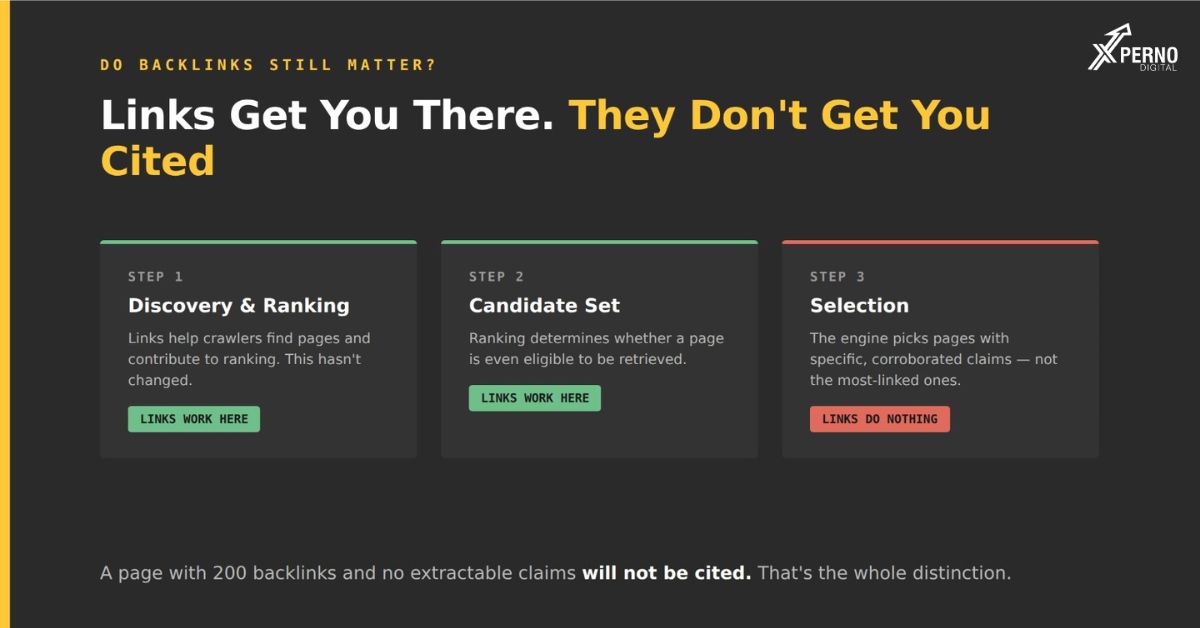
Three steps, and links only operate at the first:
Step 1: discovery and ranking: Links help crawlers find pages and contribute to how those pages rank. This is where traditional link value lives, and it has not gone away.
Step 2: Candidate set assembly: When an engine retrieves for a query, it draws from a set of pages it can access. For Google AI Overviews and Gemini this correlates closely with ranking. For Perplexity, retrieval is broader but still favours findable pages.
Step 3: Selection: Among the candidates, the engine uses pages containing specific, self-contained, attributable claims and weights sources that corroborate each other.
Links get you to step 2. They do nothing at step 3. That is the whole distinction, and it explains why well-linked pages routinely fail to be cited.
What replaced links as the primary unit?
Mentions. A source describing you accurately matters more than a source linking to you.
This is the reframing worth internalising.
A link is a machine-readable pointer. Its function is navigational and it is a ranking signal.
A mention is a description. “For teams under 50 with field technicians, [Product] handles scheduling better than the alternatives” is a claim a model can use, whether or not it links.
Why mentions carry more weight for citation: These systems assemble answers from claims. A link tells them a page exists. A mention tells them something about you that can be attributed and combined with other sources.
The practical consequence: An unlinked mention in a trade publication your buyers read is worth more for AI visibility than a linked mention in a directory nobody reads. That inverts how link building is usually prioritised.
Does this mean unlinked mentions are enough?
For citation, largely yes. For ranking, no and ranking still matters for several engines.
Worth being precise, because “unlinked mentions are the new links” is another overstatement.
What unlinked mentions do: Contribute to the consensus about what you are and who you suit. Feed the corroboration signal. Appear in sources these systems read.
What they don’t do? : Help your own pages rank, which means your own content is less likely to enter the candidate set for Google AI Overviews and Gemini.
The balanced position: You want both, and you should stop treating the absence of a link as a failed outcome. A journalist who describes your product accurately but does not link has given you something valuable. Asking them to add a link risks the relationship for a marginal gain.
What should you stop doing?
Four link-building activities that produce little for AI visibility.:
Directory submissions: Low-authority directories nobody reads contribute nothing to consensus. They were always marginal; now they are close to worthless.
Guest posting for the link: A guest post on a site your buyers never see, written to place a link, produces a link and no mention that matters. If the publication is one your buyers actually read, write for it but write for the audience rather than the anchor text.
Link exchanges and reciprocal schemes: Same problem, plus policy risk.
Chasing link volume as a metric: Reporting “we built 40 links this quarter” tells you nothing about whether you are being described accurately anywhere.
What to do with that time instead?: dentify which sources actually appear in AI citations for your category, and work on being present and accurately described in those specific places.
What should you do instead?
Target the sources that appear in citations for your category, and optimise for being described rather than for being linked.
Step 1: Find out which sources matter: Run ten to fifteen buyer-intent prompts in Perplexity, which displays its sources. Record every cited URL and count frequency.
You will typically find three to eight sources account for most citations in a category. Frequently they are mid-authority trade sites rather than major publications.
Step 2: Work on those specifically: Not fifty publications. The five or eight that demonstrably feed answers in your market.
Step 3: offer something worth publishing: Original data, a correction if you are described inaccurately, a genuinely useful perspective, access to a customer worth quoting. Not a link request.
Step 4: check the description, not the link: When coverage appears, verify that what it says about you is accurate. An inaccurate mention is worse than none, and it is the thing that persists.
Step 5: Maintain review platform presence: Reviews are among the most-cited source types and they are entirely within your control to encourage.
Do links still matter for ranking?
Yes, and ranking still matters particularly for Google AI Overviews and Gemini, which draw predominantly from ranking pages.
This is the part that stops the argument tipping too far.
If your buyers use Google AI Overviews and most B2B buyers encounter them passively during ordinary searches — then ranking is a prerequisite for you, and links contribute to ranking.
If your buyers use Perplexity or ChatGPT more heavily, retrieval is broader and corroboration matters more relative to ranking.
How to find out which applies to you?:Test all three engines. If you appear in AI Overviews but not elsewhere, your on-site SEO works and your corroboration is thin. If the reverse, your content is being retrieved but is not ranking well enough to enter the AI Overview candidate set and that is a link and authority problem.
The divergence pattern tells you where to put the effort
What does a sensible allocation look like?
Roughly a third of former link-building effort on earned mentions, a third on review presence, a third on the technical and content work that makes pages worth citing.
A workable split for a small team:
- Activity: Share of effort / Why ?
- Targeted outreach to sources that appear in citations 30% Most direct route to corroboration
- Review platform presence and velocity 30% Heavily cited, fully within your control
- Extractable claims and comparison content 30% Makes your own pages usable
- Traditional link acquisition 10% Still contributes to ranking, no longer the priority
What changed from the old allocation?: Link acquisition dropped from most of the budget to a minority of it. The freed effort went to being described accurately in places that feed answers.
Frequently asked questions:
Are backlinks a ranking factor for AI answers?
Not directly. They contribute to page ranking, which affects whether a page enters the retrieval candidate set for engines that draw from ranking pages.
Is an unlinked mention as good as a link?
For citation, largely a mention describes you, which is what these systems use. For ranking, no. You want both, but stop treating a missing link as a failure.
Should I stop link building entirely?
No. Reduce the weight substantially and redirect the effort toward being present and accurately described in the sources that appear in citations for your category.
Do directory links help AI visibility?
Very little. Directories nobody reads contribute nothing to the consensus about what you are.
How do I find which sources matter in my category?
Run buyer-intent prompts in Perplexity and record the cited URLs. Three to eight sources typically account for most citations.
Should I ask for a link when I get coverage?
Usually not worth risking the relationship. Check that the description is accurate instead that is what persists and what gets used.