
The awareness stage has partly moved into AI interfaces, which means the first impression of your brand is frequently formed somewhere you cannot see, measure or advertise.
The funnel stages themselves have not changed. Buyers still become aware, consider options, evaluate, and decide. What changed is where the first stage happens and how compressed it has become.
Previously: Awareness formed over weeks through search, content, ads and peer conversation. A buyer encountered your brand several times before considering you seriously.
Now: A meaningful share of awareness forms in a single AI response that names three to five vendors, with reasoning, in twenty seconds.
The consequence: The awareness stage is now shorter, more concentrated, and largely invisible in your reporting.
What does the new sequence look like?
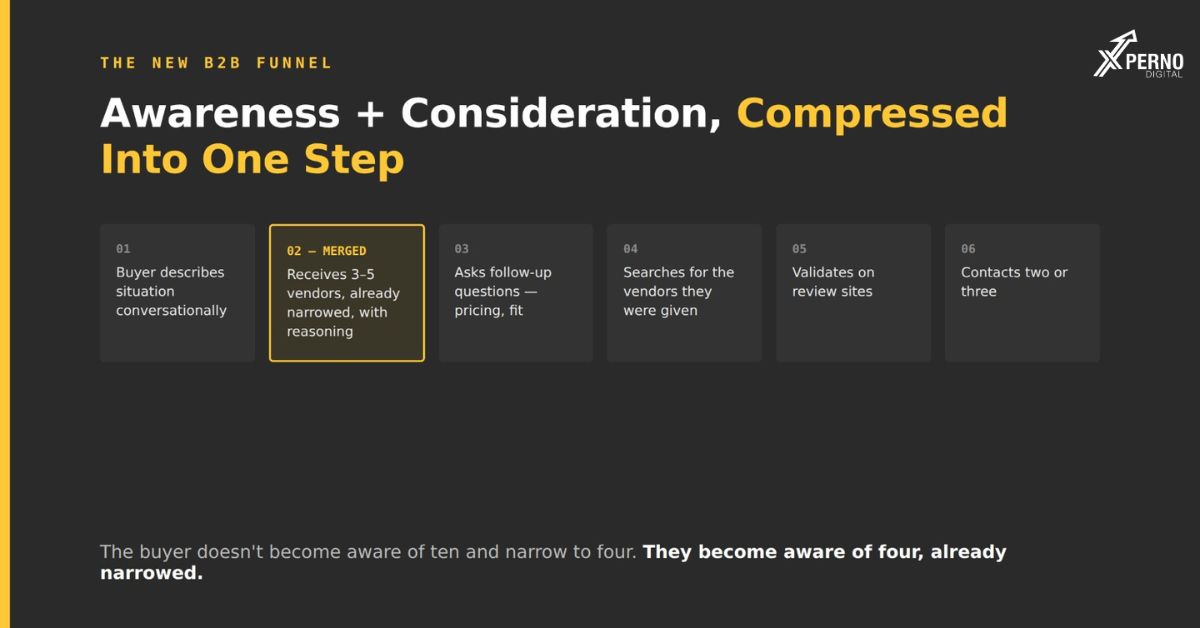
Six steps, with awareness and initial consideration collapsed into one:
1. The buyer describes their situation to an AI tool, conversationally
2. They receive three to five vendors with reasoning ← awareness and consideration, compressed
3. They ask follow-up questions pricing, fit, comparisons
4. They search for the vendors they were given
5. They validate on review sites
6. They contact two or three
Two things worth noticing about step two:
It merges awareness with consideration. The buyer does not become aware of ten vendors and then narrow to four — they become aware of four, already narrowed.
It carries reasoning. “This suits teams under 50 because of X” is a different thing from a brand impression. The buyer arrives at step four with a formed view, not just a name.
What breaks about the traditional funnel model?
Three assumptions underneath most B2B funnel design no longer hold reliably:
Assumption: awareness precedes consideration, with a gap. The gap is where nurture happens content, email, retargeting. When both stages occur in one response, there is no gap to nurture in.
Assumption: more top-of-funnel content produces more awareness. It did when awareness formed through browsing. When it forms through a synthesised recommendation, explainer content contributes little that content type is the least cited for vendor questions.
Assumption: you can measure the top of the funnel. First-touch attribution assumes a traceable first touch. An AI recommendation leaves no session, so the buyer’s actual first touch is invisible and the credit goes to whatever came next.
What still holds?: Buyers still evaluate, still compare, still involve multiple stakeholders, still take months to decide. The lower funnel is largely unchanged.
Does this mean top-of-funnel content is pointless?
No, but its role changed from generating awareness to being the raw material awareness is synthesised from.
This is the reframing that matters.
The old role: A buyer reads your blog post, learns you exist, enters your funnel. The content was the touchpoint.
The current role: Your content is one of several sources a model draws on when assembling a recommendation. The content is an input to the touchpoint rather than the touchpoint itself.
What follows from that:
Content that restates the consensus contributes nothing, because the consensus is already available from twenty sources.
Content containing something specific a comparison, a number, a boundary condition can be the reason you are named.
Third-party content about you may matter more than your own, because a synthesised answer weights independent sources more heavily than self-published claims.
The practical shift: Fewer explainer posts, more comparison content, more original data, more effort on being described accurately by sources you do not own.
How should you design a funnel for this?
Build for the two stages you can still influence: being in the answer, and converting the buyer who arrives already informed.
Stage one: be in the answer. This is the work that produces awareness now. Comparison and alternatives content, extractable facts, third-party corroboration, entity clarity.
You cannot advertise here. You cannot pay for placement. You can only be present in the sources these systems read.
Stage two: convert a better-informed buyer. The buyer arriving at your site has already been given reasoning about you. That changes what your site needs to do.
- They already know roughly what you do the explainer content on your homepage is less useful than it was
- They arrive with a comparison in mind, often against specific named competitors
- They may arrive with an inaccurate impression if the sources describing you are stale
- They are further along than a traditional organic visitor, so a longer nurture sequence may be the wrong shape
A practical implication: Check what an AI says about you, then read your own homepage as though you already knew that. Frequently the site is answering questions the buyer has already had answered, and not answering the ones they now have.
What about demand creation?
For genuinely new categories, AI search is a poor awareness channel buyers cannot ask about a category they do not know exists.
Worth separating clearly, because the advice diverges.
Demand capture: Buyers know the category and are looking for a vendor. AI search matters enormously here. Being in the answer is being in the market.
Demand creation: Nobody knows the category exists. Buyers cannot describe a problem in your terms because they lack the vocabulary. AI search cannot deliver you to them.
Where awareness forms for demand creation? : Founder and executive presence on LinkedIn, podcasts, community participation, original research that gets covered, partnerships and integrations.
The pattern: Awareness for known categories moved toward AI synthesis. Awareness for unknown categories moved toward channels attached to a person. Both are harder to produce and harder to copy than the content marketing model they replaced.
What should a leadership team take from this?
That the first impression of your brand is increasingly formed in a channel you cannot measure, and the check costs fifteen minutes.
Three specific implications:
Your top-of-funnel metrics are measuring the wrong thing. Sessions and content engagement measured awareness when awareness happened on your site. It increasingly does not.
Being absent is more expensive than it looks. You are not losing impressions. You are losing the moment when the consideration set forms, which is upstream of everything your funnel measures.
The window is open now. Most companies in most categories are not working on this yet. The cost of building presence rises as more competitors do.
The check: Run five buyer-intent prompts through ChatGPT and Perplexity in fresh sessions. If competitors are consistently named and you are not, your awareness stage is happening without you in it.
If you appear consistently, this is not your most urgent problem. That is a legitimate finding and worth establishing before committing budget.
Frequently Asked Questions:
Does this mean the funnel model is obsolete?
No. The stages still exist. Awareness and initial consideration have compressed into one moment, and that moment happens somewhere you cannot see.
Can I advertise inside AI interfaces?
Not meaningfully yet. Some platforms are testing formats, but cited sources are currently earned rather than purchased.
How do I measure the top of the funnel now?
Through visibility rather than traffic share of voice across a fixed prompt set. Traffic-based top-of-funnel metrics increasingly measure something that has moved.
Should I stop producing awareness content?
Reduce volume and change type. Explainer content contributes little to vendor recommendations. Comparison content and original data do.
Does this affect enterprise buying?
Less at final selection, where procurement and analyst relationships dominate. More in early research, where individual stakeholders form views before any formal process.
What if my category is new?
AI search is a poor awareness channel for demand creation. Founder-led content, community and partnerships work better until the category has vocabulary.