
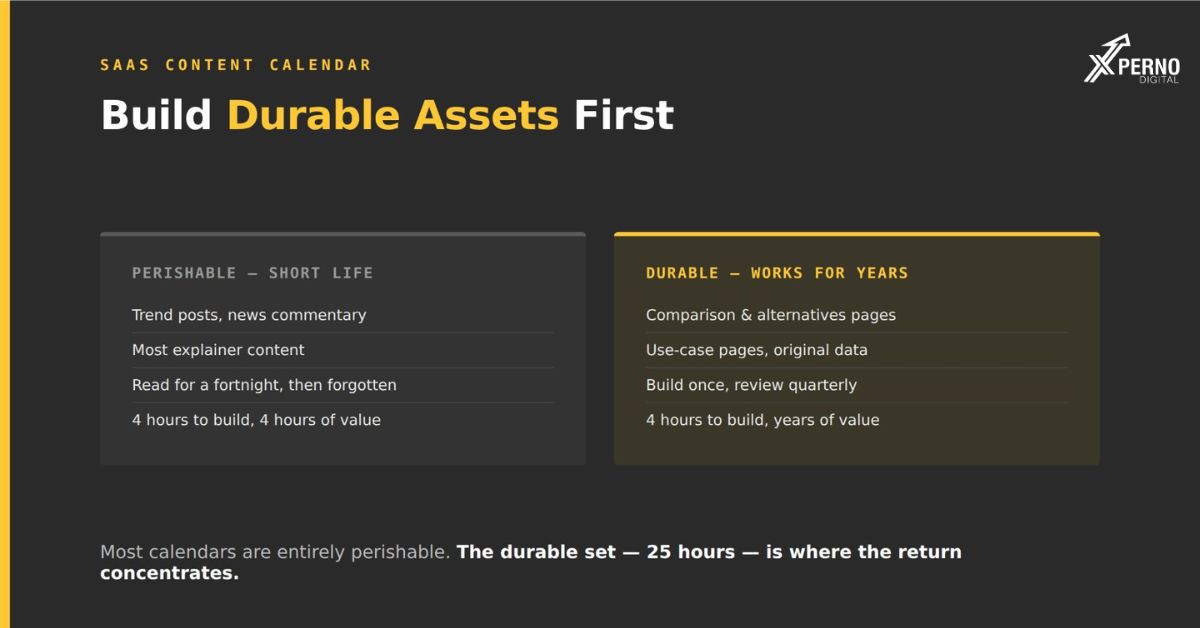
A content calendar compounds when it front-loads finite, durable assets and then sustains a low, consistent rhythm rather than committing to a publishing cadence from day one.
The standard model is a schedule: four posts a month, indefinitely. It fills a calendar, it demonstrates activity, and it produces very little that lasts.
The Distinction That Matters:
Durable assets work for years and need occasional updating. Comparison pages, alternatives pages, use-case pages, original data, documentation. Build once, maintain quarterly.
Perishable content has a short useful life. Trend posts, news commentary, most explainer content. Written, read for a fortnight, forgotten.
Most calendars are entirely perishable. A compounding calendar builds the durable set first six to ten pages, roughly 25 hours and then adds perishable content at a rate the team can actually sustain.
Why does the standard model fail?
A publishing cadence measures output rather than outcome, and output targets produce whatever is fastest to produce.
Three specific failures:
It rewards the wrong content type. A blog post takes four hours and is read for two weeks. A comparison page takes four hours and works for years. Under a “posts published” target, both count as one.
It runs out of good ideas. Four substantial pieces a month is 48 a year. Most B2B companies have perhaps fifteen genuinely worthwhile things to say annually. The remaining 33 are filler, and filler makes the good pieces harder to find.
It never gets to the durable work. Comparison and alternatives pages fall between marketing, product marketing and sales. Under a publishing schedule they never reach the top of the queue, because the queue is full of scheduled posts.
What should the first quarter look like?
Build the durable set first. It is finite, it is where the return concentrates, and it takes about 25 hours.
Weeks 1–4 comparison and alternatives
- Asset Count Hours each
- Comparison pages, one per real competitor 3–4 / 3–4
- Alternatives page for your largest competitor 1 / 4–5
Choose competitors by frequency in your actual deals, not by market size. Pull the last fifty won and lost deals and count.
Weeks 5–8 use-case and integration
- Asset Count / Hours each
- Use-case pages for your real segments 4–6 / 2–3
- Integration pages for your main integrations 5–10 / 1–2
Weeks 9–12 one substantial original piece
Original data, a benchmark from your usage data, a customer survey, or systematic testing in your domain. One piece, roughly a day of work, and the only content asset a competitor genuinely cannot replicate.
Total for the quarter: About 45 hours, producing 14–20 durable assets. That is the foundation everything else builds on
What rhythm is sustainable after that?
Two substantial pieces a month, plus quarterly maintenance on the durable set.
Monthly:
- Frequency Hours
- One substantial piece data, comparison, deep use-case 1/month 6–8 |
- One shorter piece position, observation, practical 1/month 3–4
- Off-site outreach ongoing 2–3
- Measurement and reporting 1/month 1
Quarterly:
Review and update every comparison and alternatives page competitor pricing and features change, and an outdated comparison is worse than none
One original data piece
Reassess which queries are moving and reallocate
Roughly 12–16 hours a month. Achievable for a founder or a single marketer, indefinitely.
Why two pieces rather than four?: Two pieces with genuine claim density outperform eight thin ones for both search and citation, and two is a rate a small team can sustain without the quality collapsing in month four.
How do you decide what to publish?
Work from sales calls and from your prompt testing, not from a keyword tool or a brainstorm.
Three inputs, in order of usefulness:
Sales call objections and questions. What prospects actually ask, in their words. Every recurring question is a page. This is the highest-quality input available and almost nobody uses it systematically.
Your prompt testing results. Where you are absent from AI answers tells you which content is missing. If you are invisible on alternatives queries, that is your next page.
Support tickets. Recurring problems make good documentation and good long-tail content.
What not to work from: A keyword tool alone, competitor content audits, or a quarterly brainstorm. All three produce topics rather than answers to questions someone actually asked.
How do you keep the calendar honest?
Set the calendar by asset, not by date, and review what each piece was supposed to do.
A workable structure one row per piece:
- Field Purpose|
- Asset What it is?
- Type Durable or perishable
- Question it answers In buyer language
- Source of the question Sales call, prompt test, support ticket
- What it should produce Citation on a specific query, ranking, conversion
- Published Date
- Reviewed Date durable assets need this
The “what it should produce” field is the one that keeps this honest. If you cannot state what a piece is for beyond “content,” it probably should not be on the calendar.
Review quarterly, not monthly. Check which pieces are appearing in AI citations and which are converting. Most calendars are never reviewed at all, which is how a year of publishing passes without anyone establishing whether it worked.
What about consistency?
Consistency matters for the durable set’s maintenance, not for publishing frequency.
The advice that publishing consistency is essential comes from an era when frequency drove traffic growth. It is much less true now, and it has become a justification for filler.
Where consistency genuinely matters:
- Quarterly review of comparison pages. These contain facts about other companies’ products. Stale ones actively damage credibility.
- Monthly prompt testing: Without a consistent baseline you cannot tell whether anything is working.
- Off-site outreach: This compounds and has a long lead time sporadic effort produces nothing.
- Review requests: Velocity matters more than volume, and velocity requires steadiness.
Where it matters less?: Whether you published on the fifteenth of every month. Nobody is waiting for your blog post.
The reframing: Be consistent about maintaining assets and measuring results. Be flexible about publishing frequency.
Frequently Asked Questions:
How often should a SaaS company publish?
Two substantial pieces a month is a sustainable rate that outperforms four thin ones. Frequency matters far less than whether the pieces contain something specific.
Should I build the durable assets before publishing anything?
Yes, where possible. Six to ten bottom-of-funnel pages take about 25 hours and target the highest-intent queries in your category. They return more than a quarter of blog posts.
What if leadership expects a publishing cadence?
Reframe the target around asset value rather than count. One comparison page plus one substantial piece is more defensible than four posts if you can show what each produces.
How do I find topics without a keyword tool?
Twenty recorded sales calls. Every recurring question is a page, phrased in the buyer’s own language rather than yours.
How often should I update comparison pages?
Quarterly. They contain facts about competitors’ products that change, and being demonstrably wrong undermines the whole page.
Is a content calendar necessary at all?
Some structure is. A calendar organised by asset and purpose is useful; one organised by publication date tends to become a filler generator.